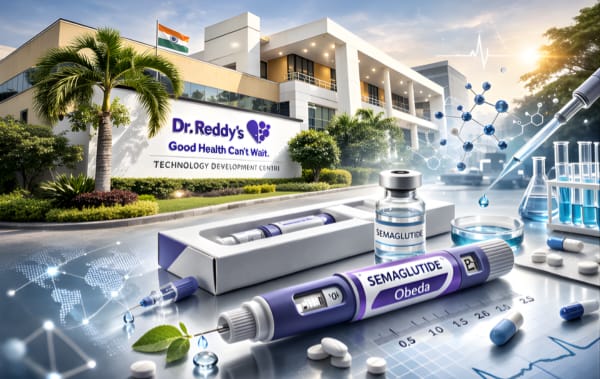
Dr. Reddy's Laboratories has paused global shipments of its generic semaglutide drug, Obeda, after identifying active pharmaceutical ingredient (API) impurities on Wednesday. The manufacturing defect will cut the firm’s FY27 supply targets from 12 million to 6 million pens, triggering a 5.2% stock drop despite verified safety compliance.
MUMBAI — Dr. Reddy’s Laboratories Limited (BSE: 500124) announced on Thursday, July 9, 2026, that it will delay commercial supplies of its generic semaglutide products. The pharmaceutical major confirmed that several production batches failed to meet strict quality criteria due to impurities detected in the Active Pharmaceutical Ingredient (API). This structural delay threatens the company’s immediate distribution timelines for its newly launched metabolic therapies across India and global markets.
API Impurities Prompt Supply Disruptions
According to a regulatory filing submitted by the company to the BSE Stock Exchange, specific batches of generic semaglutide were classified as "out of specification" during standard quality evaluations. Management clarified that the issue was identified on Wednesday, July 8, 2026, triggering an immediate internal probe into the chemical synthesis of the compound.
The drugmaker confirmed that production will pause temporarily while researchers pinpoint the exact root cause of the degradation risk. Chief Executive Officer Erez Israeli addressed the issue during an emergency investor briefing on Thursday evening, revealing that the flawed chemical profile originated during a deliberate phase to scale up production volume.
The impurity stems from a process-related chemical reaction inside a high-volume manufacturing batch. If left unaddressed, this specific variant could degrade the finished liquid formulation, reducing the active strength and therapeutic efficacy of the medication. Production lines are projected to remain offline until remediation protocols are completed, with a tentative restart scheduled for November 2026.
Market Reaction and Financial Projections
The disclosure triggered intense selling pressure on major stock exchanges. Shares of Dr. Reddy's Laboratories plummeted by over 5.2% on the Bombay Stock Exchange (BSE), bottoming out at ₹1,278 per share by midday Thursday.
Because of this manufacturing setback, Dr. Reddy’s will officially miss its annual production target for the blockbuster drug category. The generic firm originally planned to distribute 12 million automated injection pens during the 2026–2027 fiscal year (FY27). Under revised guidance, total supply volume is projected to drop to roughly 6 to 7 million pens, concentrated primarily within the final two quarters of the fiscal period.
Competition and Consumer Impact
The unexpected halt strikes during a highly competitive commercial window. Following the official expiration of Novo Nordisk's base patents for semaglutide in India in March 2026, domestic generic giants—including Sun Pharmaceutical, Zydus Life Sciences, and Glenmark Pharmaceuticals—flooded the market with affordable alternatives.
Dr. Reddy's had established an early lead in this space. The company rolled out its weekly injectable variant under the brand name Obeda in March, followed by a groundbreaking oral tablet configuration in May.
Patients utilizing Obeda for Type 2 diabetes management or weight reduction will likely experience local inventory scarcities over the coming months. Healthcare providers may need to transition some individuals to competing generic brands or alternative GLP-1 receptor agonists to prevent therapy gaps.
Official Sources Section
The operational updates, technical batch data, and forward-looking assembly estimates outlined in this report are based entirely on official corporate declarations made by Dr. Reddy’s Laboratories. Key details were sourced directly from the July 9, 2026, compliance disclosure submitted to the National Stock Exchange of India (NSE) alongside verified transcripts from the subsequent executive investor conference call.
Executive Statements
"While this issue affects our production timelines, we expect to produce 6 to 7 million pens in the third and fourth quarters of FY27, apart from the pens already sold. We caught the variance on Wednesday during our rigorous scale-up testing. Prima facie, the impurity was related to a reaction-related process in that specific API batch, which could degrade the formulation."
— Erez Israeli, Chief Executive Officer of Dr. Reddy's Laboratories
"Certain batches of semaglutide were found to be out of specification due to an issue associated with the active pharmaceutical ingredient used in the product. Until the issue is resolved, commercial supplies will be delayed for a certain period of time. There is no impact on patient safety or on the product's existing global regulatory filings."
— Corporate Communications Desk, Dr. Reddy’s Laboratories Regulatory Filing
Why It Matters
Semaglutide represents the fastest-growing therapeutic sector in modern pharmaceuticals, driving massive global demand for diabetes control and chronic weight management. Disruptions to affordable generic manufacturing pipelines slow down cost-reduction efforts for consumers. With a major supplier losing nearly half of its annual volume, market prices for alternative GLP-1 medications are likely to remain elevated as competitors scramble to absorb the excess consumer demand.
Key Facts at a Glance
The Interruption: Dr. Reddy's Laboratories has completely halted commercial shipments of generic semaglutide after uncovering quality defects.
The Timeline: Executive leadership verified they became aware of the out-of-specification batch metrics on Wednesday, July 8, 2026.
Volume Reductions: Expected output for FY27 was slashed from 12 million units down to 6–7 million injection pens.
Safety & Approvals: The company explicitly stated that patient safety remains uncompromised by the bad batches, and existing global regulatory filings are unaffected.
The Recovery Plan: System-wide manufacturing lines are projected to restart by November 2026 once synthesis chemical properties are recalibrated.
Frequently Asked Questions
Is it safe for patients currently using Dr. Reddy's Obeda?
Yes. Dr. Reddy's confirmed that no contaminated or out-of-specification batches entered retail pharmacy channels. The issue was intercepted internally at the manufacturing facility prior to packaging.
Why did Dr. Reddy's share price drop so heavily?
Investors reacted to execution risks. Semaglutide is a highly lucrative compound; cutting annual delivery goals by almost 50% impacts near-term revenue projections and hands market share to competing domestic generic brands.
When will the supply of generic semaglutide return to normal?
Full-scale commercial production is expected to resume around November 2026, with stable quantities hitting global distribution chains during the first quarter of 2027.
Sources: Dr. Reddy's Laboratories Official Investor Relations, Company Disclosure to Stock Exchanges