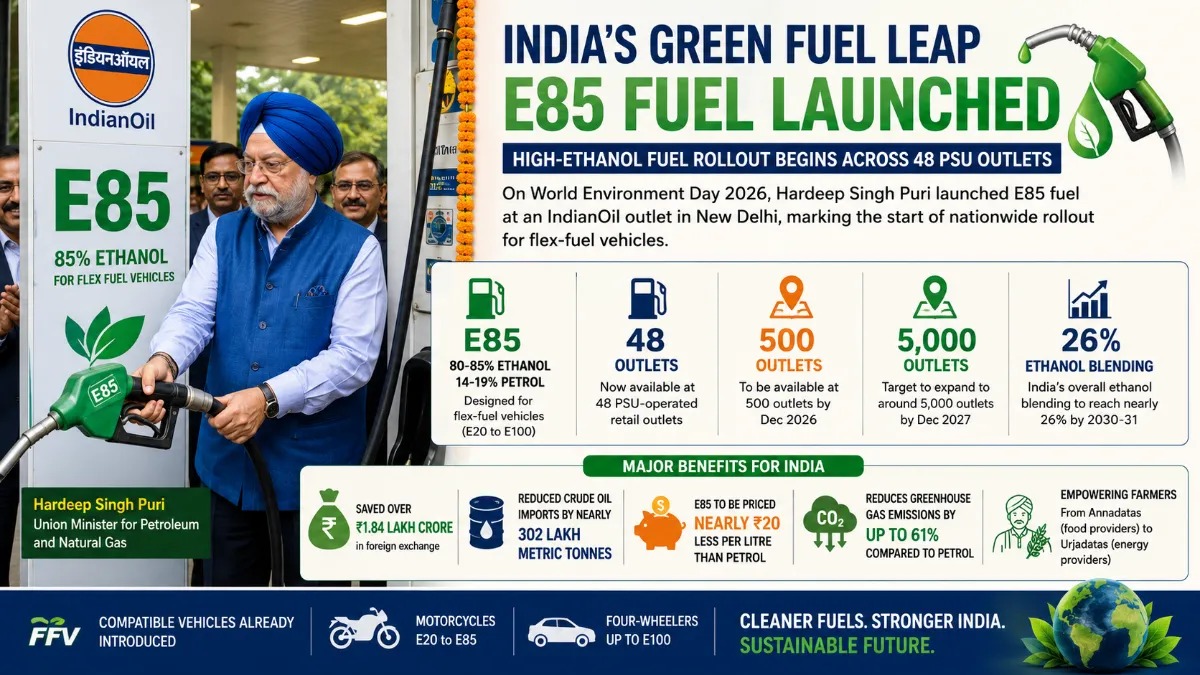
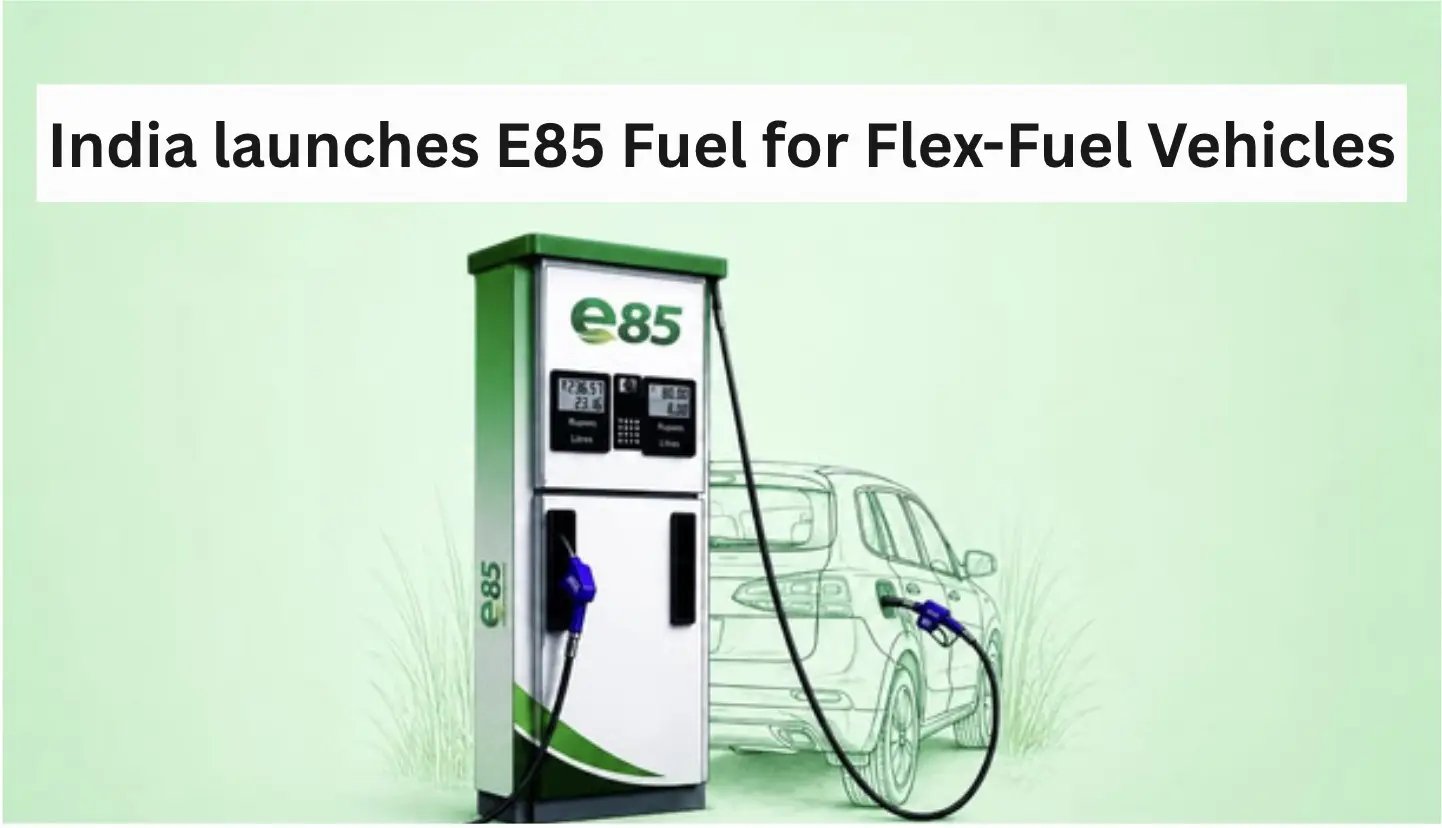
The Union government launched E85 fuel at ₹82.12 per liter across 48 initial stations to help curb India's 89% dependence on crude oil imports. Designed for new flex-fuel vehicles, the program aims to expand to 5,000 stations by late 2027, supporting local farmers and cutting emissions by 61%.
NEW DELHI — The Union government has officially launched a nationwide commercial rollout of E85 fuel as a key policy initiative to reduce India's heavy dependence on imported crude oil. Unveiled by Union Minister for Petroleum and Natural Gas Hardeep Singh Puri at an IndianOil retail outlet in New Delhi, the introduction of the high-ethanol blend marks a structural shift in the country's alternative energy landscape.
The strategy focuses on expanding fuel options beyond the standard E20 blend to a high-concentration matrix composed of 85% ethanol and 15% conventional petrol. India currently imports nearly 89% of its total crude oil requirements. By establishing E85 as the official monofuel standard for a new generation of flex-fuel vehicles (FFVs), the administration aims to create a reliable domestic energy shield, protecting consumers from foreign price fluctuations and geopolitical supply chain bottlenecks.
Massive Retail Expansion Plans Lower Consumer Fuel Costs
The roll-out of E85 is supported by an aggressive, multi-stage infrastructure expansion roadmap designed by public sector Oil Marketing Companies (OMCs). The first operational phase launched on June 5, 2026, across 48 public sector fuel stations strategically located in high-density urban corridors.
To drive quick consumer adoption, the Ministry of Petroleum and Natural Gas has priced E85 at ₹82.12 per liter in the capital region nearly ₹20 per liter cheaper than conventional regular-grade petrol. This pricing strategy aims to establish immediate cost parity for vehicle owners, offsetting the minor 15% to 20% drop in mileage that naturally occurs due to ethanol's lower volumetric energy density compared to fossil fuels.
Automotive Giants Prepare for the Flex-Fuel Era
The retail arrival of E85 coincides with major technology rollouts from domestic automobile manufacturers. Maruti Suzuki India Limited recently launched production of India’s first mass-market flex-fuel passenger car, introducing an E85-compatible variant of its WagonR model. Concurrently, two-wheeler manufacturers including Hero MotoCorp have showcased flex-fuel iterations of the Splendor Plus and HF Deluxe platforms.
Unlike older legacy engines, these specialized flex-fuel vehicles utilize corrosion-resistant fuel lines, modified injection systems, and advanced Electronic Control Units (ECUs) capable of automatically adjusting ignition timing based on the ethanol-to-petrol ratio inside a single fuel tank.
| Vehicle Component Modified | Technical Upgrade Implemented | Primary Engineering Objective |
| Fuel Delivery Lines | High-grade stainless steel or specialized polymers | Prevention of ethanol-induced chemical corrosion |
| Fuel Injection System | High-flow fuel injectors and modified seals | Managing higher fuel volume requirements |
| Electronic Control Unit (ECU) | Multi-fuel sensor calibration algorithms | Real-time ignition timing tuning based on blend |
The Ministry of Petroleum and Natural Gas confirmed that if 50% of all new two-wheelers and passenger vehicles sold transition to flex-fuel compliance, national ethanol demand will surge by an additional 400 crore liters, generating roughly ₹12,403 crore in direct revenue for agricultural communities.
Official Sources Section
The statutory fuel specifications, emission benchmarks, and retail rollout timelines are governed by technical directives published by the Bureau of Indian Standards (BIS). Macroeconomic import substitution data and foreign exchange balance logs are verified through official releases hosted on the Ministry of Petroleum and Natural Gas data portals.
Quote Section
The central administration stressed that the financial capital previously spent on foreign energy resources is now being redirected directly into the domestic rural economy.
"Our ethanol blending program has raised the blending ratio from a meager 1.5% in 2014 to a comprehensive 20% across all public sector outlets today, resulting in cumulative foreign exchange savings of over ₹1.84 lakh crore. By moving into the E85 ecosystem, we are transferring that wealth directly to our farmers, transitioning them from food producers to energy providers for the nation," stated Union Minister Hardeep Singh Puri during the launch event.
Why It Matters
For everyday consumers, automotive manufacturers, and financial investors, the E85 program introduces a structural change to long-term transportation economics. Utilizing domestically produced ethanol primarily sourced from sugarcane molasses and surplus food grains like maize lowers lifecycle greenhouse gas (GHG) emissions by roughly 61% compared to traditional fossil fuels. This transition provides a powerful tool for improving urban air quality while simultaneously shielding India's fiscal deficit from international crude oil price shocks.
Key Facts at a Glance
Launch Details: E85 fuel was officially introduced at a retail price of ₹82.12 per liter across 48 public fuel stations.
Aggressive Footprint: The government plans to expand the dispensing network to 500 outlets by December 2026, targeting 5,000 locations by late 2027.
Import Cushion: The expansion of the ethanol program has already saved India over ₹1.84 lakh crore in foreign exchange by replacing 302 lakh metric tonnes of imported crude oil.
Environmental Impact: Flex-fuel vehicles running on E85 can reduce lifecycle greenhouse gas emissions by up to 61% with near-zero particulate matter emissions.
FAQ Section
Can I pump E85 fuel directly into my standard petrol car?
No. E85 contains 80% to 85% ethanol and can only be used in specially engineered flex-fuel vehicles (FFVs). Pumping high-ethanol blends into a conventional engine can damage standard rubber gaskets, fuel pumps, and fuel lines due to ethanol's corrosive properties.
Why is E85 priced lower than regular petrol?
The government applies lower taxation and fiscal structures to domestically manufactured ethanol to ensure E85 remains highly affordable. This lower price point helps offset the minor drop in mileage caused by ethanol's lower volumetric energy density.
Where does India source its raw materials for ethanol production?
The country’s ethanol production is heavily linked to agriculture, primarily relying on heavy sugarcane molasses, broken food grains, and surplus maize crops. This setup allows the government to support farmers via the Pradhan Mantri JI-VAN Yojana framework.
Source: Ministry of Petroleum and Natural Gas Official Records, Maruti Suzuki Corporate Disclosures, Bureau of Indian Standards (BIS) Notification Registry, Indian Oil Corporation Retail Network Briefings.