The National Testing Agency has implemented an unprecedented security framework for the NEET-UG 2026 retest on Sunday, June 21, for 22.79 lakh candidates. Utilizing 1.38 lakh AI-monitored CCTVs, 51,311 signal jammers, double biometric checking, and Indian Air Force transit sorties, the agency aims to prevent any further structural leaks.
NEW DELHI — In a historic mobilization of administrative and electronic resources, the National Testing Agency (NTA) deployed a massive multi-layered security grid across the country ahead of the national National Eligibility cum Entrance Test (NEET-UG) retest scheduled for Sunday, June 21, 2026. Designed to completely prevent systemic leaks and electronic malpractices, the updated protective protocols feature more than 1.38 lakh active CCTV cameras, 51,311 signal jammers, and thorough biometric verification lines. This development is highly critical today because it comes nearly seven weeks after the initial May 3 national examination was canceled due to widespread paper leak allegations, forcing regulators to enforce rigorous new standards to restore complete public trust in India’s largest medical entrance system.
Unprecedented Surveillance Shield Sweeps Over Exam Halls
The scale of the technological deployment marks an absolute turning point for the execution of competitive public testing across South Asia. According to official operational guidelines distributed by the National Testing Agency, the re-examination is being conducted concurrently across 5,440 designated centers located inside 551 Indian cities and 14 separate international host venues.
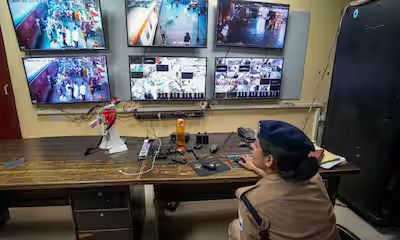
To eliminate localized monitoring blindspots, the testing authority has fitted exactly 1,38,560 CCTV cameras across more than 95,000 active exam rooms. These live feeds are being systematically funneled back into three separate levels of active governance—the National, State, and Ministry control rooms. Furthermore, advanced artificial intelligence (AI) diagnostic tools are running alongside the live feeds in real time, automatically flagging structural room anomalies or irregular student postures to prevent physical copying.
Total Signal Blackout Blocks Electronic Malpractices
To neutralize high-tech cheating syndicates that utilize hidden Bluetooth or sub-miniature communication receivers, the government has executed a comprehensive local radio frequency blackout. A network of 51,311 signal jammers has been physically installed inside the facilities—with 17,054 units provided by Electronics Corporation of India Limited (ECIL) and 34,257 systems deployed by Bharat Electronics Limited (BEL).
According to a security update broadcast by the Press Information Bureau, human identity validation pipelines have also been significantly doubled. A specialized field force comprising 38,795 dedicated frisking officers and 48,448 biometric verification personnel is managing the entry queues. By combining digital fingerprint mapping with live three-dimensional facial recognition checks, the administrative setup ensures that zero proxy candidates can bypass the outer parameter checkposts.
Military Airlifts and Ground Level Administrative Operations
The sheer depth of the logistical architecture extends all the way into national defense assets. Following consecutive high-level review conferences headed by Union Education Minister Dharmendra Pradhan, the Indian Air Force (IAF) was brought in to guarantee secure transit paths.
According to reports from the Ministry of Defence, military transport aircraft and Mi-17 helicopters executed nearly 200 separate sorties over the past week to lift sealed question sheets directly to 18 secure regional distribution points. From these hubs, the confidential material is moved to 1,500 custodian banks inside GPS-tracked vehicles under armed police escort. On average, around 40 to 50 active security personnel have been assigned to protect the perimeter of every single local testing venue.
Official Sources Section
The candidate counts, jammer allocations, CCTV installation tallies, and multi-agency transport deployments outlined throughout this report are compiled from official press statements released by the National Testing Agency, administrative briefs from the Press Information Bureau, and regional security alerts issued by state police directorates.
Quote Section
"The NTA has put in place highly comprehensive, foolproof arrangements to ensure a completely fair, secure, and candidate-friendly environment for all medical aspirants," senior testing officials announced during a Saturday night briefing. "According to officials, the combination of multi-tiered biometric authentication, AI camera monitoring, and direct military logistics ensures that the integrity of the examination process is completely absolute."
Why It Matters
For over 22 lakh young medical students and their families, these unprecedented security protocols serve as a vital guarantee that hard work and academic merit will triumph over illicit financial manipulation. For the broader healthcare sector and corporate medical networks, enforcing a fully transparent, uncompromised entrance framework is entirely necessary to verify that the next generation of practicing doctors is selected based solely on actual capability.
Key Facts at a Glance
Massive Digital Eye: A total of 1,38,560 CCTV cameras are tracking live room feeds under triple-layered AI anomaly monitoring protocols.
Signal Blackout: The agency deployed 51,311 hardware signal jammers built by ECIL and BEL to stop electronic cheating.
Biometric Guard: Over 48,000 personnel are operating upgraded facial recognition systems to completely stop proxy candidates.
Military Logistics: The Indian Air Force carried out nearly 200 sorties to airlift sensitive exam materials to regional distribution hubs.
Strict Timelines: Entry gates across 5,440 centers close at 1:30 PM sharp, with testing running precisely from 2:00 PM to 5:15 PM.
FAQ Section
Why was the initial NEET-UG 2026 examination canceled?
The original national test held on May 3 was officially canceled by the Ministry of Education following evidence of targeted paper leaks and institutional compromises, triggering a complete retest to preserve academic integrity.
What happens if a signal jammer causes a technical glitch at a testing center?
According to official NTA guidelines, a designated Centre Systems Officer (CSO) is stationed live at every single venue to immediately fix technical bugs, check video feeds, and manage hardware issues.
Are there any special facilities provided to help candidates manage summer heat?
Yes, in coordination with regional state offices, all centers are structurally mandated to supply cool drinking water, oral rehydration solutions (ORS), shaded waiting zones for parents, and on-call medical ambulances.
Source: Official security framework disclosures from the National Testing Agency, logistics summaries from the Press Information Bureau, and regional transit records from the Ministry of Defence.