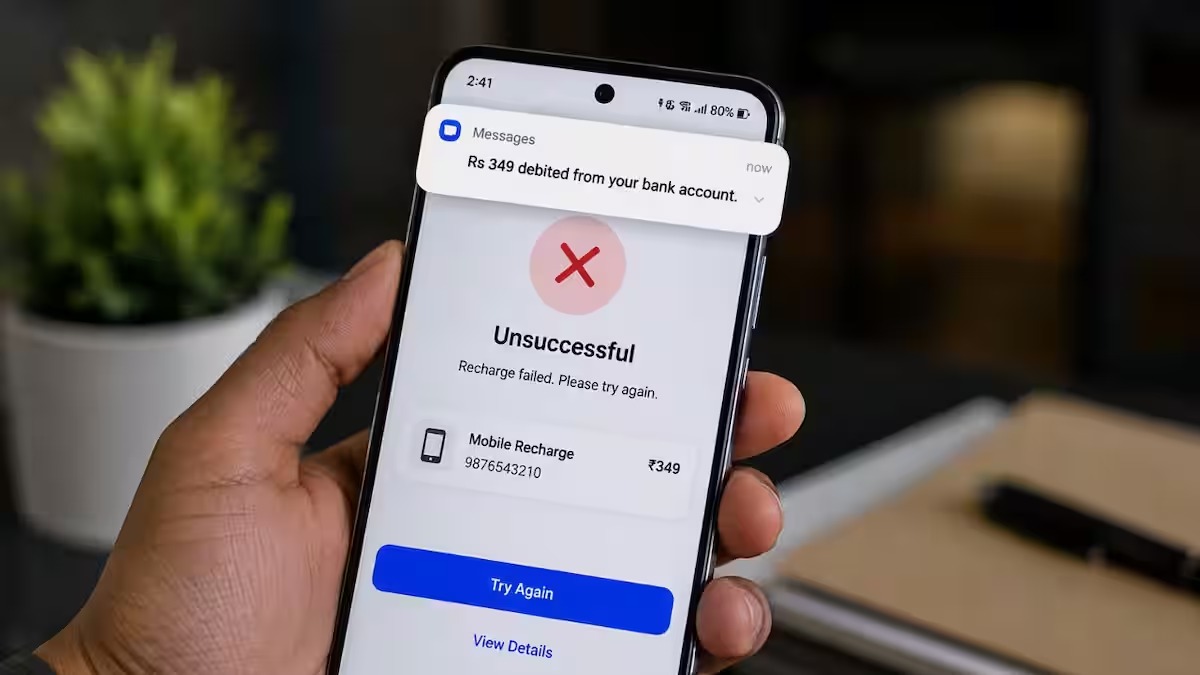
Failed digital recharges that result in deducted funds are protected by RBI turnaround time (TAT) rules. Banks are required to reverse failed transactions within 1 to 5 working days, depending on the payment method. If these deadlines are missed, consumers are entitled to compensation of ₹100 per day of delay.
In an era of increasing digital transactions, a failed mobile recharge or online payment followed by a deduction from a bank account is a common source of consumer frustration. However, the Reserve Bank of India (RBI) has established a strict framework to ensure that such instances are resolved efficiently, protecting users from unnecessary financial stress.
Under the "Harmonisation of Turn Around Time (TAT) and Customer Compensation for Failed Transactions" guidelines, the central bank has clearly defined the timelines within which banks and payment system operators must reverse failed transactions.
Understanding Your Rights Under RBI Guidelines
According to official RBI circulars, when a transaction is unsuccessful, the refund process is designed to be largely automated through the National Payments Corporation of India (NPCI) and respective bank reconciliation systems.
For failed transactions—where a consumer’s account is debited but the beneficiary (such as the telecom provider) does not receive the funds—the responsibility lies with the service provider and the customer's bank to initiate an auto-reversal. If this reversal is not completed within the prescribed timeline, the banking entity is liable to pay financial compensation to the consumer.
Mandatory Refund Timelines
The RBI has established a clear Turn Around Time (TAT) for various digital payment modes:
Unified Payments Interface (UPI): Failed transactions typically see an auto-reversal within T+1 working day (where 'T' is the date of the transaction).
Merchant Payments (P2M): For transactions involving merchants, refunds are generally processed within T+5 working days.
ATM Transactions: If cash is not dispensed but the account is debited, the reversal is mandatory within T+5 working days.
If these timelines are exceeded, the bank or payment system operator is required to pay a penalty of ₹100 per day of delay.
Action Plan: What to Do If the Refund Is Delayed
If your money has not been credited back to your account after the specified period, follow these steps to escalate the issue:
Check Transaction Status: Locate the transaction in your app’s "History" or "Passbook." Note down the Transaction Reference Number (TRN) or Unique Transaction Reference (UTR) number.
Contact Customer Support: Use the "Raise Issue" or "Help" feature within your payment app. Submit the TRN/UTR, date, and transaction amount.
Formal Complaint: If the issue remains unresolved after the TAT, contact your bank’s customer care and request a formal acknowledgement receipt of your complaint.
Escalation: If the bank fails to respond or provide a satisfactory resolution within 30 days, you can lodge a complaint through the RBI Integrated Ombudsman Scheme portal.
Quote Section
"Organizers stated that" the automated reconciliation system is designed to trigger reversals without manual intervention in most cases. According to officials, if a transaction is not reversed within the mandated T+1 or T+5 window, customers are legally entitled to claim compensation as per the RBI's established grievance redressal framework.
Why It Matters
For the average consumer, these rules ensure that digital payments remain a reliable, low-risk method of commerce. By holding financial institutions accountable through mandatory compensation and fixed timelines, the RBI maintains public trust in the digital economy. Knowing your rights allows you to act promptly, reducing the likelihood of prolonged financial uncertainty after a failed recharge.
Key Facts at a Glance
Mandatory Reversal: Banks must auto-reverse failed digital transactions within T+1 to T+5 days depending on the payment mode.
Compensation Policy: A penalty of ₹100 per day is applicable if banks fail to meet the stipulated refund deadlines.
Tracking: Always save your Transaction Reference Number (TRN) to ensure your claim can be processed by the bank.
Escalation Path: Unresolved grievances can be escalated to the RBI Ombudsman after a 30-day waiting period.
FAQ
How long should I wait before raising a complaint?
While most reversals are automatic within hours, you should wait for the period defined by the RBI (T+1 for UPI, T+5 for merchant transactions) before filing a formal complaint.
Does a failed recharge affect my credit score?
No. A failed transaction is a technical error and has no impact on your credit profile.
What if the bank denies my claim?
If a bank rejects your claim despite evidence, you can approach the internal ombudsman of the bank and subsequently the RBI’s Integrated Ombudsman portal.
Is the compensation automatic?
While the reversal is often automatic, compensation claims for delayed refunds may require you to file a formal request if the bank does not credit it proactively.
Official Sources