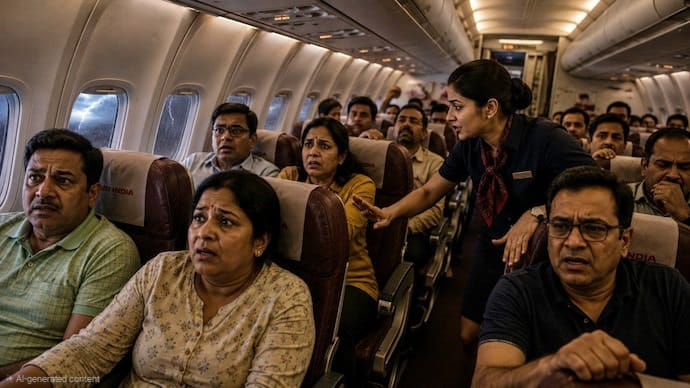
An Air India flight from Phuket to Delhi suffered a sudden 300-foot altitude drop after encountering severe clear-air turbulence, injuring 17 passengers and crew members. The event underscores scientific studies linking global climate change to increased jet stream instability and higher frequencies of invisible atmospheric turbulence.
NEW DELHI — An Air India flight operating from Phuket to Delhi encountered severe clear-air turbulence during cruise, resulting in a sudden 300-foot altitude loss that injured 13 passengers and four cabin crew members. The incident, involving an Airbus A320neo carrying 137 passengers and eight crew members, occurred while cruising over Indian airspace. The flight landed safely at Indira Gandhi International Airport in New Delhi, where emergency medical services transferred the injured to local hospitals. The event has renewed international focus on atmospheric studies showing that global climate change is accelerating wind shear along high-altitude jet streams, leading to more frequent and intense clear-air turbulence events.
Severe Altitude Loss Triggers Emergency Response in Delhi
The incident unfolded approximately 90 minutes after departure from Phuket International Airport. Air India flight AI2379 encountered an unpredicted pocket of clear-air turbulence, causing the aircraft to experience a rapid 300-foot loss of altitude. Unbuckled passengers and crew members were thrown against cabin fixtures and overhead panels, sustaining head, neck, and soft-tissue injuries.
Upon landing in Delhi, medical teams deployed to the tarmac to administer initial triage. Hospital authorities confirmed that 17 individuals received emergency care across medical facilities in Gurugram and Delhi. Aviation safety regulators, including the Directorate General of Civil Aviation (DGCA), have initiated a formal inquiry and secured both the Cockpit Voice Recorder (CVR) and Flight Data Recorder (FDR) for technical evaluation.
Climate Science Links Warming Atmosphere to Increasing Air Turbulence
Meteorological research links the rise in severe clear-air turbulence to global climate change. Clear-air turbulence occurs without visual indicators like clouds and cannot be detected by conventional onboard radar systems. It develops near high-altitude jet streams where rapid changes in wind speed and direction create strong vertical wind shear.
Atmospheric studies, including research conducted by the University of Reading and the UK Met Office, demonstrate that rising global temperatures are altering thermal gradients between equatorial and polar air masses. This disparity destabilizes jet streams, amplifying shear forces high in the troposphere. Analysis indicates that severe clear-air turbulence over major flight corridors increased by more than 55 percent over recent decades, with predictive models projecting further atmospheric instability as global temperatures rise.
Operational Challenges and Safety Adaptations for Commercial Aviation
The growing frequency of invisible atmospheric hazards presents operational hurdles for airlines, air traffic management, and aircraft manufacturers. Unlike convective turbulence caused by storm clouds, clear-air turbulence offers flight crews little to no advance warning, limiting the time available to illuminate seatbelt signs or instruct passengers to sit.
Commercial flight operations are increasingly integrating advanced meteorological forecasting systems, satellite data, and pilot reports (PIREPs) to map real-time jet stream movements. Aviation regulators worldwide are emphasizing passenger seatbelt compliance throughout flights to mitigate injury risks during unexpected turbulence encounters.
Official Sources Section
According to official statements issued by Air India, the aircraft experienced a brief, severe turbulence event before flight crews stabilized the plane and landed without further incident in New Delhi. Official announcements from the Directorate General of Civil Aviation confirm that flight data recorders have been retrieved to examine meteorological data and flight dynamics during the drop.
Quote Section
"According to officials from Air India, flight AI2379 experienced a sudden loss of altitude during cruise, after which the aircraft continued normally to land safely in Delhi, where immediate medical care was provided to affected passengers and crew."
"Aviation safety officials stated that a thorough technical investigation is underway to examine flight recorder data and assess atmospheric conditions along the flight path."
Why It Matters
The Air India turbulence incident highlights the direct operational impacts of climate change on commercial aviation. As global warming increases wind shear along jet streams, airlines and passengers face higher risks of unexpected, severe clear-air turbulence. Mitigating these risks requires stricter adherence to cabin safety rules, improved meteorological modeling, and updated operational protocols.
Key Facts at a Glance
Flight Details: Air India flight AI2379 dropped 300 feet after encountering clear-air turbulence en route from Phuket to Delhi.
Injuries Reported: At least 17 passengers and cabin crew members sustained injuries and received medical treatment in Delhi.
Regulatory Action: The Directorate General of Civil Aviation (DGCA) launched an investigation and secured the CVR and FDR.
Climate Link: Peer-reviewed atmospheric research indicates clear-air turbulence has increased by over 55 percent due to climate-driven jet stream instability.
FAQ Section
What is clear-air turbulence, and why is it difficult to detect?
Clear-air turbulence occurs in cloudless skies near high-altitude jet streams without visual signs or weather radar indicators, making it difficult for flight crews to detect in advance.
How is global climate change causing more frequent turbulence?
Rising global temperatures increase temperature contrasts between air masses, intensifying vertical wind shear along jet streams and destabilizing high-altitude air layers.
What precautions should airline passengers take against unexpected turbulence?
Aviation authorities recommend keeping seatbelts fastened whenever seated, even when the seatbelt sign is turned off, to protect against sudden, unannounced atmospheric shifts.
Source: Directorate General of Civil Aviation, Air India Official Press Portal, UK Met Office