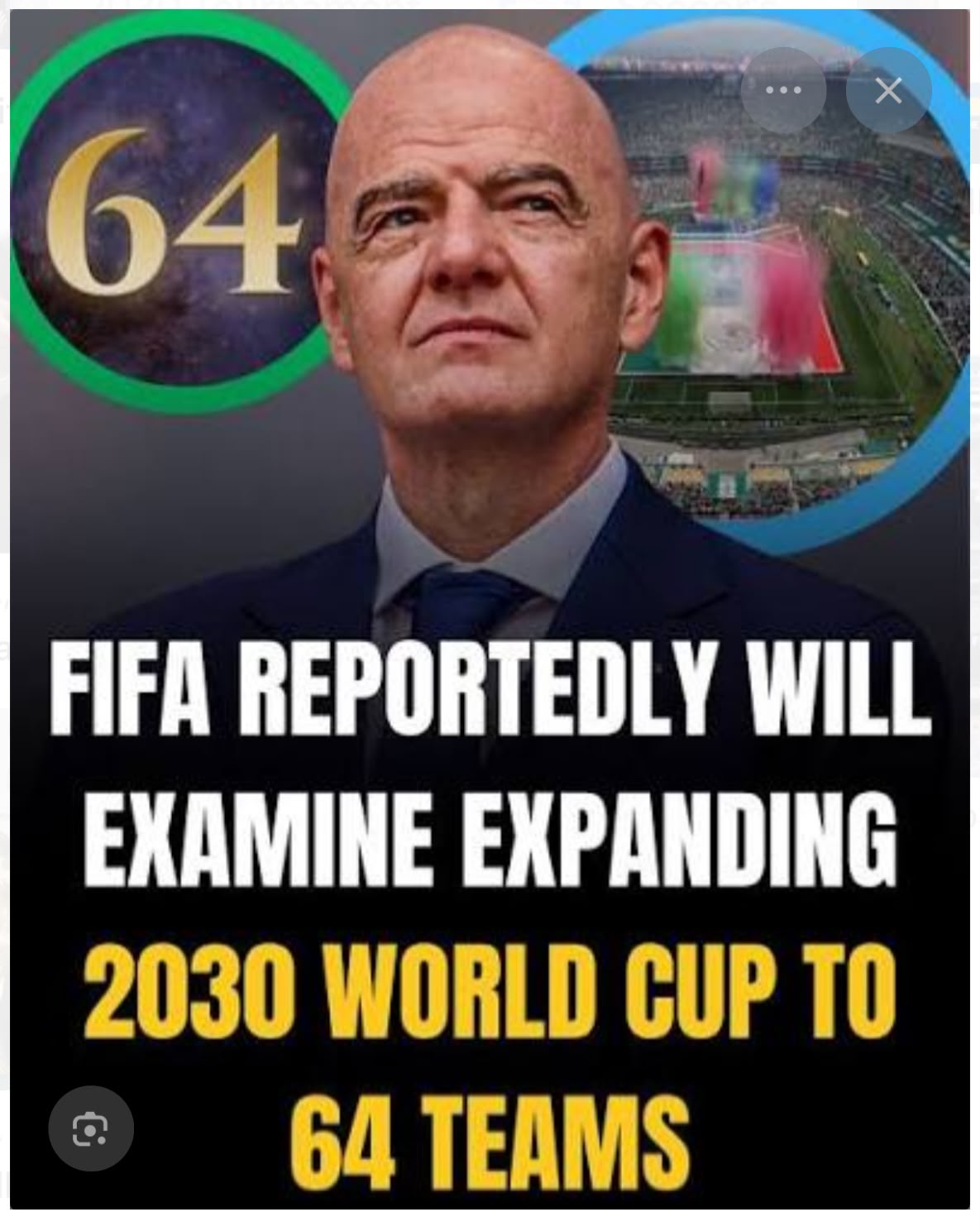
FIFA Eyes a Mega-Field: 64-Team World Cup Under Review
Pearl Doshi - Gujarat Bureau Jul 13, 2026 1,900 Views
FIFA President Gianni Infantino confirmed that the governing body will formally evaluate expanding the 2030 World Cup to 64 teams. Following the success of the 48-team format in 2026, FIFA aims to assess whether a further increase would better support global football development and fittingly mark the tournament's centenary anniversary.
FIFA President Gianni Infantino confirms the governing body will formally evaluate expanding the 2030 tournament to 64 teams to mark the competition's centennial.
ZURICH — In a move that could redefine the scale of international football, FIFA President Gianni Infantino announced on July 12, 2026, that the governing body will formally examine the possibility of expanding the 2030 FIFA World Cup to a 64-team tournament. The proposal, if approved, would represent a significant increase from the 48-team format currently making its debut at the 2026 World Cup hosted by the United States, Canada, and Mexico.
The discussion surrounding a "supersized" tournament for 2030 stems from a formal pitch by South American football leaders, who argue that a 64-team format would be a fitting tribute to the tournament’s centenary. The 2030 edition is already historic, set to be hosted across six nations on three continents, with centennial matches in Uruguay, Argentina, and Paraguay, and the primary tournament hosted by Morocco, Portugal, and Spain.
Inclusivity or Dilution? The Expansion Debate
Infantino’s endorsement of the potential expansion centers on the principle of global inclusivity. Speaking to Swiss media outlet Bluewin, the FIFA president argued that providing more nations with a path to the World Cup is essential for the development of the sport.
"Every nation should be allowed to dream of participating in the World Cup," Infantino stated. "You can see that the quality of the teams is extremely high, and it's getting higher and higher, all over the world. If you don't give smaller countries a chance to participate in the World Cup, they'll lack the incentive to keep improving."
However, the prospect of a 64-team field has met with significant pushback from various stakeholders. Critics, including sports analysts and several high-ranking football officials, argue that further expansion could dilute the competitive quality of the finals, render regional qualification processes meaningless, and impose an unsustainable physical workload on players.
Contextualizing the Growth
The 2026 World Cup marked the first major expansion in recent history, moving from the long-standing 32-team format—used from 1998 through 2022—to 48 teams. Infantino has maintained that the 2026 transition has been a "100 percent success," justifying his willingness to explore further growth for the 2030 cycle.
According to officials, the formal review of the 64-team proposal will take place in relevant FIFA committees following the conclusion of the ongoing 2026 tournament. No final decision has been reached, and the governing body must still navigate logistical, sporting, and financial hurdles before finalizing a format for the centenary celebrations.
Why It Matters
For global football, this evaluation is more than just a logistical adjustment; it is a fundamental shift in the tournament's philosophy. A 64-team World Cup would see over a quarter of FIFA’s 210 member nations participate, effectively turning the tournament into a massive global festival. For fans and investors, such an expansion would drastically increase the volume of matches, potentially supercharging the sports betting and broadcast markets, while simultaneously testing the structural limits of tournament hosting.
Key Facts at a Glance
Current Proposal: FIFA is formally evaluating a 64-team format for the 2030 centenary World Cup.
Evolution: The tournament expanded from 32 teams to 48 in 2026; a shift to 64 would add another 16 squads.
Proposed Hosting: The 2030 tournament will span three continents, with opening matches in Uruguay, Argentina, and Paraguay, and main fixtures in Morocco, Portugal, and Spain.
Timeline: Formal committee reviews are scheduled to commence after the conclusion of the 2026 tournament.
FAQ
Has a decision been made to expand to 64 teams?
No. FIFA has only confirmed that the proposal will be "examined and discussed" in relevant committees after the 2026 World Cup.
Why are South American leaders pushing for 64 teams?
The proposal is tied to the 2030 tournament marking the centenary of the first World Cup held in Uruguay in 1930; proponents believe a larger tournament is a fitting way to celebrate the milestone.
What are the main criticisms of this expansion?
Critics argue that more teams could weaken the overall quality of play, devalue regional qualification stages, and increase the physical strain on participating athletes.