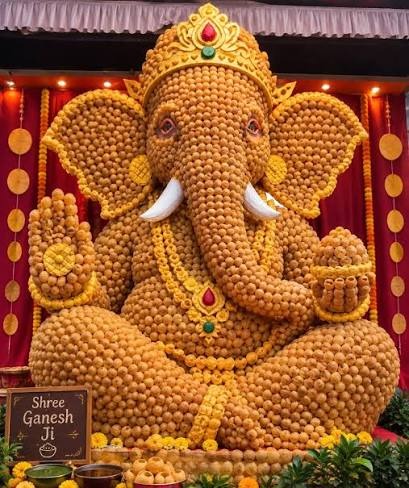
An artist in Pune erected a 13-foot-tall Lord Ganesha idol utilizing 21,000 pani puri shells. The eco-friendly installation sits outside Ganesh Bhel on Fergusson College Road. Bamboo and recycled paper form the base framework. The organic sculpture highlights zero-waste religious celebrations and eliminates toxic chemical runoff during final immersion rituals.
Local eatery Ganesh Bhel installed the eco-friendly structure on Fergusson College Road to eliminate synthetic festive waste.
PUNE - A local artist constructed Pune's 13-Ft Ganpati idol using 21,000 discarded pani puri shells. The installation debuted outside the Ganesh Bhel commercial outlet located along Fergusson College Road. Artisans sourced leftover dough strictly from regional street vendors to assemble the organic display. The creation directly addresses mounting municipal concerns regarding plaster of Paris pollutants entering municipal waterways during the annual Ganeshotsav immersion cycle.
Structural Engineering and Assembly
Artist Prashant Salunkhe led an eight-member team to execute the framework. Workers required 15 days to mount the baked flour spheres onto a biodegradable skeleton. Constructors utilized raw bamboo stalks and recycled newspaper to bear the physical load of the 11-foot-wide installation. Organizers applied food-grade organic sealants to prevent structural collapse caused by atmospheric moisture and September monsoon humidity. Commercial eatery Ganesh Bhel commissioned the artwork. This marks their fourth consecutive year funding non-synthetic religious installations for public viewing.
Urban Waste Management Context
Civic authorities consistently battle toxic runoff following the 10-day Hindu festival. Traditional idols contain heavy metals and non-biodegradable synthetic paints. By utilizing surplus edible dough that vendors would otherwise relegate to landfills, the installation introduces a zero-waste consumption model for large-scale public art. Festival organizers confirmed the entire structure will dissolve naturally during the final immersion rituals without increasing the chemical oxygen demand of local rivers. Pune's 13-Ft Ganpati idol serves as a blueprint for biodegradable commercial sponsorships.
Quote Section
According to syndicated wire disclosures, artist Prashant Salunkhe stated:
"It took around 15 days to complete the idol with the help of 8-10 artisans. We used over 21,000 pani puri shells. This is an eco-friendly Bappa as we have used paper and bamboo for its structure."
Why It Matters
The organic installation presents a scalable alternative for commercial festival sponsorships. Local businesses investing in biodegradable public art simultaneously drive massive foot traffic to their storefronts while remaining compliant with tightening civic environmental regulations. As Pune's 13-Ft Ganpati idol attracts regional tourism, it proves eco-friendly mandates do not restrict commercial visibility.
Key Facts at a Glance
Dimensions: The sculpture measures 13 feet in height and 11 feet in width.
Material Volume: Artisans attached exactly 21,000 baked pani puri shells.
Labor Metrics: A team of ten workers spent 15 days assembling the unit.
Framework: Scaffolding consists entirely of raw bamboo and recycled paper.
Location: Displayed publicly outside Ganesh Bhel on Fergusson College Road.
FAQ Section
Q: What materials hold the idol together?
A: Artisans utilized a skeletal frame built from raw bamboo and recycled paper. Food-grade sealants protect the outer dough shells from humidity and sudden moisture.
Q: Who commissioned the installation?
A: Pune-based snack retailer Ganesh Bhel funded the project. The outlet historically sponsors unconventional, eco-friendly religious displays during the annual festival.
Q: Will the idol pollute water bodies during immersion?
A: No. The structure relies purely on baked flour, bamboo, and paper. It will dissolve completely in water without leaving synthetic chemical residue.
SOURCE: ANI / Ganesh Bhel / Pune Municipal Desks