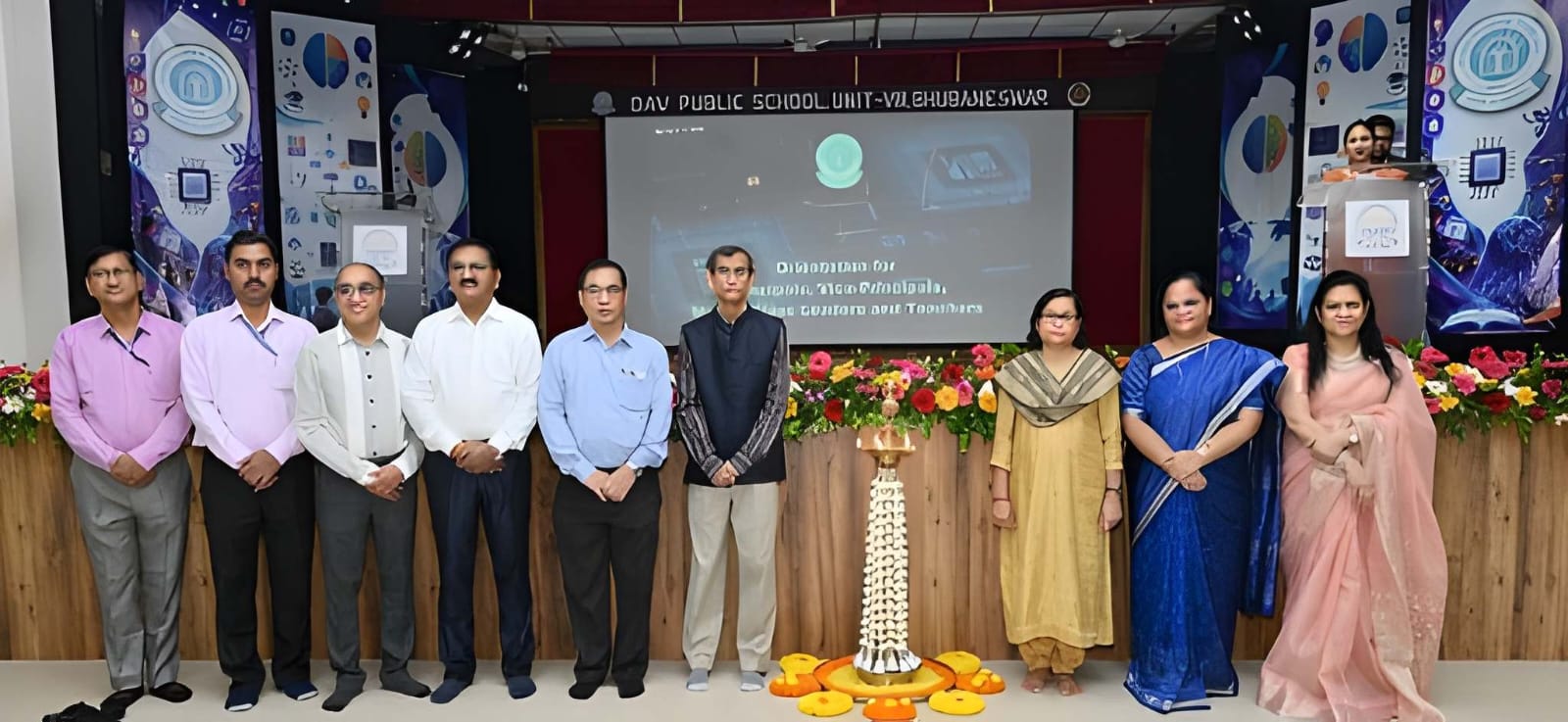
The Central Board of Secondary Education organized a regional workshop on Computational Thinking and Artificial Intelligence in Bhubaneswar, attended by over 280 educators from Odisha and West Bengal. The training equipped teachers with interdisciplinary methods to build logical reasoning, algorithmic skills, and ethical AI literacy in classrooms.
BHUBANESWAR — The Central Board of Secondary Education (CBSE) held a regional workshop on Computational Thinking (CT) and Artificial Intelligence (AI) in Bhubaneswar, Odisha, bringing together over 280 educators and academic experts from across Odisha and West Bengal.
The day-long capacity-building event, organized under the aegis of the local CBSE Centre of Excellence (CoE), forms a core component of the Board’s nation-wide professional development initiative for the 2026–27 academic session. Aligned with the National Education Policy (NEP) 2020 and the National Curriculum Framework for School Education (NCF-SE), the workshop focused on equipping middle and secondary school teachers with the pedagogical frameworks required to integrate logical reasoning, algorithmic problem-solving, and AI readiness into everyday classroom instruction.
Curriculum Alignment and District-Level Deliberations
The Bhubaneswar workshop operated as part of the District-Level Deliberations (DLD) framework mandated under CBSE Notification TRG-02. Sessions provided practical guidance on implementing the Board's updated CT & AI curriculum rollout for Classes 3 through 8.
Resource persons and master trainers led interactive modules structured around four core pillars of computational thinking:
Decomposition: Breaking down complex multi-step problems into manageable component parts.
Pattern Recognition: Identifying data regularities to build foundational concepts for machine learning.
Abstraction: Stripping away unnecessary details to focus on core logical rules.
Algorithmic Design: Formulating step-by-step instructions to solve mathematical, scientific, and real-world challenges.
Educators participated in case paper presentations and peer-review sessions. Selected high-scoring papers from the Bhubaneswar workshop will qualify for presentation at the upcoming CBSE National Teachers' Conference scheduled for November 2026.
Focus on Interdisciplinary Learning and Responsible AI
A major focus during the regional meeting was cross-subject integration. CBSE academic coordinators emphasized that computational thinking should not be treated merely as an isolated computer science topic, but integrated directly into Mathematics, Science, and Social Sciences.
The workshop also addressed ethics and responsible technology use, instructing educators on how to guide students regarding data privacy, algorithmic bias, and academic integrity when using AI tools.
Official Sources Section
According to official releases from the Central Board of Secondary Education (CBSE) and notifications published by the Ministry of Education, the regional training sessions contribute toward mandatory Continuing Professional Development (CPD) hours for affiliated teachers.
Quote Section
"According to officials, embedding computational thinking and AI literacy into early schooling ensures that students develop foundational problem-solving skills necessary to navigate an increasingly digital global economy."
Why It Matters
For School Teachers: Provides practical tools and certified CPD credits to meet updated CBSE curriculum delivery standards.
For Students: Ensures early exposure to structured logic, problem-solving, and digital literacy without relying strictly on rote memorization.
For School Administrations: Helps CBSE-affiliated institutions across Odisha and West Bengal establish standardized CT & AI implementation roadmaps.
Key Facts at a Glance
Event Location: Bhubaneswar, Odisha.
Attendance: Over 280 teachers and academic experts from Odisha and West Bengal.
Primary Theme: Computational Thinking and Artificial Intelligence (CT & AI).
Target Grades: Pedagogy integration focused on Classes 3 to 8.
Frequently Asked Questions (FAQ)
What is computational thinking in the CBSE curriculum?
Computational thinking is a problem-solving methodology that involves breaking down complex issues, identifying patterns, abstracting key details, and developing step-by-step algorithmic solutions.
Is computational thinking a mandatory subject for CBSE schools?
Yes, CBSE has introduced CT & AI learning frameworks across affiliated schools starting from the 2026–27 academic session for primary and middle grades.
Do teachers receive training credits for attending these workshops?
Yes, participation in recognized CBSE district and regional workshops counts toward mandatory Continuing Professional Development (CPD) hours under CBSE training guidelines.
Source: Central Board of Secondary Education (CBSE) | CBSE Academic Website | Ministry of Education