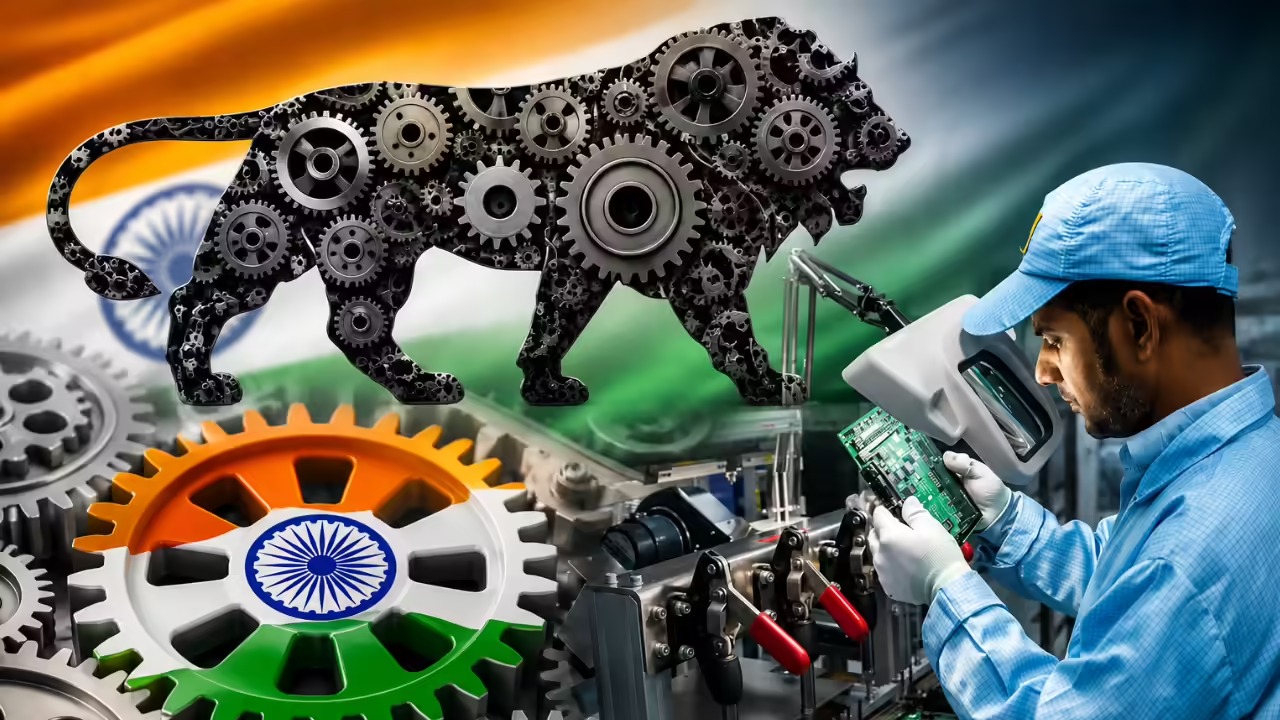
The Indian government has launched a fresh manufacturing push, working with industry to identify around 100 products that are either not made in India or are manufactured in very limited quantities. The goal is straightforward but ambitious: convert import dependence into domestic production, and then use that base to pitch India as a global manufacturing hub across priority sectors like autos, engineering, chemicals and pharma.
Speaking at an industry interaction, DPIIT Secretary Amardeep Singh Bhatia said a “unique and interesting” basket of products has already been shortlisted, including auto components such as axles and motorcycle parts. These items have two things in common large import bills and latent capacity or capability within India that can be scaled up with the right policy push, technology partnerships and branding support.
What The 100-Product Drive Aims To Do
Under this initiative, the government is mapping products that are either not produced or insufficiently manufactured domestically but have strong demand both within India and in export markets. The exercise spans sectors like automotive components, engineering goods, plastics, chemicals, and select pharmaceutical and intermediate products. Alongside this, a “Made in India Brand Scheme” is being rolled out, starting with a pilot in the steel sector, to certify quality and build global trust around Indian-made products.
India’s Global Manufacturing Hub Ambitions
The 100-product strategy dovetails with the broader vision of turning India into a high-quality, cost-competitive global manufacturing hub. The World Economic Forum and multiple policy reports have highlighted India’s advantages: a large domestic market, a young workforce, and government programmes like PLI, infrastructure upgrades and ease-of-doing-business reforms. The challenge now is execution moving from generic “Make in India” slogans to sharp product-level bets where India can plug into global value chains, raise capacity utilisation and eventually become an export base.
Why This Matters For Industry And Jobs
For manufacturers, the list of 100 products is effectively a roadmap of where policy, demand and import substitution interests converge. Companies that move early could tap incentives, secure long-term contracts and position themselves as preferred suppliers in both domestic and overseas markets. For the economy, success would mean lower import dependence, better utilisation of existing plants, new capex in core sectors and more formal jobs on the shop floor crucial if manufacturing is to rise meaningfully above its current share of GDP.
Manufacturing Playbook Highlights
- Government and industry jointly identifying about 100 products for a focused manufacturing push
- Target items include auto components like axles and motorcycle parts, plus engineering, plastics, chemicals and pharma products
- Aim is to replace high-import products with domestic output while also serving export markets
- “Made In India Brand Scheme” to offer branding and quality assurance, piloted in the steel sector
- Fits into India’s larger goal of becoming a global manufacturing hub with stronger participation in global value chains
Sources: Devdiscourse, BusinessStandard, MillenniumPost, TheHindu, WEF, IndiaBriefing