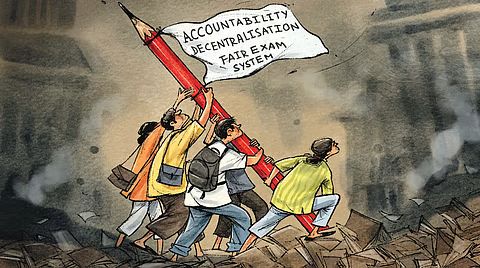
Youth-led protests in New Delhi have forced the resignation of Union Education Minister Dharmendra Pradhan. While hailed as a major democratic victory for students, analysts stress that this milestone must now translate into a comprehensive, structural overhaul of India's centralized testing and educational policy framework.
Youth-led demonstrations in New Delhi force cabinet changes, marking a pivotal turning point for Indian education reform.
In a historic political and social development, months of intense youth-led protests across New Delhi culminated in a major watershed moment as Union Education Minister Dharmendra Pradhan stepped down from office. The high-stakes demonstrations, spearheaded by thousands of students demanding systemic accountability, shattered government resistance against growing institutional grievances. Analysts note that while the ministerial exit represents an undeniable victory for civic activism, the underlying structural challenges facing India's educational architecture demand immediate, profound transformation rather than superficial political adjustments.
Cracking the Centralized Testing Framework
According to civil society reports and policy evaluations highlighted by public commentators, the core catalyst for the unrest was the severe erosion of credibility within the National Testing Agency (NTA).
Systemic Bottlenecks: The hyper-centralized examination apparatus has faced intense criticism following repeated paper leaks, cancellation scandals, and deep-seated administrative failures.
Federal Concerns: Critics and regional stakeholders argue that centralized entrance structures—such as unified national medical and engineering tests—disproportionately disadvantage rural students and undermine state-level educational autonomy.
Socioeconomic Disparities: Observers point out that an increasingly commercialized coaching ecosystem has turned competitive exams into high-pressure financial burdens, shutting out marginalized applicants who cannot afford expensive private instruction.
Navigating the Path Toward Systemic Overhaul
The recent political shift has amplified calls from educationists, student unions, and state administrators to overhaul the implementation of the National Education Policy (NEP) 2020. Policy experts emphasize that sustainable reform requires decentralizing examination management, expanding equitable public school infrastructure inspired by successful regional models, and re-establishing meritocratic integrity. Without these corrective measures, experts warn that administrative turnover alone will fail to resolve the anxieties of millions of students navigating India’s high-stakes academic landscape.
Quote Section
"According to official statements and public policy evaluations, 'The resignation of the education minister is a testament to the steadfast resolve of India's youth, but true victory will only be realized when systemic flaws in national testing and centralized education policies are thoroughly reformed.'"
Why It Matters
For millions of students and families across India, the current crisis highlights the urgent need for transparent, fair, and accessible academic evaluations. Restructuring the nation's testing apparatus is vital to alleviating extreme student burnout, curbing predatory commercial coaching expenses, and ensuring equitable access to higher education.
Key Facts at a Glance
Catalyst Event: Sustained student protests in New Delhi demanding accountability and educational reform.
Political Consequence: Resignation of Union Education Minister Dharmendra Pradhan.
Core Grievances: Widespread examination paper leaks, systemic flaws in NTA protocols, and the commercialization of coaching.
Reform Imperative: Shifting from centralized test filters toward an equitable, decentralized, and student-centric educational framework.
Frequently Asked Questions
What triggered the recent protests in New Delhi?
The protests were driven by student anger over recurring examination paper leaks, systemic failures within centralized testing agencies, and mounting academic stress.
Who stepped down following the student demonstrations?
Union Education Minister Dharmendra Pradhan stepped down from his position following the widespread public outcry and youth-led movement.
Why are critics calling for structural transformation rather than just leadership changes?
Experts argue that administrative exits alone cannot fix deeper systemic issues like centralized testing monopolies, commercialized coaching mafias, and regional educational disparities.
Source: Ministry of Education, The New Indian Express, National Testing Agency