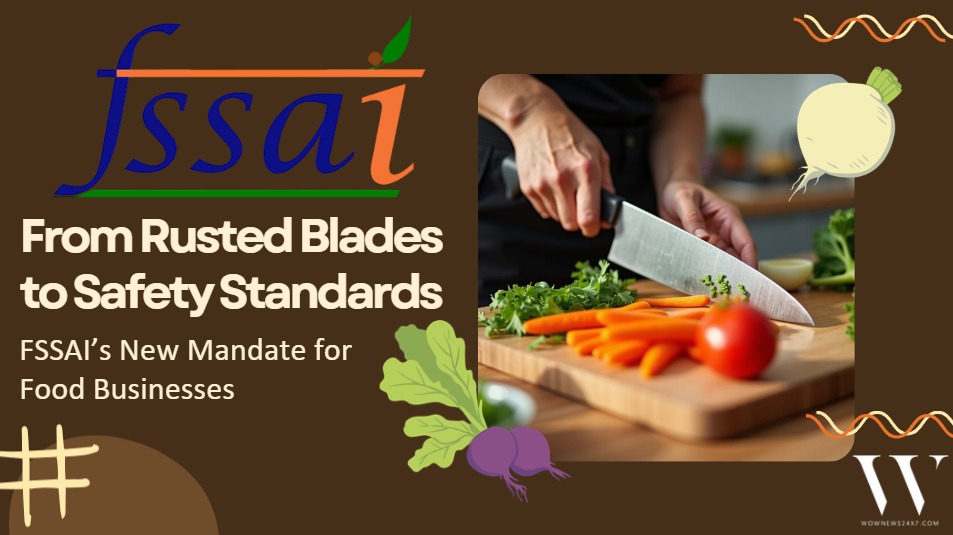
The FSSAI has ordered all food businesses to immediately replace rusted, chipped, or damaged knives and cutting tools to prevent physical, chemical, and microbiological contamination. The nationwide directive aims to improve hygiene standards and protect public health by mandating the use of food-grade, corrosion-resistant equipment in all food preparation operations.
The Food Safety and Standards Authority of India (FSSAI) has issued a nationwide directive requiring all food business operators (FBOs) to discontinue the use of rusted, corroded, chipped, or otherwise damaged knives and blades. The advisory, released on June 15, 2026, aims to mitigate significant physical, chemical, and microbiological risks that such tools pose to the food supply chain.
As India intensifies its oversight of food hygiene, the regulator emphasized that kitchen tools coming into direct contact with food must be made of food-grade, non-toxic, and corrosion-resistant materials. The move follows reports of various establishments using degraded equipment for slicing, processing, and packaging, which regulators describe as a direct violation of established sanitary standards.
The Health Risks of Degraded Cutting Tools
While often viewed as a cosmetic issue, the FSSAI warns that rust and corrosion transform metal surfaces into rough, porous environments. These microscopic crevices can trap moisture and food particles, creating breeding grounds for dangerous pathogens such as Salmonella and E. coli.
Beyond microbiological risks, the regulator highlighted two other primary concerns:
Physical Contamination: Chipped blades or flakes of rust and paint can break off during food preparation, posing a serious choking hazard or causing internal injury if ingested.
Chemical Contamination: Corrosion compromises the protective oxide layer of stainless steel, potentially allowing harmful metal ions to leach into acidic or salty food products like pickles, vinegar-based dishes, or tamarind-heavy preparations.
Regulatory Enforcement and Compliance
Under Schedule 4 of the Food Safety and Standards (Licensing and Registration of Food Businesses) Regulations, 2011, food establishments are already legally required to maintain their equipment in a sound, hygienic condition. However, the FSSAI noted that consistent lapses in these protocols necessitated a more stringent enforcement push.
"The use of rusted, corroded, chipped, painted, damaged, inadequately cleaned or non-food-grade knives, blades and cutting equipment may result in physical, chemical and microbiological contamination of food," the FSSAI stated in its official advisory.
State-level food safety commissioners and regional directors have been instructed to ramp up inspections. Businesses found in violation of these standards face potential regulatory action under the Food Safety and Standards Act, 2006.
Official Sources
The Food Safety and Standards Authority of India (FSSAI) issued the formal advisory on June 15, 2026, to all Food Business Operators (FBOs), state food safety commissioners, and regional directors. The directive is based on mandatory hygiene requirements outlined in the Food Safety and Standards (Licensing and Registration of Food Businesses) Regulations, 2011.
Quote Section
"According to officials," the move is a necessary step to ensure that the food served to the public is free from preventable hazards. Organizers stated that the authority has directed state food safety officers to maintain strict vigilance during routine inspections and initiate appropriate legal action against establishments that continue to use non-compliant equipment.
Why It Matters
This directive directly impacts the daily operations of millions of restaurants, street food vendors, and industrial food processing units across India. By forcing an industry-wide transition to high-quality, corrosion-resistant tools, the FSSAI aims to improve the baseline hygiene of the Indian food sector. For consumers, this means a reduced risk of foodborne illnesses and physical injuries caused by contaminated or fragmented food products.
Key Facts at a Glance
Directive Date: June 15, 2026.
Scope: Applies to all knives, blades, and cutting tools used in food handling, processing, and packaging.
Prohibited Conditions: Rust, corrosion, chipping, cracks, peeling paint, or broken edges.
Legal Basis: Schedule 4 of the Food Safety and Standards Regulations, 2011.
Consequences: Potential penalties and enforcement action under the Food Safety and Standards Act, 2006.
Frequently Asked Questions (FAQ)
What qualifies as "food-grade" equipment?
Food-grade materials are those deemed safe for direct food contact; they are non-toxic, resistant to corrosion, and can be effectively sanitized. Industry standard for kitchen blades is typically high-quality stainless steel (such as 420 grade) that is properly maintained.
Does this rule apply to home kitchens?
No, the FSSAI advisory specifically targets Food Business Operators (FBOs), which include restaurants, caterers, food processors, and street food vendors. However, general food safety principles regarding clean tools apply to all settings.
Are there specific schedules for replacing knives?
There is no fixed expiry date, but FBOs are expected to perform regular inspections and replace tools immediately upon detecting signs of rust, damage, or wear.
Source: Food Safety and Standards Authority of India (FSSAI), Times of India, India Today