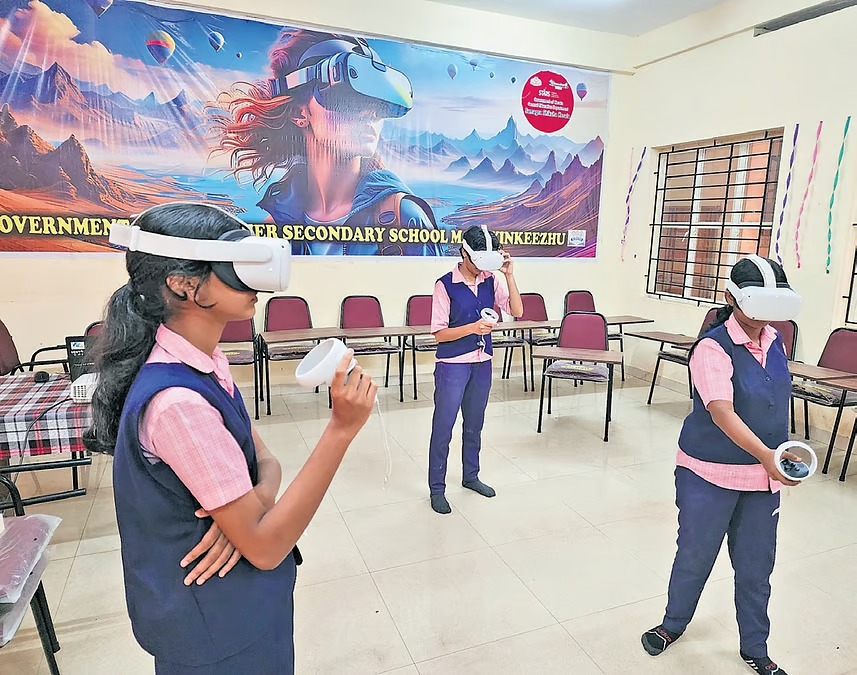
Kerala is once again leading the charge in educational reform, this time by integrating Virtual Reality (VR) and Extended Reality (XR) technologies into its school curriculum. The state’s Department of General Education, through its tech-forward agency KITE (Kerala Infrastructure and Techno...
Kerala is once again leading the charge in educational reform, this time by integrating Virtual Reality (VR) and Extended Reality (XR) technologies into its school curriculum. The state’s Department of General Education, through its tech-forward agency KITE (Kerala Infrastructure and Technology for Education), has launched a sweeping update to its Information and Communication Technology (ICT) textbooks, embedding immersive learning tools that promise to revolutionize how students engage with subjects across grades.
This initiative is part of Kerala’s broader AVGC-XR policy—which stands for Animation, Visual Effects, Gaming, Comics, and Extended Reality—introduced last year to modernize digital education and equip students with future-ready skills. The updated curriculum now includes modules in VR-based storytelling, game design, animation, and digital music composition, offering students hands-on experience with tools that were once reserved for professional studios.
What’s New in the Classroom?
The revised ICT textbooks are not just about coding and computer literacy—they’re a gateway into immersive learning. Starting from Class 3, students are introduced to digital arts through playful modules like “Songbox,” where they learn musical notes via trial-and-error. By Class 4, they begin composing their own songs, and by Class 8, they’re creating background scores for animated films using LMMS (Linux Multimedia Studio).
Animation is introduced in Class 6 using Pencil 2D software, progressing to advanced projects in Class 10 with Open Toonz, where students learn storyboarding, character design, keyframing, and tweening. These tools are not just for fun—they’re aligned with real-world applications in media, entertainment, and design industries.
Game design follows a similar trajectory. Students start with logical gaming concepts in Class 3, move to Scratch programming in Class 4, and by Class 6, they’re building their first computer games. In Classes 9 and 10, they transition to Python programming, preparing them for more complex development environments.
Why VR and XR Matter
The inclusion of VR and XR in the curriculum isn’t just a flashy upgrade—it’s a pedagogical leap. These technologies allow students to explore abstract concepts in science, history, and mathematics through immersive simulations. Imagine walking through a virtual digestive system, manipulating molecules in 3D space, or experiencing historical events as if you were there. These experiences deepen understanding, improve retention, and make learning more inclusive and engaging.
K Anvar Sadath, CEO of KITE and Chairman of the ICT textbook drafting committee, emphasized that the new curriculum is designed to help students “acquire technical skills, understand complex subjects, and develop job-ready competencies in the age of AI.” He added that the content was refined through feedback from members of the Little KITES clubs, a student-led tech initiative, before being rolled out statewide.
Teacher Training and Infrastructure
To ensure smooth implementation, KITE has trained ICT teachers across Kerala and equipped schools with a customized Free and Open Source Software (FOSS) operating system suite. This includes all necessary applications for animation, music production, coding, and VR integration. The second volume of the textbooks for Classes 8, 9, and 10 will be distributed after the Onam holidays, in Malayalam, English, Tamil, and Kannada, ensuring linguistic inclusivity.
A Model for the Nation
Kerala’s VR-powered curriculum sets a precedent for other states looking to modernize their education systems. By embedding immersive technologies into foundational learning, the state is not only preparing students for careers in tech and media but also making education more accessible and engaging.
As India moves toward a digitally empowered learning ecosystem, Kerala’s initiative could serve as a blueprint for national policy. The integration of AI, robotics, and immersive media into school curricula reflects a shift from rote learning to experiential education—one that could redefine the classroom for generations to come.
Sources: Digital Learning, Onmanorama, Times Now News