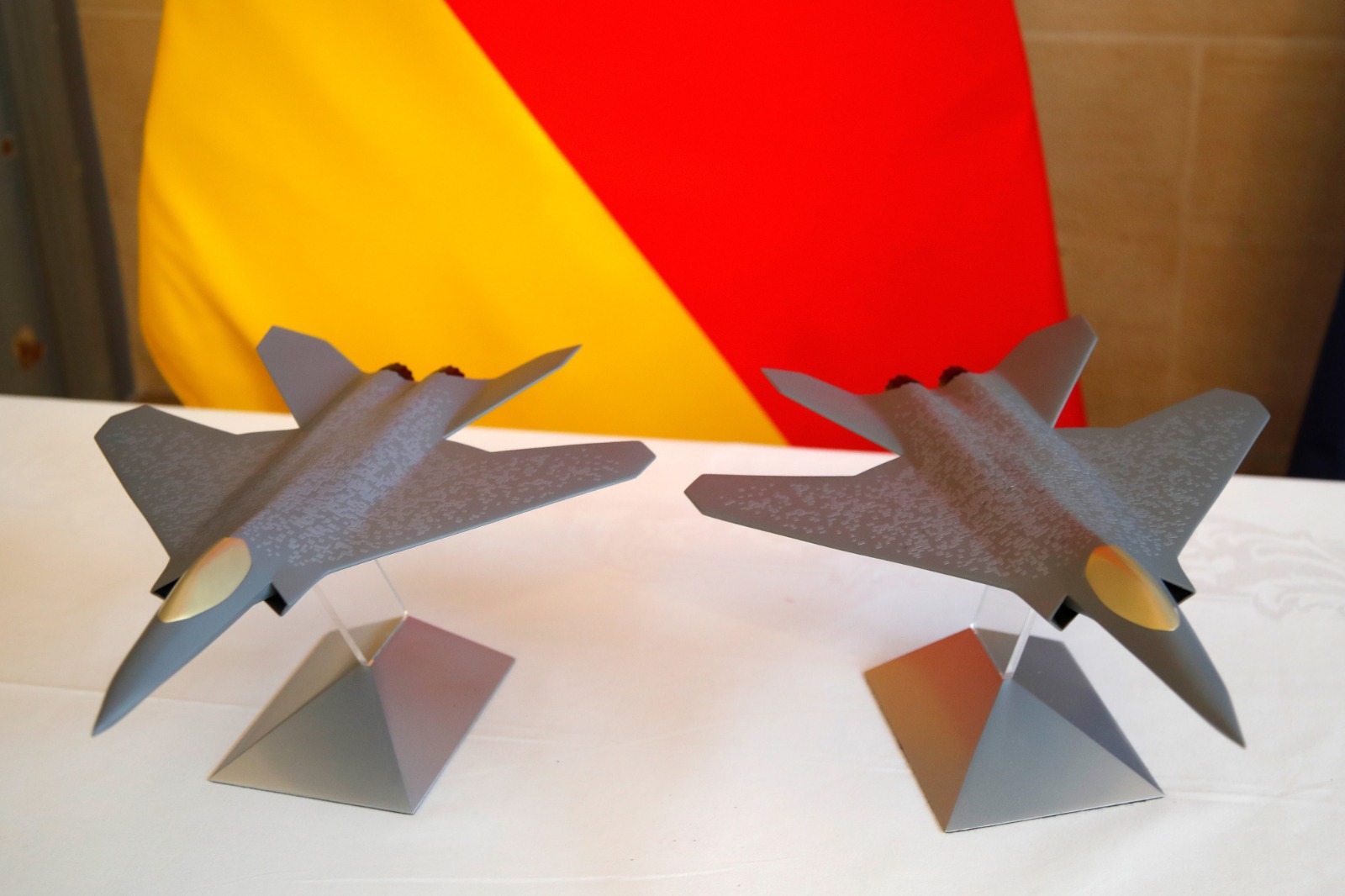
German Chancellor Friedrich Merz announced the cancellation of the €100 billion joint FCAS fighter jet project with France due to industrial disputes and misaligned military requirements. Instead, Berlin and Paris will pivot their defense alliance toward a collaborative "Combat Cloud" air defense data network, with detailed plans arriving by July 2026.
BERLIN, June 10, 2026 — German Chancellor Friedrich Merz announced on Wednesday that Germany and France have officially abandoned their ambitious plans to build a next-generation joint fighter jet under the Future Combat Air System (FCAS) banner. Speaking at the Berlin Air Show, Merz confirmed that he and French President Emmanuel Macron reached a shared assessment that the industrial partners could not reconcile their deep-seated differences. While the core fighter aircraft component has been terminated, Berlin and Paris intend to pivot their alliance toward collaborative software architectures, specialized cloud networking, and shared nuclear deterrence frameworks.
Industrial Friction and Conflicting Military Demands Sinker Core Aircraft
The cancellation of the €100 billion ($108 billion) joint fighter jet follows years of compounding friction between the project's primary aerospace defense contractors. France’s Dassault Aviation and European consortium Airbus, which represents German and Spanish state interests, reached a total impasse regarding intellectual property control, leadership over the flyable demonstrator phase, and hardware workshare balancing.
Beyond corporate rivalries, fundamental strategic divergence between the two nations broke the core design requirements. According to official government briefings, France required a highly tailored carrier-capable aircraft capable of deploying airborne nuclear weapons to align with its standalone strategic doctrine. Conversely, Germany rejected these design mandates as excessive and mismatched with its own immediate air force specifications, which favor traditional land-based tactical air defense.
"President Macron and I agreed not to proceed with building a joint fighter jet," Chancellor Merz explicitly stated during his address at the Berlin Air Show, bringing a decisive end to the signature European defense initiative first co-launched by Macron and former German Chancellor Angela Merkel in 2017.
Pivot to the Combat Cloud Data Network and Shared Deterrence
Despite terminating the manned sixth-generation fighter jet assembly, the cross-border coalition will not collapse entirely. Germany and France have pledged to channel remaining development resources into defensive software infrastructure, specifically targeting high-speed military data links and decentralized battle networks.
Revised Directives: The defense ministries of both countries are mandated to compile a comprehensive, joint action plan by July 2026 to outline this reworked collaboration on data networks.
The Combat Cloud: Engineers will prioritize the "Combat Cloud" architecture—a robust digital system intended to link disparate aircraft, unmanned aerial vehicles (UAVs), radar sensors, and command nodes across allied airspace.
Timeline Allocation: The final software plan will be formally submitted ahead of the next scheduled Franco-German intergovernmental summit taking place in Germany next month.
Concurrently, Chancellor Merz reaffirmed Germany's dedication to integrated European security protocols. Addressing geopolitical vulnerabilities, Merz underscored that Berlin wishes to proceed in close alignment with France on regional nuclear deterrence capabilities, ensuring the broader defense pact remains functional despite the industrial setback.
Official Sources Section
The termination of the FCAS joint fighter jet development program and the upcoming July revisions were verified via official governmental briefings in Berlin, joint ministerial communiqués from the Berlin Air Show, and regulatory corporate press dispatches compiled by Reuters and Agence France-Presse (AFP).
Quote Section
"According to officials familiar with the intergovernmental deliberations, the decision represents a pragmatic acknowledgment of industrial realities. Organizers stated that forcing a singular aircraft design on two fundamentally different military requirement profiles was no longer financially or operationally viable."
Why It Matters
The cancellation of the flagship FCAS fighter jet marks a significant shift for global defense contractors, industrial investors, and European taxpayers. The collapse of the joint fighter jet initiative will likely trigger a massive consolidation and reshuffling of corporate alliances across Europe's fragmented defense ecosystem.
With Airbus freed from the restrictive Dassault partnership, Germany could seek closer alignment with rival defense consortiums. Industry analysts point to the competing Global Combat Air Programme (GCAP) led by the United Kingdom, Italy, and Japan or an independent alliance with Sweden's Saab AB as logical landing zones for future German aerospace investment. For European citizens, the pivot away from a costly, unified hardware platform toward agile, cloud-based software tracking could potentially streamline defense budgets and accelerate the deployment of tactical drone networks.
Key Facts at a Glance
Project Cancelled: Manned sixth-generation joint fighter jet component under the €100 billion FCAS program.
Core Conflict: Unresolvable workshare disputes between Dassault Aviation (France) and Airbus (Germany/Spain), paired with conflicting carrier/nuclear mission parameters.
New Technical Focus: Development of an interconnected "Combat Cloud" air defense data network and software infrastructure.
Next Major Deadline: German and French defense ministers must deliver the revised networking blueprint by July 2026.
Strategic Continuity: Germany explicitly commits to continuing joint nuclear deterrence strategy discussions with France.
FAQ Section
Why did Germany and France officially cancel the joint fighter jet project?
The project was cancelled due to a combination of corporate disputes over engineering control between Airbus and Dassault Aviation, alongside incompatible national requirements. France required a carrier-capable, nuclear-weapon-ready jet, whereas Germany did not need those specific capabilities for its air force.
Does this mean the entire Future Combat Air System (FCAS) alliance is over?
No. While the physical fighter jet will not be built together, the bilateral defense alliance is pivoting to digital infrastructure. Both nations are actively collaborating on a shared "Combat Cloud" data network to connect existing aircraft, command stations, and drone systems.
What happens next to the development timeline?
The defense ministers of Germany and France are currently drafting a reworked blueprint for their joint air defense data network. This newly structured plan is scheduled to be presented in July 2026 before the upcoming Franco-German intergovernmental meeting.
Where does this leave corporate players like Airbus and Dassault?
The cancellation causes an immediate shift in the European defense sector. Dassault will likely focus heavily on independent iterations or domestic upgrades, while Airbus may seek new international collaboration opportunities with other regional partners, such as Sweden's Saab or participants in the UK-led GCAP program.
Source: Official prime ministerial statements, corporate press releases from the Berlin Air Show, and statutory bilateral defense reports monitored by the German Federal Ministry of Defence and the French Ministry of the Armed Forces.