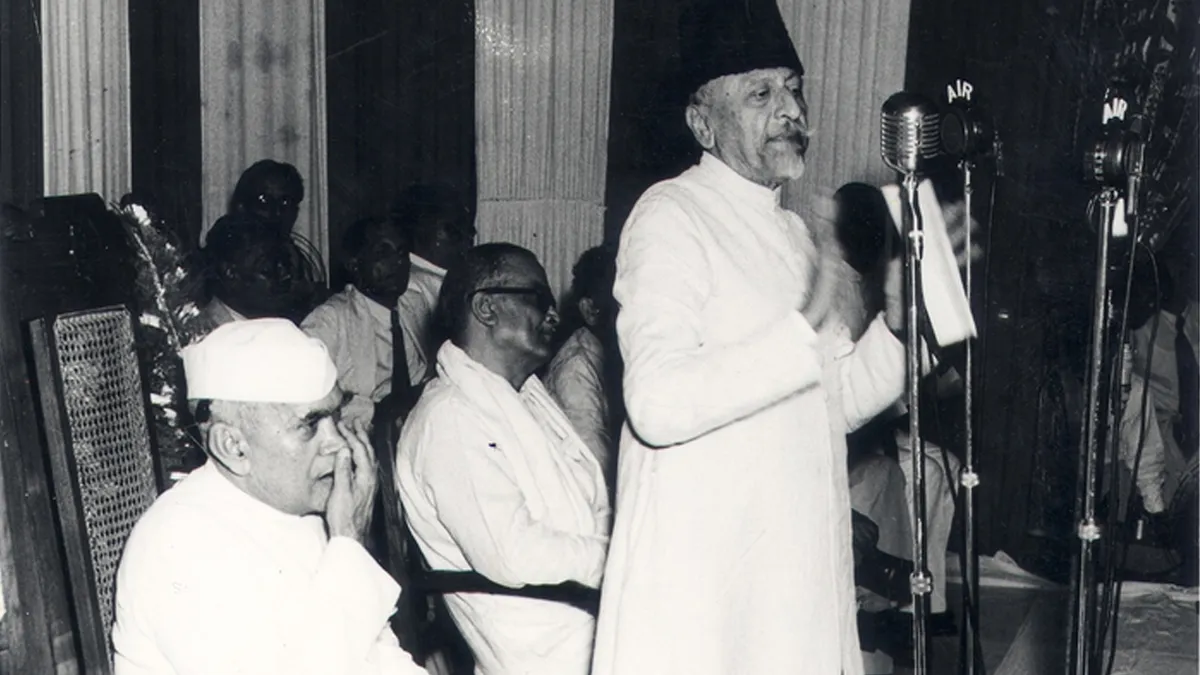
Maulana Abul Kalam Azad, independent India’s first Minister of Education, laid the foundation of the nation's modern academic infrastructure. Despite receiving no formal school or university education, he established the Indian Institutes of Technology (IITs), the University Grants Commission (UGC), and championed universal primary education across India.
NEW DELHI — Long before India emerged as a global hub for technical and scientific talent, its foundational educational institutions were envisioned and established by a man who never attended a formal school or university. Maulana Abul Kalam Azad, who served as independent India’s first Union Minister of Education from August 15, 1947, until his death in February 1958, personally architected the regulatory and academic infrastructure that continues to govern Indian higher education today.
Under his decade-long tenure, Azad spearheaded the creation of the Indian Institutes of Technology (IITs), established the University Grants Commission (UGC), and laid down the policy framework for free and compulsory primary education.
Early Life and Self-Taught Academic Journey
Born in Mecca in 1888, Azad’s early education took place entirely at home under the guidance of his father, a scholar, and private tutors. Rather than enrolling in traditional colonial schools, he pursued a rigorous self-directed study regimen covering Arabic, Persian, philosophy, geometry, mathematics, and science.
By age twelve, Azad was running a local reading room and debating society, and by fourteen, he was contributing learned essays to major literary journals. His intellectual prowess earned him the honorific title Maulana (master) at a young age, positioning him as one of the preeminent Islamic scholars, journalists, and political philosophers of pre-independence India.
Foundational Role in Higher Education: IITs and the UGC
Upon taking charge of the Ministry of Education in 1947, Azad focused on building national capacity in scientific research, engineering, and humanities. Accepting the recommendations of the Sarkar Committee, Azad established the first Indian Institute of Technology (IIT) at Kharagpur, West Bengal, in 1951 to train world-class engineers for a newly sovereign nation.
To maintain standards and disburse federal grants to higher education institutions, Azad initiated the formation of the University Grants Commission (UGC). Initially inaugurated in 1953, the UGC became a statutory parliamentary body under his leadership in 1956.
| Institution / Policy | Year Established | Core Mission / Function |
| IIT Kharagpur | 1951 | India's premier engineering and technological institute. |
| University Grants Commission (UGC) | 1956 | Statutory regulator for university standards and funding. |
| Cultural Academies | 1952–1954 | Sahitya, Sangeet Natak, and Lalit Kala Akademis for national arts. |
| Universal Primary Education | Policy Focus | Universal, free education for all children up to 14 years. |
Azad also oversaw the establishment of the Indian Council for Cultural Relations (ICCR), the Sahitya Akademi, the Sangeet Natak Akademi, and the Lalit Kala Akademi, ensuring that scientific advancements were complemented by cultural preservation.
Impact on Modern Students, Institutions, and Policy
The structural reforms introduced by Azad continue to shape contemporary academic standards and public policy in India:
For Engineering Students: The expansion of the IIT network provides access to world-class technical education, enabling global employment and innovation pathways.
For Universities and Colleges: The UGC maintains standardized accreditation, faculty qualifications, and federal funding distribution across thousands of higher education institutions.
For National Education Policy: Azad’s push for universal primary schooling laid the early legal foundation for the Right to Education (RTE) Act.
Official Sources Section
According to official historical records, government archives, and educational releases:
Quote Section
According to historical government records and public policy archives:
"According to officials, Maulana Abul Kalam Azad consistently maintained that a nation's strength lies in its commitment to universal, scientific, and humanistic education, driving the establishment of central universities and technical institutions across post-independence India."
Why It Matters
Maulana Abul Kalam Azad's vision transformed India's post-colonial educational system from a limited administrative tool into a national infrastructure for scientific research, social mobility, and higher learning. Every year, his birth anniversary on November 11 is celebrated nationwide as National Education Day to honor his enduring contributions to Indian education.
Key Facts at a Glance
First Education Minister: Served as Union Minister of Education from 1947 until his passing in 1958.
No Formal Schooling: Self-taught scholar who mastered multiple languages, sciences, and philosophies through homeschooling.
Key Institutions: Spearheaded the founding of IIT Kharagpur (1951) and the UGC (1956).
National Education Day: November 11 is observed annually across India in his memory.
Frequently Asked Questions (FAQ)
Who was India's first Education Minister?
Maulana Abul Kalam Azad served as independent India's first Minister of Education from August 15, 1947, to February 22, 1958.
Did Maulana Abul Kalam Azad go to school or college?
No. Azad received no formal schooling or university degrees. He was homeschooled by his father and private tutors, self-studying advanced literature, mathematics, theology, and philosophy.
Which major institutions were established during his tenure?
He played a direct role in establishing the Indian Institutes of Technology (IITs), the University Grants Commission (UGC), Jamia Millia Islamia, and major national academies including the Sahitya and Lalit Kala Akademis.
Why is National Education Day celebrated on November 11?
National Education Day is celebrated every year on November 11 to mark the birth anniversary of Maulana Abul Kalam Azad and honor his contributions to building India's education framework.
Source: Ministry of Education | University Grants Commission | Press Information Bureau