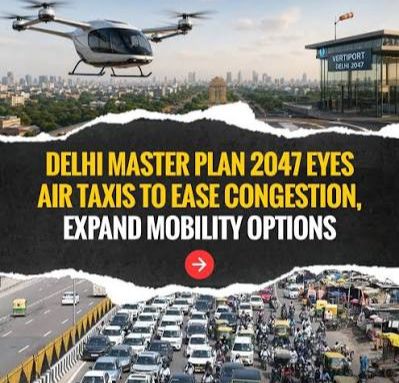
The Delhi Development Authority has officially approved the transport chapter of the Master Plan Delhi-2047, introducing forward-looking mobility solutions such as air taxis and air pods. The long-term strategy aims to alleviate severe road congestion, reduce private vehicle dependence, and integrate advanced air mobility with regional transit hubs.
Backed by official regulatory approvals, Delhi's long-term urban blueprint explores futuristic air taxis and aerial pods to transform metropolitan mobility.
Expanding Horizons: Moving Beyond Conventional Road Transport
As traffic congestion and urban density continue to challenge the national capital, municipal planners are looking skyward for solutions. According to official announcements released in August 2026, the Delhi Development Authority (DDA) formally approved the comprehensive transport chapter of the Master Plan Delhi-2047 (MPD-2047). For the first time in the capital's planning history, the official framework formally incorporates advanced mobility options, including air taxis and air pods, as part of its long-term strategic vision.
The inclusion of air-based transit modes reflects a broader global shift toward Advanced Air Mobility (AAM). While traditional infrastructure such as the Delhi Metro, regional rapid transit systems (RRTS), and arterial road networks remain the backbone of daily commuting, municipal documents indicate that futuristic aerial transport could soon relieve overwhelming pressure on ground-level transit corridors.
Integration With Regional Corridors and Advanced Air Mobility
The policy framework aligns with recent feasibility studies within the National Capital Region (NCR). Industry evaluations, including proposals from aviation analysts, have highlighted potential pilot corridors connecting key commercial and transit hubs—such as Gurugram, Connaught Place, and the upcoming Noida International Airport at Jewar. Utilizing electric vertical take-off and landing (eVTOL) aircraft, these proposed routes could dramatically cut travel times that currently span hours by road down to under 30 minutes.
Alongside air-based solutions, the Master Plan 2047 outlines several complementary transit strategies:
Inland Waterway Systems: Proposals to develop passenger and cargo movement along the Yamuna River, the Sahibi River (Najafgarh drain), and connected canals.
Multimodal Hub Integration: Seamless physical and ticketing integration between expanded railway stations, inter-state bus terminals (ISBTs), metro lines, and regional rail networks.
Smart Traffic Management: Implementation of artificial intelligence-driven command-and-control systems for real-time traffic monitoring, parking optimization, and freight management.
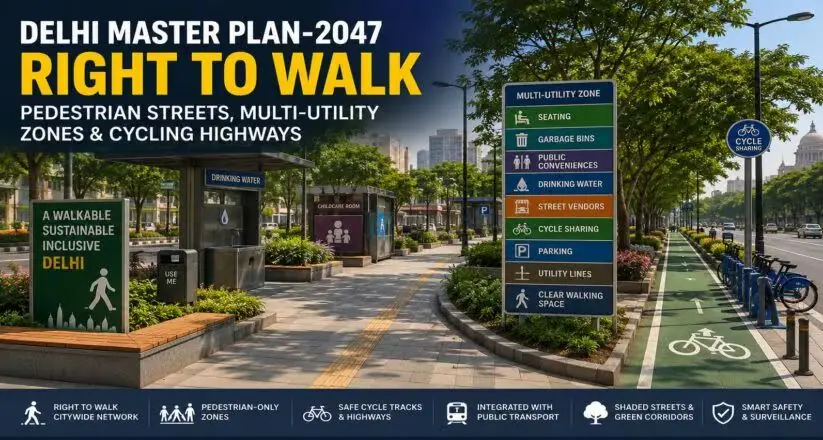
Active Mobility Networks: Dedicated expansion of non-motorized transport (NMT) corridors, pedestrian-only zones, and cycling tracks to curb private vehicle usage.
Why It Matters
The inclusion of air taxis and aerial pods in the master plan signals a forward-thinking regulatory approach to urban planning. For commuters, investors, and city planners, this opens the door for public-private partnerships in green technology, aiming to reshape regional travel and reduce long-term carbon emissions across the capital.
Key Facts at a Glance
Policy Milestone: Transport chapter of Master Plan Delhi-2047 approved by the DDA.
Futuristic Additions: Formal exploration of air taxis, air pods, and inland waterways.
Corridor Focus: Linking major commercial centers and airports like Indira Gandhi International and Noida International Airport.
Core Objective: Reducing private vehicle dependence and mitigating severe road congestion.
FAQ Section
Why are air taxis included in the Delhi Master Plan 2047?
Air taxis and air pods are part of a long-term strategy to relieve pressure on overcrowded roads, railways, and metro systems by introducing advanced air mobility options.
Have specific routes or timelines been finalized for air taxis in Delhi?
The Master Plan outlines air transport as an emerging option for future exploration, building upon preliminary industry proposals for regional corridors connecting major business hubs and airports.
What other innovative transport methods are proposed in MPD-2047?
In addition to air-based options, the plan proposes developing inland waterways along the Yamuna River and Najafgarh drain, alongside AI-managed traffic systems.
Where can citizens review the official Delhi Master Plan 2047 documents?
Comprehensive planning documents, zoning layouts, and committee updates are published regularly through the Delhi Development Authority (DDA) Official Portal.
Source: Delhi Development Authority (DDA) Portal, Hindustan Times, The Economic Times