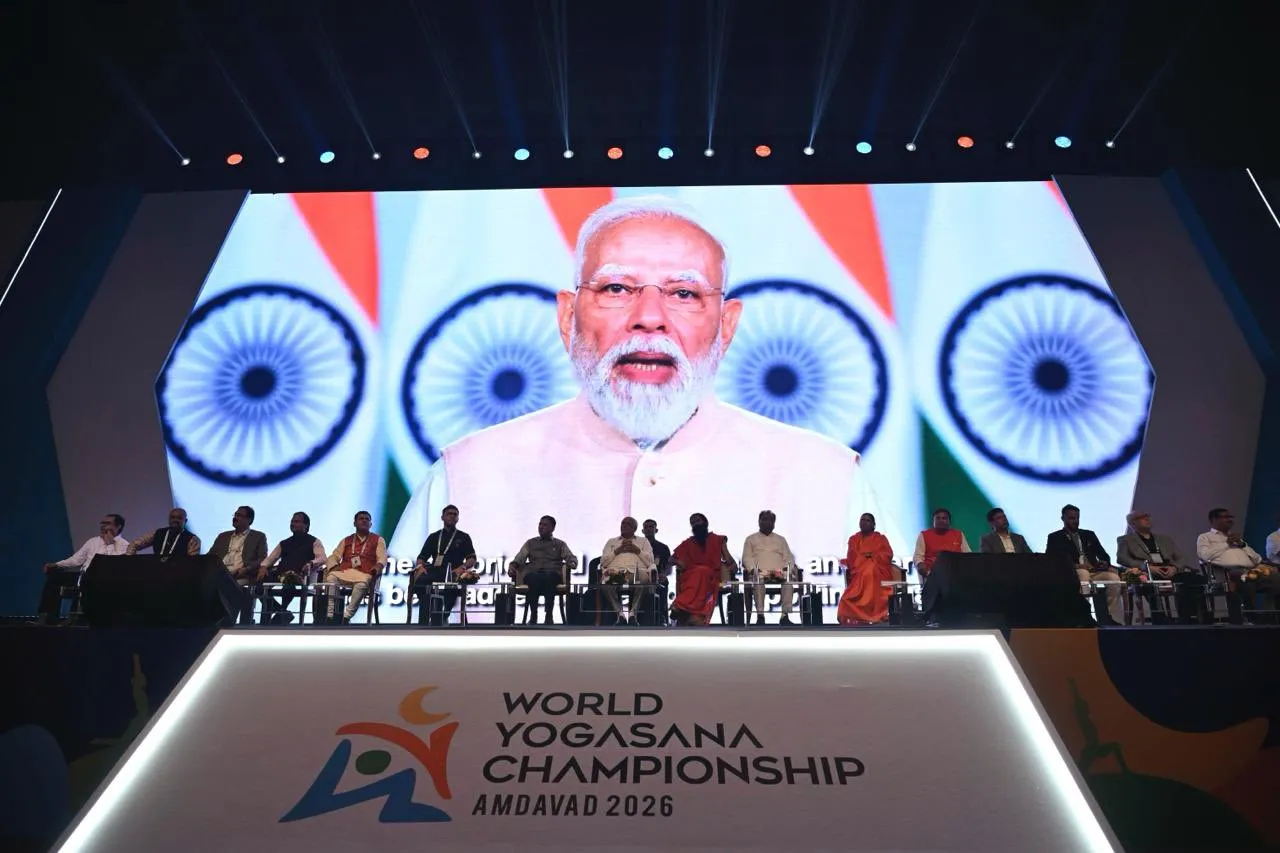
The inaugural World Yogasana Sports Championship commenced in Ahmedabad, Gujarat, drawing over 500 athletes from 78 nations. Virtually opened by Prime Minister Narendra Modi, the ground-breaking event utilizes advanced electronic scoring systems to transition the ancient Indian practice into a highly standardized, internationally recognized competitive sport targeting future Olympic inclusion.
AHMEDABAD, India — Prime Minister Narendra Modi virtually inaugurated the first-ever World Yogasana Sports Championship in Ahmedabad, Gujarat, on Thursday, declaring the international event open via video conferencing. Bringing together more than 500 elite athletes representing 78 countries, the five-day global competition marks a structural transition for the ancient discipline. The event establishes an institutional shift to transform an ancient physical and mental wellness art into a strictly regulated, globally recognized competitive sporting discipline.
The tournament, hosted at the EKA Arena TransStadia, serves as a cornerstone for India’s long-term athletic diplomacy strategy. By defining standardized rules, specialized age divisions, and a standardized point system, state organizers and global bodies are engineering a pathway intended to eventually secure the sport's inclusion within future Olympic Games and major multi-sport competitions.
Technical Regulation and Global Athlete Participation
Organized ahead of the annual International Day of Yoga on June 21, the championship establishes a formal athletic structure for an activity previously viewed primarily through the lens of individual health. Host nation India has fielded a highly trained 122-member contingent to compete alongside international delegations from diverse nations, including the United States, Malaysia, Ghana, Kenya, Uzbekistan, and Sri Lanka.
To eliminate subjectivity in judging and ensure international sports compliance, the tournament introduced a dedicated Electronic Scoring System for its global debut. A total of 32 international judges and 51 national judges are presiding over the mats.
Athletes compete across individual, artistic, and traditional group categories, with their routines strictly evaluated by the panel based on predefined difficulty matrices, stability, hold times, and transition fluidity.
Cultivating a Modern Sports Ecosystem
In his address to the participating delegates, Prime Minister Modi emphasized that migrating Yogasana into a professional competitive format will generate a sustainable, independent economic ecosystem. Similar to the commercial infrastructure surrounding established global sports, the expansion of competitive Yogasana is projected to create highly specialized career paths.
The growth of national and international tournament circuits will systematically drive demand for certified athletic trainers, specialized sports scientists, biomechanics researchers, professional judges, and international sports event managers.
"Every living tradition enters new phases with time. This World Championship marks the beginning of such a new phase... Yogasana will gain recognition as a competitive sport." — Prime Minister Narendra Modi
Official Sources Section
The operational protocols, participant statistics, and administrative directives outlined in this report are sourced directly from formal statements published by the Press Information Bureau (PIB) under the Ministry of Ayush, official tournament registries compiled by Yogasana Bharat, and executive event briefs from the Gujarat State Government Portal.
Quote Section
Underscoring the broader diplomatic and professional purpose behind the tournament, World Yogasana President Yogrishi Swami Ramdev stated:
"Today marks an important occasion as participants from across the world come together for the first World Yogasana Championship. Millions of young people are embracing Yogasana as a sport and as a path to personal growth."
Why It Matters
The formalization of Yogasana into an international sport has significant practical implications for global athletics, regulatory bodies, and local economies. Structuring the discipline under clear scoring criteria allows it to move past subjective interpretations, making it eligible for consideration in school games, continental championships, and the Olympic bid framework. For businesses, this opening signals an emerging global market for specialized sportswear, training equipment, and digital performance-tracking applications.
Key Facts at a Glance
Global Footprint: Over 500 athletes representing 78 countries participating in the inaugural event.
Olympic Strategy: Positioned as the foundational stepping stone toward permanent Olympic Games consideration.
Scoring Standard: Implemented an electronic scoring protocol to ensure absolute transparency and objective judging.
Global Outreach: Competitors designated as international ambassadors for India's "Yoga 365" wellness campaign.
FAQ Section
How is competitive Yogasana different from regular yoga practice?
While traditional yoga focuses on personal meditation, breath control, and overall wellness, competitive Yogasana treats physical postures as athletic routines. Competitors are explicitly scored by a panel of certified judges on measurable athletic criteria, including structural flexibility, core strength, balance, endurance, and technical precision.
What countries are participating in this inaugural championship?
The event features athletes from 78 nations. Notable international delegations present at the EKA Arena include competitors from the United States, Kenya, Malaysia, Ghana, Sri Lanka, and Uzbekistan, alongside a 122-member host contingent from India.
What are the age limits for the athletes in this competition?
The tournament features six distinct age categories designed to ensure fair competition. These divisions range from sub-junior brackets for children aged 10–14 up to senior master brackets accommodating experienced practitioners between the ages of 45 and 55.
Source: Press Information Bureau, Yogasana Bharat, World Yogasana Sports Federation