Prime Minister Narendra Modi visited L&T's Hazira complex in Gujarat to review advancements in indigenous defence manufacturing, including the air-transportable Zorawar light tank and the TEJASTRA laser system. The visit emphasizes India's strategy to engage private-sector engineering to build military hardware locally and improve national security.
HAZIRA, India — Prime Minister Narendra Modi visited Larsen & Toubro’s (L&T) advanced industrial complex in Hazira, Gujarat, on Friday to conduct a comprehensive assessment of India’s domestic heavy engineering and defence manufacturing capabilities. The high-profile tour of the facility focused on advanced armored platforms and next-generation warfare systems, highlighting the expanding role of private industry in advancing the national "Aatmanirbhar Bharat" (self-reliant India) policy framework.
During his visit to the sprawling A.M. Naik Heavy Engineering Complex within the Hazira facility, Prime Minister Modi was briefed by senior L&T corporate executives and military engineers on a pipeline of indigenously developed defence assets. The inspection centered on newly engineered combat vehicles designed to secure India’s frontier regions.
Strategic Inspection of Next-Generation Armoured Hardware
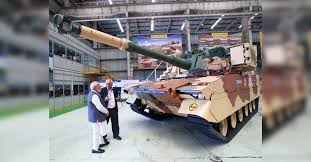
A key focus of the Prime Minister’s assessment was the "Zorawar" light tank, an innovative 25-tonne, air-transportable armored fighting vehicle. The platform was jointly developed by L&T Defence and the Combat Vehicles Research and Development Establishment (CVRDE), an arm of the state-run Defence Research and Development Organisation (DRDO).
Engineered for rapid deployment via military cargo aircraft, the Zorawar tank is specifically optimized for high-altitude operations, such as those along the Line of Actual Control (LAC).
Beyond armored vehicles, company officials presented breakthroughs in domestic propulsion and electronic warfare. The Prime Minister inspected a newly designed, indigenous 1,500-horsepower tank engine and transmission system alongside an unmanned 30 mm turret configuration intended for the Future Infantry Combat Vehicle (FICV) initiative.
L&T also demonstrated its TEJASTRA High Energy Laser System, a tactical directed-energy weapon optimized for low-altitude air defence and counter-drone operations.
Expanding Industrial Footprint and Regional Infrastructure
The review at the manufacturing facility occurred within a broader regional development program. Following the factory inspection, Prime Minister Modi initiated a series of industrial, energy, and infrastructure projects across Gujarat and Daman valued at approximately ₹22,000 crore.
Out of this infrastructure package, more than ₹18,000 crore is dedicated to expanding transport networks, power grids, and industrial zones near Surat. Key municipal projects launched during the broader itinerary include a 200-bed Employees' State Insurance Corporation (ESIC) hospital in Surat and a newly constructed terminal building at the NAMO Airport in Daman.
"Hazira gives a clear glimpse of Aatmanirbhar Bharat. It presents an integrated ecosystem of defence production, energy, steel, ports, and global trade." — Prime Minister Narendra Modi
Official Sources Section
The operational details, project statistics, and strategic parameters detailed in this report are verified through official updates issued by the Press Information Bureau (PIB) under the Prime Minister's Office, statutory industrial disclosures from Larsen & Toubro Ltd, and project profiles managed by the Defence Research and Development Organisation.
Quote Section
In an official statement published via his social channels following the tour, Prime Minister Modi noted:
"Witnessed some of their pioneering innovations across different sectors. The role played by L&T in furthering self-reliance in the defence sector is commendable."
Why It Matters
The Prime Minister's review highlights a structural shift in India's defence supply chain, transitioning away from long-term reliance on foreign state enterprises toward domestic private-sector manufacturing. For industrial investors and engineering companies, this underscores a steady pipeline of state-backed military contracts. For the broader public, achieving local supply security in heavy engineering reduces capital flight and ensures the armed forces have specialized gear tailored for high-altitude border security.
Key Facts at a Glance
Core Project Reviewed: The 25-tonne Zorawar light tank designed for high-altitude deployment.
Technology Milestone: Introduction of an indigenous 1,500-horsepower tank engine to replace foreign power plants.
Broader Economic Impact: The tour aligned with the launch of regional infrastructure projects worth ₹22,000 crore.
Next-Gen Capabilities: On-site presentation of the TEJASTRA directed-energy laser system for counter-drone operations.
FAQ Section
What makes the Zorawar tank unique compared to standard battle tanks?
The Zorawar light tank is heavily weight-optimized at 25 tonnes, making it light enough for rapid transport by military aircraft. Standard main battle tanks often exceed 50 tonnes, limiting their deployment speed in high-altitude mountain environments like the Himalayas.
What is the role of the private sector in these defence projects?
Under the current defense acquisition policy, private firms like L&T serve as design, development, and manufacturing partners alongside state agencies like the DRDO. This collaboration speeds up manufacturing times and introduces advanced commercial engineering methods to military hardware.
How do these developments impact the local economy in Gujarat?
The engineering cluster in Hazira forms a specialized industrial ecosystem. The growth of heavy military assembly plants drives high-tech jobs, supports a vast network of local component suppliers, and helps fund regional civic infrastructure like the new regional hospitals and transport hubs.
Source: Press Information Bureau, Larsen & Toubro Corporate Communications, Ministry of Defence