Internet Protocol Detail Records (IPDR) are revolutionizing cybercrime investigations in India by enabling police to track digital session metadata, trace online banking fraud, and identify cyber criminals. Supported by the Ministry of Home Affairs, IPDR equips law enforcement to solve complex internet-based scams beyond traditional call records.
NEW DELHI — Indian law enforcement agencies and specialized digital forensic units are increasingly deploying Internet Protocol Detail Records (IPDR) to track cyber criminals, dismantle transnational online fraud syndicates, and collect admissible court evidence. With cumulative digital financial fraud losses mounting in recent years and perpetrators turning to encrypted messaging applications and virtual private networks, the integration of IPDR cybercrime investigations in India marks a decisive shift in modern policing. Spearheaded by the Ministry of Home Affairs (MHA) through the Indian Cyber Crime Coordination Centre (I4C), police departments across various states are utilizing IPDR data provided by Internet Service Providers (ISPs) to tie anonymous digital actions directly to physical devices and subscriber identities.
From CDR to IPDR: Understanding the Technological Evolution
For decades, police officers relied heavily on Call Detail Records (CDR) to establish contact between suspects and geographical locations via cell tower logs. However, the rapid migration of criminal activity to Over-The-Top (OTT) platforms, Voice over IP (VoIP), and app-based interactions rendered traditional cellular voice records insufficient.
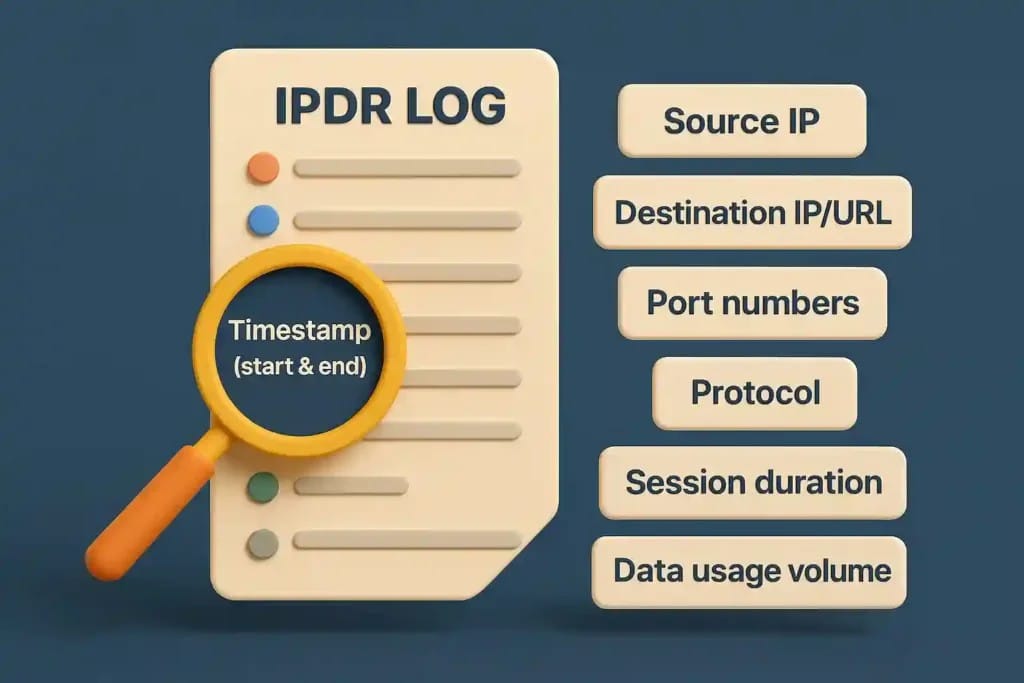
Where CDR records "who called whom," IPDR captures session-level metadata generated whenever a device connects to the internet. Telecom service providers generate IPDR logs automatically whenever a user accesses data services. These structured logs record essential parameters without intercepting message text or private content:
Source and Destination IP Addresses: Identifying the assigned subscriber IP and the target server or domain.
Timestamps: Millisecond-accurate start and end times of every internet session.
Port Numbers and Protocols: Pinpointing specific protocols (HTTP, HTTPS, TCP, UDP) and applications used.
Data Volume and Duration: Measuring uploaded and downloaded byte volumes per session.
By cross-referencing IPDR logs with Customer Application Forms (CAF) and cell tower data, investigators can establish complete digital timelines during complex IPDR cybercrime investigations in India.
Tackling Financial Scams and Transnational Syndicates
The deployment of IPDR analysis has proved especially vital in combatting "digital arrest" scams, illegal investment apps, and phishing portals. Official records indicate that organized cybercrime networks operating across Southeast Asia and domestic mule account hubs have siphoned thousands of crores of rupees from Indian citizens.
When a victim reports an unauthorized bank transfer or fraudulent login, bank servers record the incoming IP address and timestamp. Investigators submit lawful disclosure requests to ISPs to obtain matching IPDR logs for that specific IP at that exact second. This process allows police to uncover the source subscriber, trace unauthorized administrative access, and locate physical devices even when perpetrators alter SIM cards or operate across state borders.
"IPDR analysis provides law enforcement with an objective metadata layer. It allows teams to establish presence, verify online interactions, and reconstruct attack sequences without infringing on content privacy," noted cyber security specialists during training modules conducted by the National Cybercrime Training Centre.
Impact on Citizens, Businesses, and Law Enforcement
The scaling of IPDR cybercrime investigations in India delivers direct benefits across multiple sectors:
Citizens and Consumers: Speeds up account freeze actions and improves victim recovery rates by quickly identifying malicious servers and mule account handlers.
Businesses and Financial Institutions: Helps banks and fintech companies trace automated credential-stuffing attacks, unauthorized API calls, and payment gateway exploits.
Police and Judicial Systems: Strengthens digital evidence presented in courts under Section 65B of the Indian Evidence Act, ensuring higher conviction rates through verifiable metadata trails.
Official Sources Section
According to official statistics released by the Ministry of Home Affairs (MHA) and the Indian Cyber Crime Coordination Centre (I4C), automated threat analytics platforms and standardized capacity-building programs through the National Cybercrime Training Centre (CyTrain) have trained over 160,000 law enforcement personnel in advanced IPDR handling and digital forensics. Telecommunications operators provide these internet session records under strict compliance frameworks established by the Department of Telecommunications (DoT).
Quote Section
According to officials at the Cyber and Information Security (C&IS) Division, "The continuous modernization of technical tools, including centralized IPDR correlation and specialized capacity building for State Police units, remains central to establishing a secure digital ecosystem and curbing cross-border cyber fraud."
Why It Matters
As India’s digital economy expands rapidly through UPI transactions, cloud banking, and e-governance, cyber criminals continuously modify their operational tactics. By embedding structured IPDR analysis into daily police workflows, investigative agencies can bypass the limitations of VPNs, proxy routing, and app-based spoofing. This metadata-driven approach shortens case clearance times from months to days, creating a deterrent against organized cyber crime rings.
Key Facts at a Glance
Metadata Focus: IPDR records session timings, IP addresses, ports, and protocols without recording voice calls or private message content.
Operational Shift: Replaces legacy CDR analysis to track app-based scams, VoIP impersonation, and banking portal intrusions.
Legal Admissibility: Admissible as electronic evidence under Section 65B of the Indian Evidence Act when accompanied by valid ISP certificates.
National Training: Over 160,000 law enforcement officers have completed specialized digital forensic modules via I4C’s CyTrain portal.
Frequently Asked Questions (FAQ)
What is the difference between CDR and IPDR?
Call Detail Records (CDR) log voice calls, SMS, and cell tower locations. Internet Protocol Detail Records (IPDR) log internet data sessions, including assigned IP addresses, timestamps, protocols, and destination server connections.
Does IPDR capture private messages or browsing content?
No. IPDR captures metadata only (who connected where, when, and for how long). It does not record message text, chat content, or audio files.
How do police obtain IPDR logs during an investigation?
Law enforcement officers issue formal, authorized requests to Internet Service Providers (ISPs) or telecom operators under statutory provisions, obtaining certified session logs for specific IP addresses or subscriber accounts
Source: Official releases and technical frameworks published by the Ministry of Home Affairs, the Department of Telecommunications, and the Indian Cyber Crime Coordination Centre (I4C).