India’s defence exports reached a historic Rs 21,083 crore in FY24, fueled by demand for indigenous missile systems. The landmark sale of BrahMos to the Philippines and Akash to Armenia validates India's technical capability, boosts self-reliance, and strengthens foreign policy, reducing dependence on traditional arms suppliers.
NEW DELHI — India is experiencing an unprecedented surge in its defence exports, primarily driven by international demand for its advanced, home-grown missile systems like the BrahMos supersonic cruise missile and the Akash surface-to-air defense network. Data from the Ministry of Defence (MoD) indicates a historic high in export volume for the 2023-24 financial year, underscoring New Delhi's evolving strategic shift from a top global arms importer to a credible international supplier. This development is crucial as it validates the technical capabilities of the "Make in India" initiative and strengthens India's geopolitical influence across the Indo-Pacific and beyond, reducing critical over-reliance on traditional suppliers like Russia.
BrahMos Secures Landmark International Orders
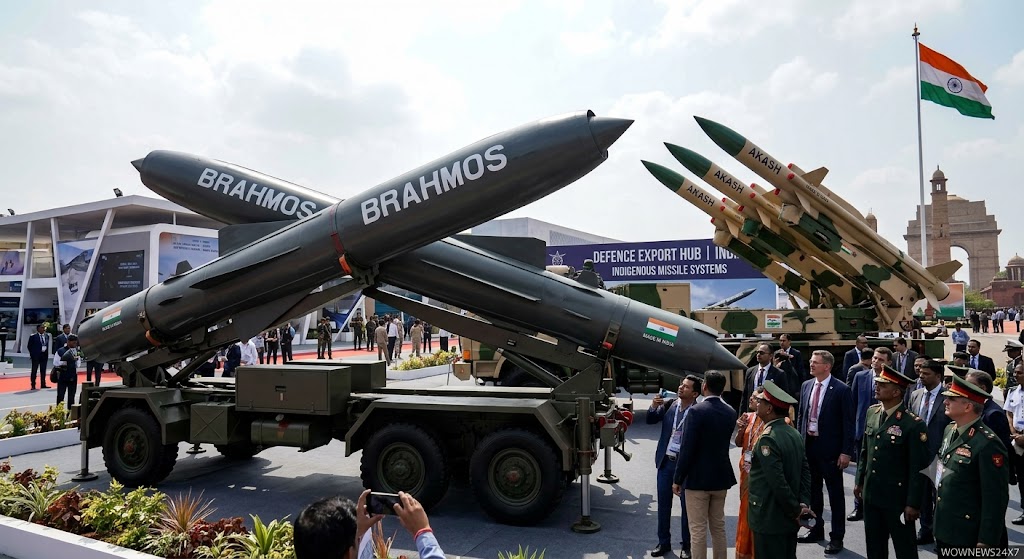
The cornerstone of India's recent export success is the BrahMos missile, a Joint Venture between India's Defence Research and Development Organisation (DRDO) and Russia's NPO Mashinostroyeniya. The system is renowned for its speed (Mach 2.8), precision, and devastating kinetic energy, making it one of the most formidable anti-ship and land-attack cruise missiles globally.
In a landmark transaction, the Philippines signed a $375 million deal in 2022 to acquire three batteries of the shore-based anti-ship variant of the BrahMos. Official statements confirm that deliveries are already underway. Furthermore, discussions are reportedly in advanced stages with other Southeast Asian and Middle Eastern nations, significantly broadening India's customer base for premium high-technology defense hardware.
Akash Missile System Attracts Regional Customers
Complementing the BrahMos' offensive success is the defensive capability of the Akash missile system. Developed by the DRDO, Akash is a short-range surface-to-air missile (SAM) system capable of simultaneously tracking and neutralizing multiple aerial threats, such as aircraft, helicopters, and drones, within a 25 km range. Its mobility, rapid response time, and all-weather operational capability make it highly suitable for regional air defense needs.
India officially confirmed the first export of the Akash system to Armenia. While specific figures remain undisclosed for security reasons, the deal is part of a larger, multifaceted defense agreement valued at over Rs 2,000 crore, significantly expanding India's footprint in the Caucasus region. The MoD stated that multiple countries are now evaluating the Akash system.
Broader Impact and Regulatory Shifts
The success of these indigenous weapons programs is transforming India’s domestic aerospace and defense industrial complex. It provides a reliable revenue stream for both public sector undertakings (PSUs) like BrahMos Aerospace, Bharat Dynamics Limited (BDL), and Bharat Electronics Limited (BEL), as well as a growing ecosystem of private companies involved in supply chains.
From an economic perspective, the surge in exports helps alleviate India's persistent trade deficit. In the 2023-24 financial year, India's defence exports reached Rs 21,083 crore (approximately $2.6 billion), registering a 32.5% growth over the previous year. This indicates a sustained upward trajectory, with current exports being nearly 31 times higher than they were a decade ago.
Path Forward and Policy Framework
Analysts attribute this unprecedented growth to a combinations of factors:
"Make in India" Initiative: Strong policy support emphasizing indigenous design, development, and manufacturing.
Positive Indigenisation Lists: Strategic MoD directives banning imports of hundreds of subsystems over a phased timeline to mandate local procurement.
Streamlined Export Protocols: Reforms reducing bureaucratic hurdles and offering line of credit (LOC) facilities to friendly nations for defence purchases.
Proactive Defence Diplomacy: The government actively promotes Indian-made defense equipment through high-level bilateral and multilateral engagements.
Geopolitically, these exports serve as a vital tool for India to deepen strategic partnerships with friendly nations, especially in the Indo-Pacific, offering them a reliable and technically advanced alternative to dependence on traditional major arms exporters.
Official Sources Section
According to official data and announcements from:
The Ministry of Defence (MoD), Government of India.
The Defence Research and Development Organisation (DRDO).
Corporate communications from BrahMos Aerospace, Bharat Dynamics Limited (BDL), and Bharat Electronics Limited (BEL).
Bilateral agreements announced by the Governments of India, the Philippines, and Armenia.
Quote Section
"India has achieved a historical high in defence exports. Our goal is not just self-reliance, but to become a global leader in designing, developing, and manufacturing advanced defence technology," stated Prime Minister Narendra Modi during a recent dynamic address in Bengaluru.
Why It Matters
This surge in defense exports signifies India's technical capability to build world-class, sophisticated missile systems like BrahMos and Akash. This development matters now because it validates India's "Make in India" policy, generates high-skilled manufacturing jobs, enhances economic self-reliance, and provides New Delhi with a significant new tool for foreign policy, thereby reducing dependence on major power suppliers like Russia.
Key Facts at a Glance
Export Value: Reached Rs 21,083 crore ($2.6 billion) in FY 2023-24, a 32.5% increase.
Major Missiles: BrahMos (supersonic cruise missile) and Akash (surface-to-air missile) are the primary drivers.
Key Customers: Philippines (BrahMos) and Armenia (Akash).
Policy Drivers: Make in India, Positive Indigenisation Lists, and dynamic defense diplomacy.
FAQ Section
Q1: Which are the major Indian-made missile systems being exported?
The BrahMos supersonic cruise missile and the Akash surface-to-air defense system are the two major indigenous systems driving current export growth.
Q2: Which countries have signed deals for India's missile systems?
The Philippines has acquired the shore-based BrahMos, and Armenia is the first customer for the Akash system.
Q3: How much have India's defence exports grown?
In the 2023-24 financial year, exports hit a historic high of Rs 21,083 crore, a growth of 32.5% from the previous year.
Q4: Is India still a major arms importer?
Yes, India remains one of the world's top importers of key advanced systems, but the rapid growth in indigenous development and exports shows a clear long-term shift toward reducing that dependency.
Source: Ministry of Defence (MoD) Reports, DRDO Releases, BrahMos Aerospace, BDL Communications, and Press Trust of India.