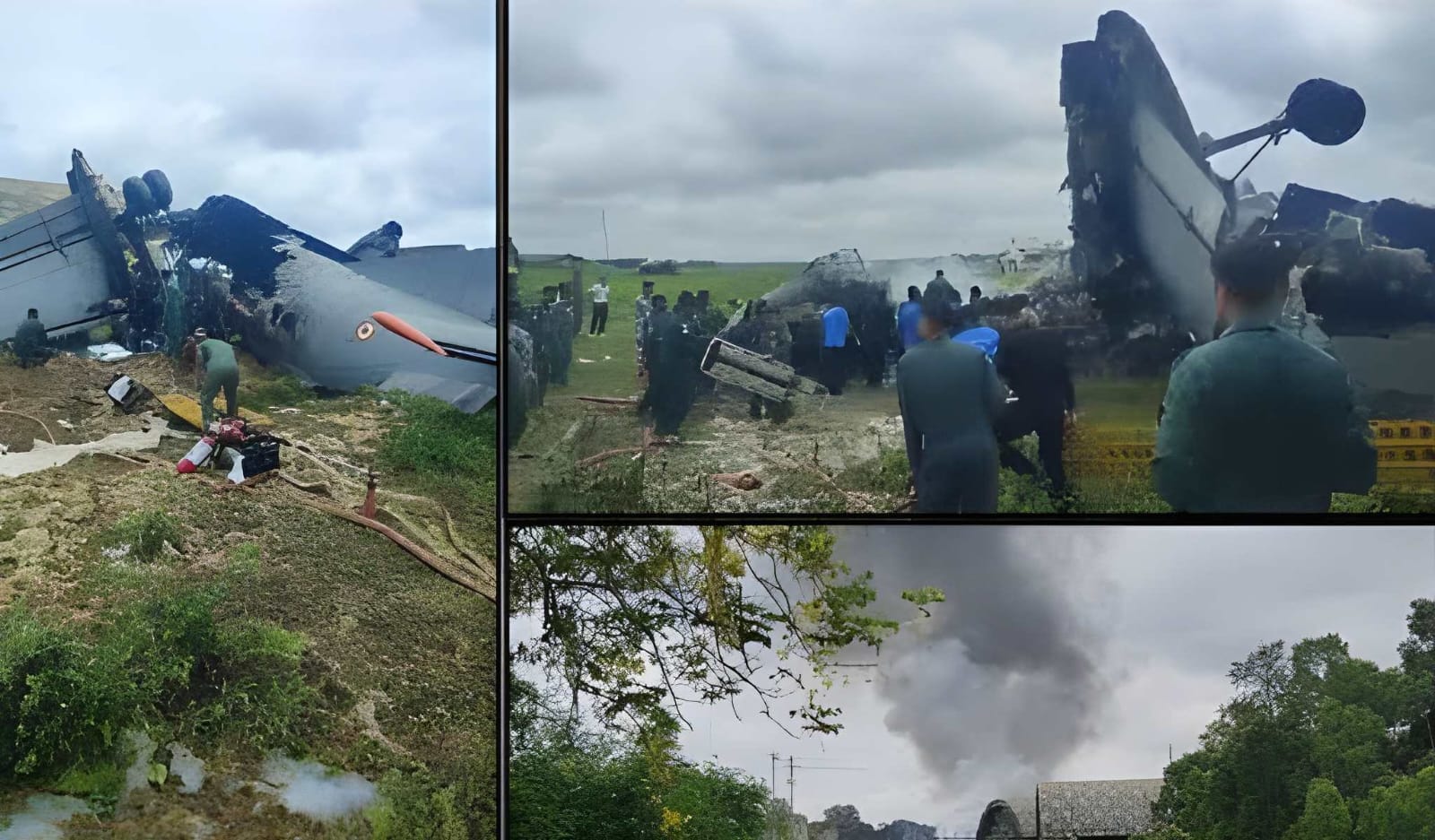
An Indian Air Force AN-32 transport aircraft crashed and caught fire during a landing attempt at the Jorhat Air Force Station in Assam on Saturday morning. The tactical transport workhorse sustained major damage, prompting immediate emergency response operations and the launch of a formal military court of inquiry.
JORHAT, INDIA — An Indian Air Force (IAF) Antonov AN-32 tactical transport aircraft crashed and caught fire on Saturday morning, June 13, 2026, while attempting to land at the Air Force Station in Jorhat, Assam. The incident triggered an immediate high-priority emergency response operation within the secure military perimeter as specialized firefighting tenders rushed to suppress a blaze that erupted upon impact.
According to preliminary updates from defense authorities, the twin-engine turboprop aircraft went down inside the premises of the airbase, located in the Rowriah area of Jorhat district, during its final landing phase. Thick plumes of dark smoke were observed rising from the airfield layout shortly after the crash. Senior IAF operational commanders and crash investigation units have rushed to the site to secure the wreckage and coordinate recovery efforts.
Technical Emergency Forces Immediate Court of Inquiry
In the immediate aftermath of the accident, the Indian Air Force confirmed the structural mishap via an official statement released on its social channels. Operational command structures have initiated a statutory military probe to isolate the exact combination of technical failures or environmental factors that caused the aircraft to catch fire during landing.
"An IAF An-32 aircraft met with an accident today while landing at Jorhat. A court of inquiry is being constituted, to ascertain the cause of the accident," the statement issued by the Indian Air Force read.
Military investigators are scheduled to evaluate multiple data points, including runway surface data, structural fatigue registers, and automated air traffic control communications. The inquiry will specifically examine whether the onboard fire was caused by a mechanical failure in the landing gear mechanism or an engine systems malfunction during deceleration.
Strategic Impact on Northeastern Military Logistics
The accident has temporary operational implications for forward-deployed military assets and logistics tracking throughout India’s northeastern frontiers. The Air Force Station in Jorhat serves as a critical transport terminal and supply hub for distant garrisons deployed along the Line of Actual Control (LAC) and mountainous regions across Arunachal Pradesh.
The Antonov AN-32 functions as the tactical workhorse of the IAF transport fleet, with roughly 100 units currently maintained in active service. Engineered by the Soviet Union specifically to meet Indian requirements for a high-altitude, hot-climate military transport, the platform handles complex roles, including:
Frontline Troop Movement: Capable of ferrying nearly 50 fully equipped combat troops or 42 specialized paratroopers.
Heavy Cargo Delivery: Built to air-drop or land up to 7.5 tonnes of supplies onto unimproved short-takeoff-and-landing (STOL) mountain airfields.
Air Medical Evacuation: Configured to rapidly evacuate wounded personnel from remote sectors during regional emergencies.
Heightened Alert Levels and Regional Flight Clearances
Local aviation security authorities in Assam placed regional search-and-rescue teams on standby immediately following the accident. While civilian operations at adjoining domestic transport facilities remained unaffected, internal military flight movements at the Rowriah airfield were briefly halted to allow fire crews to foam the runway and safely clear hazardous debris.
The accident occurs only three months after a separate fatal military aviation accident in the region. In March 2026, an IAF Sukhoi Su-30MKI twin-seat fighter jet crashed in the remote Karbi Anglong district after taking off from the exact same Jorhat Air Force Station, resulting in the loss of both onboard pilots. Consequently, defense analysts indicate that the current inquiry will face intense institutional pressure to evaluate structural maintenance standards at the local airbase.
Official Sources Section
The tactical operational updates, asset designations, and safety directives detailed in this news dispatch are verified directly via official defense bulletins issued by the media wing of the Ministry of Defence and published logs distributed on the official corporate media feeds of the Indian Air Force.
Quote Section
At the time of publication, defense officials were working to secure the site and determine the health status of the flight crew, with initial local alerts signaling that rescue operators were managing a severe impact site.
"According to officials, emergency teams and specialized base firefighting units were on the scene within seconds to contain the fire. A formal assessment of the flight platform and its manifest is underway, and a specialized military board will investigate the exact operational circumstances leading up to this airfield accident."
Why It Matters
For citizens and strategic analysts, any operational disruption involving the AN-32 fleet directly affects the logistical stability of remote border communities and forward military lines that rely entirely on air-dropped food, medicine, and equipment. For the families of service personnel and local defense investors, this accident highlights the ongoing technical challenges of maintaining legacy aircraft fleets in difficult tropical and high-altitude flight corridors.
Key Facts at a Glance
Location of Mishap: The accident occurred directly on the runway grid within the Air Force Station at Jorhat (Rowriah), Assam.
Aircraft Variant: The involved platform is an Antonov AN-32, a twin-engine tactical military transport workhorse.
Immediate Consequence: The transport aircraft sustained a severe post-landing impact fire, prompting an extensive emergency response.
Investigative Action: The IAF has formally convened a military Court of Inquiry to pinpoint mechanical or human variables.
Regional Context: The base previously hosted a Sukhoi Su-30MKI fighter jet that crashed in the nearby Karbi Anglong district in March.
Frequently Asked Questions
What is the primary role of the AN-32 aircraft inside the Indian Air Force?
The Antonov AN-32 serves as the primary tactical transport workhorse for the IAF. It is used to move troops, deliver heavy equipment, run medical evacuations, and drop supplies to forward-deployed military positions in mountainous terrains.
Has the airbase closed down civilian commercial traffic because of the crash?
No. While emergency teams focused on extinguishing the burning military airframe inside the secure Air Force Station premises, broader commercial aviation networks across the region remained functional under normal parameters.
How old is the AN-32 fleet, and are these planes scheduled to be replaced?
The IAF has operated the Soviet-designed AN-32 since the 1980s. While many units have undergone extensive mid-life upgrades to modern avionics standards, the fleet is scheduled to be gradually replaced over the coming decade by newer European Airbus C-295 tactical transport aircraft.
Source: Official incident press logs issued by the Indian Air Force Media Cell, aerospace maintenance reports from the Ministry of Defence, and regional emergency services dispatch records from the Government of Assam.