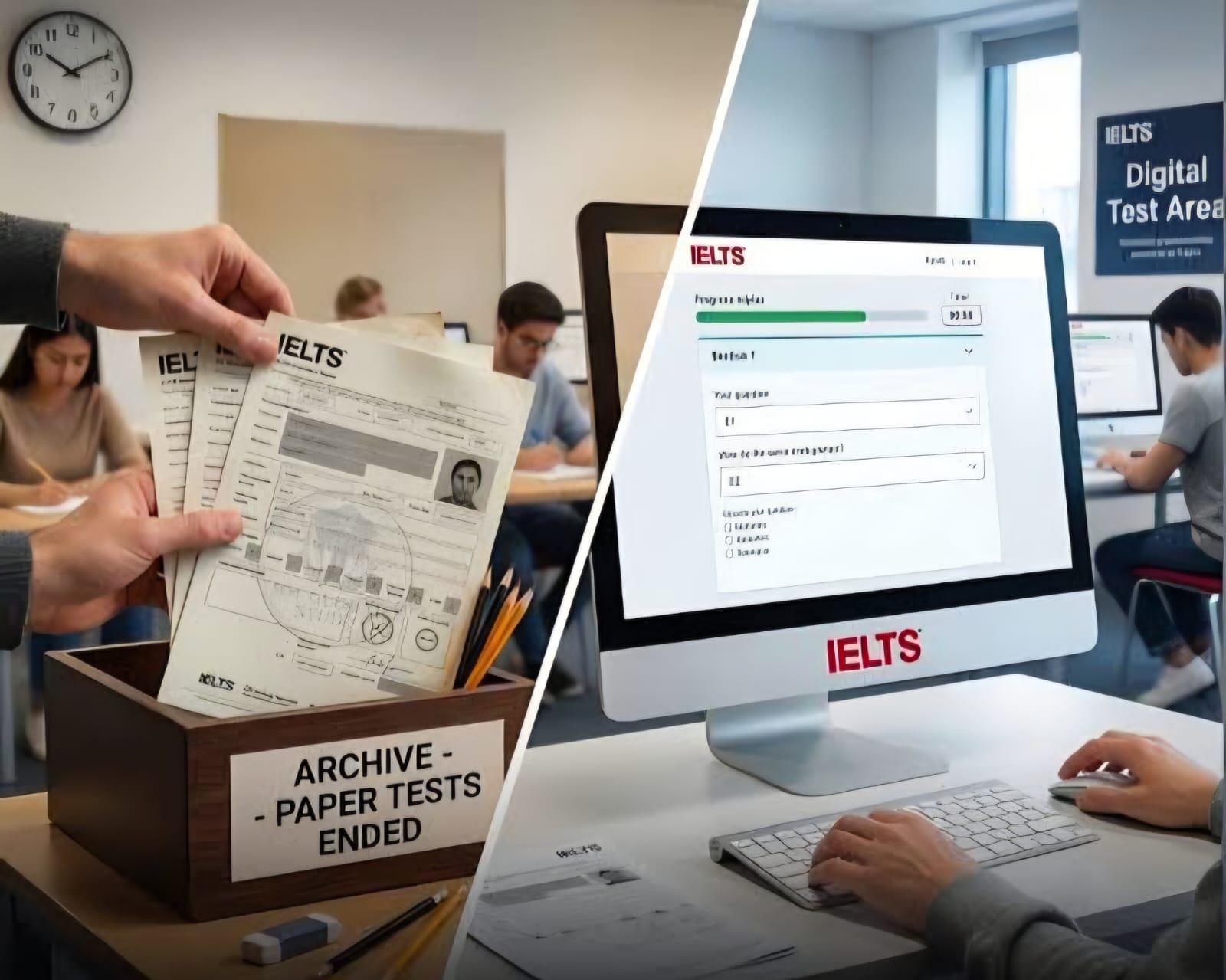
IDP Education has announced that the IELTS exam in India will transition fully to a computer-based format starting September 2026. The final paper-based exams will conclude on August 22, 2026. The transition offers faster 1–2 day result turnarounds while keeping the core exam scoring and difficulty identical.
NEW DELHI, India — The International English Language Testing System (IELTS) will transition completely to a computer-based format across India starting September 2026, marking the end of the traditional pen-and-paper testing era. Announced by co-owner IDP Education on July 16, 2026, this structural policy shift is designed to modernize the testing pipeline by providing faster results, greater scheduling flexibility, and enhanced digital interface tools for candidates. The decision is poised to reshape preparation strategies for hundreds of thousands of Indian students, professionals, and migrants aiming to move abroad.
The End of Paper-Based English Assessment
According to the official declaration by IDP Education, the traditional IELTS on Paper format will be phased out entirely by the end of August 2026. Aspirants who prefer writing by hand have exactly three final opportunities remaining to attempt the traditional paper test, with exams scheduled nationwide on July 25, August 6, and August 22, 2026. Following the conclusion of the August 22 session, test centers across India will no longer accept registrations for the paper-delivered format, standardizing the digital delivery of the assessment.
Despite the shift in the medium of administration, officials confirmed that the fundamental core of the assessment remains unchanged. The exam pattern, total test duration (approximately 2 hours and 45 minutes), question types, difficulty levels, and the rigorous nine-band scoring system will remain identical to the legacy format.
Two Computer-Based Formats Introduced for Test Takers
To help smooth the transition for candidates with varying levels of digital literacy, IDP Education will offer two distinct testing models starting in September 2026:
Standard IELTS on Computer: Candidates will complete the Listening, Reading, and Writing sections using a terminal at an authorized center, typing out their responses directly.
IELTS on Computer (Writing on Paper): This hybrid model serves as a transitional bridge. Test takers will complete the Listening and Reading segments digitally but will handwrite their long-form essays and answers for the Writing section on a physical answer sheet.
Crucially, under both options, the Speaking test avoids complete automation. It will continue to be conducted face-to-face with a certified human examiner, either in-person or via a secure, proctored live video call within the center.
Technical Features and Impact on Global Mobility
The implementation of digital testing introduces several quality-of-life upgrades to the testing environment. The computerized interface incorporates on-screen countdown timers, simplified text navigation, and digital editing capabilities that allow candidates to cut, copy, and paste text during the Writing module. Additionally, the Listening module will feature personal, high-fidelity headphones for all candidates to optimize individual audio clarity, replacing ambient room speakers.
For global mobility aspirants, the most profound impact lies in evaluation timelines. Traditional paper tests required a processing window of up to 13 days. In contrast, the computer-delivered format accelerates score turnarounds significantly, allowing card releases to take just one to two days. This rapid turn-around helps applicants rushing to meet tight university intake deadlines or fast-tracked visa windows.
Official Sources Section
The direct directives outlining the timeline, final paper-testing dates, and software capabilities were released publicly through official press communiqués and web portals managed by IDP IELTS India. These operational adjustments apply universally to both the IELTS Academic and IELTS General Training modules conducted within the territory of India.
Quote Section
Regarding the shift in the examination paradigm, officials from IDP Education stated:
"The transition to a fully computer-based testing format in India aims to provide candidates with greater flexibility, faster results, and a more convenient testing experience. The change will not affect the exam pattern, question types, difficulty level, or scoring criteria, ensuring that the test's integrity and global recognition remain uncompromised."
Why It Matters
This policy updates India's evaluation methods to match international standards. Major global standardized tests like the GRE, GMAT, and TOEFL have long relied heavily on digital testing models. By removing the logistically complex process of shipping, sorting, and grading physical paper booklets, the testing body reduces administrative delays and mitigates security risks associated with physical paper transit. For prospective international students and professionals, typing proficiency and digital interface familiarity will now become foundational elements of test preparation alongside English language skills.
Key Facts at a Glance
Effective Digital Transition Date: September 2026.
Final Dates for Paper Testing: July 25, August 6, and August 22, 2026.
Core Structure Continuity: Test duration, band scoring, and question difficulty remain unchanged.
Speaking Test Status: Stays face-to-face with a certified human examiner.
Result Turnaround: Drops from roughly 13 days down to just 1–2 days post-exam.
FAQ Section
What are the final dates to take the paper-based IELTS in India?
Candidates who prefer the paper-based layout can register for the remaining final dates: July 25, August 6, or August 22, 2026. No paper exams will be administered after August 22.
Will the computer-based format change the scoring or syllabus?
No. The exam pattern, total test duration, band scores, evaluation metrics, and difficulty levels will remain exactly the same as the paper version.
Can I still write the essay section by hand if I take the digital test?
Yes. IDP Education is introducing a hybrid option titled "IELTS on Computer (Writing on Paper)," where the Listening and Reading sections occur on screen, but the Writing section is completed by hand on an answer sheet.
How long does it take to receive results for the computer-based test?
Computer-based test results are typically delivered much faster, taking only 1 to 2 days to process compared to the 13 days required for paper exams.
Sources: IDP Education Corporate Announcements, IDP IELTS India Official Portal