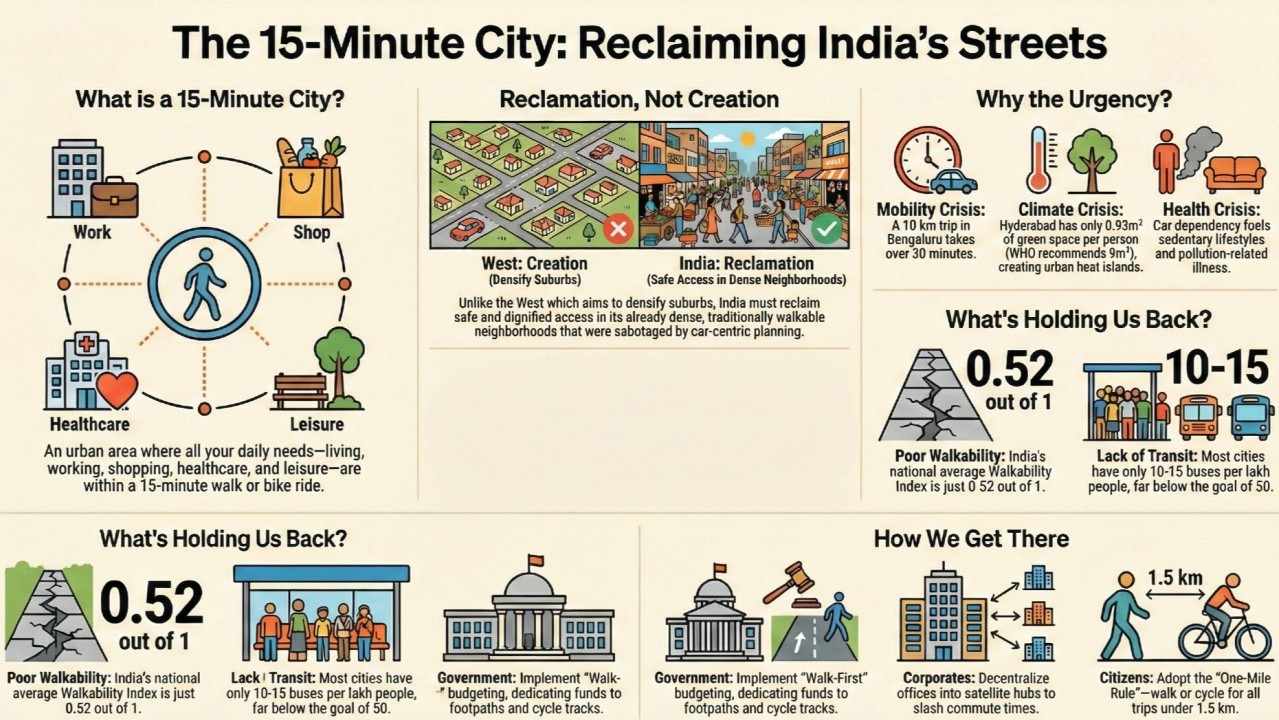
India is implementing "15-minute city" strategies to integrate workplaces, schools, and essential services within pedestrian-friendly radii. Backed by NITI Aayog reforms and 2026 BRICS resolutions, the initiative aims to boost economic productivity, reduce carbon emissions, and enhance urban liveability by transforming sprawling metros into self-sustained, polycentric neighborhoods.
NEW DELHI — India is overhauling its urban development roadmap to prioritize "15-minute cities," a planning model designed to place essential services offices, schools, and malls within a short walk or cycle from residential hubs. Amid rising climate stresses and record urban migration, the Ministry of Housing and Urban Affairs (MoHUA) and NITI Aayog have signaled a shift toward "chrono-urbanism," aiming to reduce the massive social and economic costs of long-distance commuting. Unlike the automobile-centric sprawl of previous decades, the new framework targets hyper-local accessibility to transform India’s million-plus cities into resilient, self-contained economic engines.
From Megacities to Polycentric Hubs
The 15-minute city concept, popularized globally by Professor Carlos Moreno, is being adapted to the Indian context to address "unplanned urban sprawl." The strategy moves away from centralized business districts in favor of a polycentric model a city with multiple local centers.
As part of the Viksit Bharat 2047 vision, government planners are focusing on mixed-use land development. This approach legalizes and encourages the stacking of residential units above commercial spaces and corporate offices, ensuring that a professional’s workplace, a child’s school, and a family’s recreational mall are located within the same geographical radius.
Key structural components of the transition include:
Active Mobility Networks: Prioritizing wide pavements and dedicated cycling tracks over expanded highway lanes.
Public-Private Integration: Offering incentives to developers who incorporate affordable housing within high-end commercial and tech-park zones.
Nature-Based Solutions: Integrating green infrastructure to mitigate the "urban heat island" effect, making walking viable during India’s peak summer months.
Institutional Reforms and Global Cooperation
The push for proximity-based living is being supported by significant governance reforms. In April 2026, NITI Aayog released a framework for million-plus cities, recommending empowered city governments with directly elected mayors to streamline localized planning.
Internationally, New Delhi has leveraged its 2026 BRICS chairship to champion "people-centric urban development." During the 13th BRICS Urbanisation Forum held in June 2026, member nations adopted a declaration to advance inclusive and liveable cities. Union Minister Manohar Lal Khattar emphasized that the future of Indian urbanization hinges on "proactive planning and long-term adaptability," ensuring that even marginalized groups gain equitable access to high-quality urban services within their immediate neighborhoods.
Official Sources Section
According to official releases from the National Institute of Urban Affairs (NIUA) and regulatory filings by NITI Aayog, the government has launched the "National Urban Learning Platform" to build technical capacity for this transition. Official sources confirm that future funding for Smart City projects will be increasingly tied to proximity metrics—specifically how many essential services are reachable without a motorized vehicle.
Quote Section
According to officials at the Ministry of Housing and Urban Affairs:
"The 15-minute city is not just an environmental goal; it is a productivity mandate. By reducing the time citizens spend in traffic, we unlock billions of hours for economic activity and family life. Our goal is to make 'proximity' the primary amenity in the Indian real estate market."
Dr. P. K. Mishra, Principal Secretary to the Prime Minister, stated during the NIUA Golden Jubilee:
"As our cities face growing climate-related stresses, future urban development must focus on proactive planning and sustainable systems. We are planning not just for growth, but for resilience and long-term adaptability."
Why It Matters
For the average Indian citizen, the 15-minute city promises a dramatic improvement in quality of life by reclaiming time lost to congestion. For investors and businesses, it signals a shift in real estate value toward "complete neighborhoods," where commercial viability is tied to residential density. Practically, this model reduces the carbon footprint of urban living and lowers the personal transportation costs for consumers, while simultaneously creating "micro-economies" that support local small businesses and informal service providers.
Key Facts at a Glance
Core Goal: Ensuring residents can reach work, healthcare, and education within a 15-minute walk or bike ride.
Economic Impact: Supports India's transition toward a $30 trillion economy by 2047 through improved urban productivity.
Climate Resilience: Employs nature-based solutions and green infrastructure to counter rising urban temperatures.
Governance Reform: Moves toward empowered city governments and directly elected mayors to manage local zones.
Global Alignment: Reaffirmed through the 2026 BRICS Ministerial declaration on people-centered urban development.
FAQ Section
Q: Does the 15-minute city model restrict where people can travel?
A: No. The model focuses on access rather than restriction. It aims to provide the option to meet all daily needs locally, while public transport networks continue to provide connectivity for longer citywide trips.
Q: How will this affect existing, densely populated Indian neighborhoods?
A: Many older Indian neighborhoods already have high density. The focus here is on improving the quality and formalization of services such as better sidewalks, safer parks, and organized commercial zones rather than rebuilding from scratch.
Q: What are the main challenges to implementing this in India?
A: The primary hurdles include "unplanned urban sprawl," high land costs in established areas, and the need to upgrade aging infrastructure to support increased pedestrian and cycling traffic.
Source: Ministry of Housing and Urban Affairs (MoHUA), NITI Aayog Reports on Urban Governance, National Institute of Urban Affairs (NIUA), BRICS 13th Urbanisation Forum Declaration.