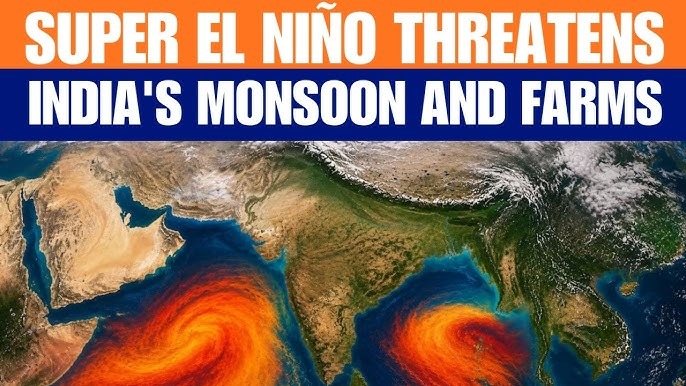
The formal arrival of a potent El Niño has triggered fears of a severe agricultural shock in India, with monsoon projections dropped to 90% of historical averages. In response, the Centre has placed 197 vulnerable districts under emergency watch, mandating crop diversification and updated irrigation plans to cushion rural economies against drought risks.
NEW DELHI — India’s agricultural sector has been placed on high alert following official declarations that an El Niño event is formally underway in the tropical Pacific Ocean. The India Meteorological Department (IMD) alongside the World Meteorological Organization (WMO) confirmed that the warming phase of the El Niño-Southern Oscillation (ENSO) has commenced and is projected to intensify into a rare "Super El Niño" by late 2026.
With data indicating a 63% probability of sea-surface temperatures exceeding the critical 2°C anomaly threshold, weather trackers have significantly downgraded monsoon expectations. The development has sent shockwaves through rural communities, forcing the Union Government into emergency intervention mode to mitigate cascading risks to national food security, rural inflation, and economic growth.
Weakest Monsoon Forecast in 26 Years Clashes with Sowing Timelines
The structural timing of this climate phenomenon is uniquely damaging for Indian agronomy. The southwest monsoon provides over 70% of India's annual precipitation, driving the production of critical Kharif (summer-sown) crops such as rice, pulses, oilseeds, cotton, and soybean.
The IMD’s revised models project cumulative rainfall to drop to just 90% of the Long Period Average (LPA). This update presents a 35% probability of a completely "deficient" monsoon season—more than double the historical baseline probability of 16%.
The core monsoon zone—encompassing the massive rainfed agricultural heartlands of Central India, Vidarbha, Marathwada, Rajasthan, and Jharkhand—is expected to bear the brunt of the deficit, with precipitation levels dropping below 94% of the LPA. Because approximately 60% of Indian farmers depend entirely on timely rain for their crop cycles, a weak and delayed onset severely limits initial germination success.
Crisis Management and District Contingency Overhauls
In immediate response to the impending agricultural shock, the Union Agriculture Ministry has entered a proactive crisis posture. Agriculture Minister Shivraj Singh Chouhan announced that the Centre has explicitly identified 197 highly vulnerable districts across the country to prioritize for structural defensive planning.
State governments have been directed to execute an accelerated overhaul of decade-old district agricultural contingency plans. These updated guidelines mandate localized, stage-wise interventions based on real-time groundwater access, soil profiles, and regional irrigation levels.
A compounding risk factor is the current state of national water infrastructure. Reports indicate that storage levels in India's 166 monitored reservoirs have seen rapid early depletions, plunging to roughly 34.45% of total structural capacity. To counter this deficit, agrometeorological advisory boards are aggressively urging rural communities to abandon water-heavy cash crops like sugarcane and paddy in favor of drought-resilient millets, short-duration pulses, and oilseeds.
Official Sources Section
According to official climate updates released by the World Meteorological Organization (WMO) and the United States National Oceanic and Atmospheric Administration (NOAA), the ocean-atmosphere coupling is structurally locked into a moderate-to-strong transition phase that will persist through winter.
Domestically, the Ministry of Agriculture and Farmers Welfare has coordinated with the Indian Council of Agricultural Research (ICAR) to deploy emergency seed banks. These facilities provide localized distributions of short-cycle crop varieties to counter severe localized dry spells.
Quote Section
Commenting on the global and regional scales of the climate threat, WMO Secretary-General Celeste Saulo stated:
"We need to prepare for a potentially strong El Niño event – which will exacerbate drought and heavy rainfall and increase the risk of heatwaves both on land and in the ocean. The planet is warmer today, and impacts will hit harder, travel even farther, and cross borders with devastating speed."
Prominent agricultural economist Dr. Ashok Gulati, former chairman of the Commission on Agricultural Costs and Prices, raised serious warnings over the macroeconomic indicators:
"The agri-GDP growth is likely to be almost zero or even negative depending upon the spatial and temporal spread of rains. Given that IMD has forecast a strong El Niño... it is going to be a pretty bad year for agriculture, and of course, farmers that derive much of their income from it. I would expect food inflation to rise and so would overall CPI inflation."
Why It Matters
The convergence of an El Niño shock with a weak monsoon distribution alters the daily economic realities for millions of Indian citizens. For urban consumers, a contraction in the harvests of core food items like pulses, oilseeds, and fresh vegetables drives up food inflation, potentially pushing consumer price index numbers well above the 5% threshold.
For corporate investors and consumer goods companies, a drop in overall farm incomes severely impacts rural purchasing power, directly affecting the sales of fast-moving consumer goods (FMCG), tractors, and automobiles. Furthermore, decreased river and reservoir inflows place heavy operational pressure on hydroelectric power generation grids just as rural pumping networks surge demand to keep parched fields alive.
Key Facts at a Glance
Super El Niño Onset: NOAA and IMD have officially declared the start of El Niño conditions, with a 63% chance of ocean warming developing into a severe "super" event.
Historical Weak Forecast: The 2026 southwest monsoon is projected at a low 90% of its Long Period Average, making it one of the weakest opening forecasts in 26 years.
Targeted Interventions: The central government has flagged 197 high-risk districts for specialized crop-shifting and irrigation assistance.
Reservoir Realities: Water levels across 166 major domestic reservoirs have depleted down to roughly 34.45% of total retention capacity.
Macroeconomic Pressure: Analysts warn that localized crop failures could trigger zero agricultural GDP growth and drive food inflation up by late autumn.
FAQ Section
Q: What exactly is an El Niño and why does it affect India's farming?
A: El Niño involves an abnormal warming of sea surface waters in the central and eastern Pacific Ocean. This shift disrupts global atmospheric winds, weakening the trade winds that pull rain clouds across the Indian ocean, thereby causing delayed monsoons and long dry spells across India.
Q: Are certain crops more vulnerable to this weather shock than others?
A: Yes. Water-intensive crops like paddy, sugarcane, and rainfed pulses (such as tur and urad) face high structural risks. Oilseeds and cotton planted across central rainfed districts are also heavily exposed to prolonged moisture stress.
Q: What steps can a farmer take to protect their livelihood this season?
A: Agricultural bureaus recommend shifting away from water-heavy staples to short-duration pulses, maize, or millets. Farmers are also advised to utilize micro-irrigation tools, monitor local Gramin Krishi Mausam Sewa weather advisories, and delay sowing until the soil displays sufficient base moisture.
Source: India Meteorological Department Monsoon Portal, World Meteorological Organization (WMO) Media Centre, Ministry of Agriculture & Farmers Welfare Notifications.