Prime Minister Narendra Modi and French President Emmanuel Macron launched the Bharat Innovates 2026 conclave in Nice, France. The event showcases 120 Indian deep tech startups and 15 premier higher education institutions to over 500 global investors, aiming to drive cross-border venture funding and research commercialization across 13 frontier sectors.
NICE — Prime Minister Narendra Modi and French President Emmanuel Macron jointly inaugurated the maiden edition of the Bharat Innovates 2026 conclave in Nice today. The high-stakes event transitions India’s standard technology narrative from localized software services to high-value global deep tech commercialization.
Organized under the aegis of the Union Ministry of Education, the summit serves as a dedicated cross-border bridge linking academic intellectual property directly with institutional growth capital. The three-day convention establishes a programmatic framework to accelerate pilot validation, technology exchange, and cross-border expansion routes across Europe.
Expanding the Academic-to-Market Pipeline
The structural architecture of Bharat Innovates 2026 marks a systemic departure from conventional corporate trade shows by utilizing premier domestic universities as incubation engines. Anchored by IIT Bombay as the central nodal institution, the platform presents vetted, IP-backed research ventures directly to international syndicates.
A Technical Oversight Committee, led by the Principal Scientific Advisor to the Government of India, Shri Ajay Kumar Sood, curated a delegation of 120 Indian startups. These ventures are paired alongside 15 premier Higher Education Institutions (HEIs), including multiple Indian Institutes of Technology (IITs) and the Indian Institute of Science (IISc).
The technical portfolio spans 13 critical frontier industrial domains:
By presenting pre-vetted, university-backed corporate structures, the initiative positions India’s higher education system as an institutional partner capable of delivering high-impact solutions optimized for resource-constrained environments.
Convergence of Sovereign Policy and Venture Capital
The convention is structured as a conversion-focused platform rather than a purely diplomatic assembly. Over 500 accredited international investors, venture capital syndicates, global CEOs, and European corporate innovation officers have convened at the Palais des Expositions de Nice to evaluate the delegation.
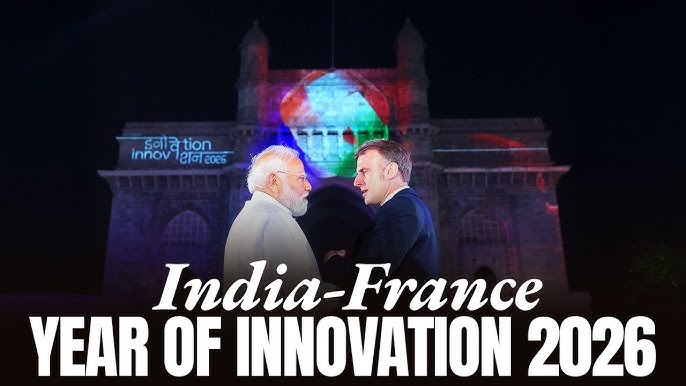
The event aligns with the broader India-France Year of Innovation 2026, a bilateral master-framework finalized by both heads of state in Mumbai earlier this year. By embedding commercial accelerators within diplomatic channels, the two nations are formalizing soft-landing routes, cross-border technology validation structures, and joint supply-chain partnerships in specialized fields like quantum computing and critical mineral processing.
Official Sources Section
According to official administrative briefings published by the Press Information Bureau (PIB) and operational brochures from the University Grants Commission (UGC), Prime Minister Modi is supported in Nice by a senior cabinet delegation, including Union Minister for External Affairs Dr. S. Jaishankar and Union Minister for Commerce and Industry Shri Piyush Goyal. Government data registries indicate that institutional frameworks negotiated during the summit will seek to streamline international patent filings and establish standardized mechanisms for cross-border engineering talent mobility.
Quote Section
In his departure statement released ahead of the inaugural ceremony, Prime Minister Narendra Modi outlined the strategic objectives of the summit:
"This landmark event, being held against the backdrop of the India-France Year of Innovation, will connect India's most promising start-ups with global investment and serve as a major accelerator for innovations emerging from India's higher education ecosystem."
Underscoring the operational shift in global perception, French President Emmanuel Macron noted during the inaugural forum:
"The structural question confronting the global technology sector is no longer simply if India innovates, but rather who will actively innovate alongside India to deploy solutions at a global scale."
Why It Matters
For international venture investors and corporate buyers, Bharat Innovates 2026 provides a secure, state-vetted gateway to early-stage, IP-backed deal flows originating inside India's elite research corridors. For academic researchers and student entrepreneurs, the initiative removes traditional geographical barriers to capital, allowing them to scale lab-validated prototypes into international markets. Practically, for consumers and global industries, these structural academic linkages accelerate the time-to-market for vital technologies, including lower-cost medical devices, efficient green energy hardware, and localized semiconductor applications designed to balance strained global supply lines.
Key Facts at a Glance
Sovereign Launch: Jointly inaugurated by PM Narendra Modi and French President Emmanuel Macron on June 14, 2026, in Nice, France.
Institutional Scale: Features 120 vetted deep tech startups alongside 15 premier Indian higher education institutions, including the IITs and IISc.
Investor Footprint: Attracts over 500 global investors, venture capital corporations, and technology sector CEOs.
Sectoral Breadth: Encompasses 13 distinct frontier technological fields, including semiconductors, space tech, quantum computing, and biotechnology.
Nodal Oversight: Managed under the Ministry of Education with technical selection directed by the Principal Scientific Advisor to the Government of India.
FAQ Section
Q: What makes Bharat Innovates different from regular commercial tech exhibitions?
A: Regular tech exhibitions focus primarily on consumer applications and software-as-a-service (SaaS) products. Bharat Innovates specifically targets deep tech and hard science innovations that originate within academic laboratories and higher education research parks.
Q: How are the participating startups and institutions selected for the France conclave?
A: Startups undergo a rigorous screening process overseen by a specialized Technical Oversight Committee led by India's Principal Scientific Advisor, ensuring all featured innovations possess defensible intellectual property and market viability.
Q: What are the anticipated long-term outcomes of this bilateral initiative?
A: The project is designed to establish ongoing frameworks for joint R&D, cross-border investment facilitation, fast-track procurement pilots, and mutual technology transfers between the Indian and European industrial ecosystems.
Source: Press Information Bureau (PIB) India, Official Bharat Innovates 2026 Portal, University Grants Commission (UGC) Directives.