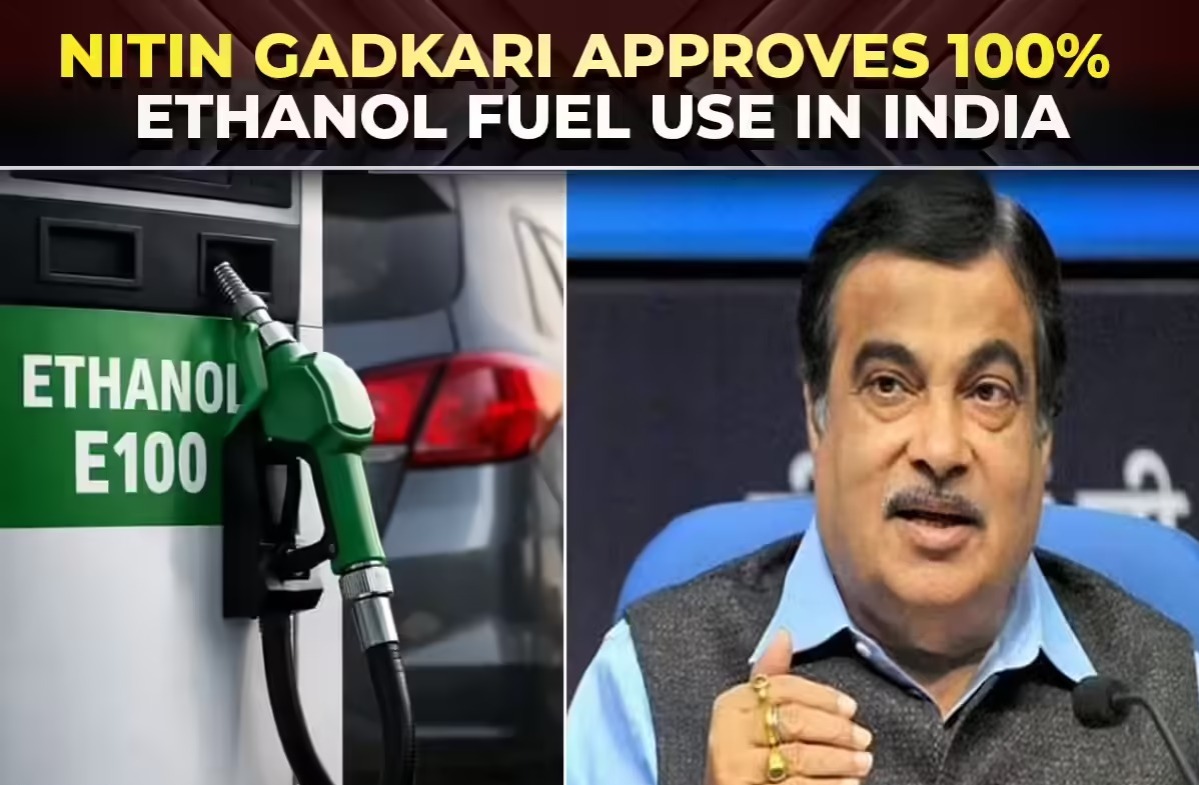
Union Minister Nitin Gadkari has signed the regulatory framework legally authorizing 100 percent ethanol (E100) as an automotive fuel in India. Aimed at reducing the country's ₹22 lakh crore import dependency, the policy clears the way for automakers like Maruti, Toyota, and Hero to launch flex-fuel vehicles within weeks.
NAGPUR — In a major step toward domestic energy self-reliance, Union Minister for Road Transport and Highways Nitin Gadkari announced that the Indian government has officially approved and legalized the use of 100 percent ethanol (E100) as an automotive fuel. Addressing a press conference on Saturday, June 13, 2026, Gadkari confirmed that he had finalized the regulatory frameworks amending the Central Motor Vehicles Rules to establish the legal process for pure ethanol adoption.
The policy shift is explicitly designed to expand the availability of eco-friendly alternatives to conventional petroleum, shield consumers from volatile global oil disruptions, and systematically lower India’s massive ₹22 lakh crore fossil fuel import bill.
Overcoming Skepticism and Industry Pushback
The formal signing of the E100 regulations marks a significant personal and political milestone for Gadkari, who has spent over a decade advocating for high-blend biofuels in the face of widespread institutional skepticism. The minister noted that early proposals to shift the national transport architecture toward pure agricultural biofuels were frequently met with doubt and criticism from both economic and engineering circles.
In his address, Gadkari highlighted that alongside genuine structural challenges, the green transition has frequently had to counter active campaigns of misinformation. He dismissed lingering concerns regarding engine performance, noting that current automotive engineering parameters allow flex-fuel power units to match or exceed the durability and power metrics of conventional petrol engines.
Major Automakers Readies Flex-Fuel Product Blitz
With legal frameworks firmly in place, the domestic automotive industry is rapidly scaling up assembly operations to support pure biofuel usage. A coalition of major two-wheeler and four-wheeler manufacturers has already completed field testing for localized flex-fuel engines.
According to official briefings, the following vehicle deployments are currently underway:
Four-Wheelers: Maruti Suzuki has formally showcased a prototype version of its best-selling WagonR engineered to operate entirely on 100 percent ethanol. Major international manufacturers—including Toyota, Hyundai, and MG Motor—are slated to commercially launch their own E100-compatible variants within the next six weeks.
Two-Wheelers: Hero MotoCorp, which commands a significant share of the domestic motorcycle sector, has launched flex-fuel variants for its popular Splendor+ and HF Deluxe platforms. These models are optimized to handle high-ethanol compositions efficiently.
To ease the economic transition for motorists, Union Minister for Petroleum and Natural Gas Hardeep Singh Puri stated that high-blend alternatives, such as the recently rolled out E85 fuel, will be positioned at an attractive price discount compared to standard E20 petrol, maximizing market incentives for rapid multi-sector adoption.
Official Sources Section
According to notifications released via the Ministry of Road Transport and Highways and updates from the Ministry of Petroleum and Natural Gas, the legal formalization of E100 complements India's wider biofuel roadmap. Government statistics show that India achieved its 10 percent ethanol blending target in late 2022 and managed to reach its 20 percent blending parameters well ahead of the original 2030 timeline. The new rules provide structural parameters for mass-producing and distributing pure ethanol via specialized agricultural supply chains.
Quote Section
Reflecting on the evolution of the policy from a fringe idea to standard regulations, Union Minister Nitin Gadkari stated:
"Last night at around 8:00 PM, I signed the file making rules for 100 percent ethanol and giving it legal process. I used to talk about this dream, and people used to laugh. Some friends even used to criticize it. The country faces an import burden of ₹22 lakh crore. With this resolution, an alternative to petrol and diesel will finally be ready, produced directly by our agricultural sectors."
Emphasizing the downstream energy economics, Petroleum Minister Hardeep Singh Puri noted:
"We are having very widespread discussions with the auto industry, including SIAM, to guarantee infrastructure readiness. Even if a single percentage of high-blend fuels like E85 or E100 is adopted in the immediate supply cycles, it will generate massive domestic demand, shifting capital directly to rural economies."
Why It Matters
The green-lighting of 100 percent ethanol fuel carries widespread practical implications for Indian consumers, farmers, and heavy industries. For urban vehicle buyers, the policy guarantees a wider selection of alternative powertrains that offer lower operational running costs per kilometer compared to conventional high-tax petrol. For the massive agrarian sector, a localized fuel industry turns excess sugarcane, broken rice, and agricultural residue into high-value cash commodities, boosting rural incomes. On a macroeconomic scale, reducing crude oil imports protects national forex reserves and improves fiscal stability during geopolitical crises.
Key Facts at a Glance
Sovereign Approval: Minister Nitin Gadkari signed the final regulatory files on June 12, 2026, granting formal legal recognition to E100 automotive fuel.
Macro Relief: The initiative targets a structural reduction in India's annual ₹22 lakh crore crude oil and hydrocarbon import expenditure.
Commercial Launches: Major carmakers like Toyota, Suzuki, and Hyundai are scheduled to launch production-ready E100 vehicles within 45 days.
Two-Wheeler Momentum: Hero MotoCorp has already introduced high-blend flex-fuel versions of its mass-market motorcycle variants.
Tax Negotiations: The Ministry of Road Transport is actively coordinating with the GST Council to lower current tax brackets on high-blend alternative fuels.
FAQ Section
Q: What exactly is a flex-fuel vehicle (FFV)?
A: A flex-fuel vehicle is equipped with an internal combustion engine designed to run efficiently on conventional petrol or any blend of ethanol and petrol up to 100 percent pure ethanol (E100), utilizing an automated sensor to adjust fuel injection based on the active mixture.
Q: Can I use 100% ethanol fuel in my current standard petrol car or motorcycle?
A: No. Standard internal combustion engines are calibrated for low blends like E10 or E20. Running pure E100 requires modified fuel lines, anti-corrosive tank linings, and adjusted engine mapping to handle ethanol's specific combustion characteristics.
Q: Will E100 fuel be cheaper at the pump than regular petrol?
A: Yes. Because ethanol is produced domestically from agricultural processes rather than imported, the government can offer structural price discounts, such as those applied to E85, making it highly competitive against regular fuel lines.
Source: Ministry of Road Transport and Highways (MoRTH) Circulars, Ministry of Petroleum and Natural Gas Project Data, Press Trust of India (PTI) / ANI Nagpur Press Bureau.