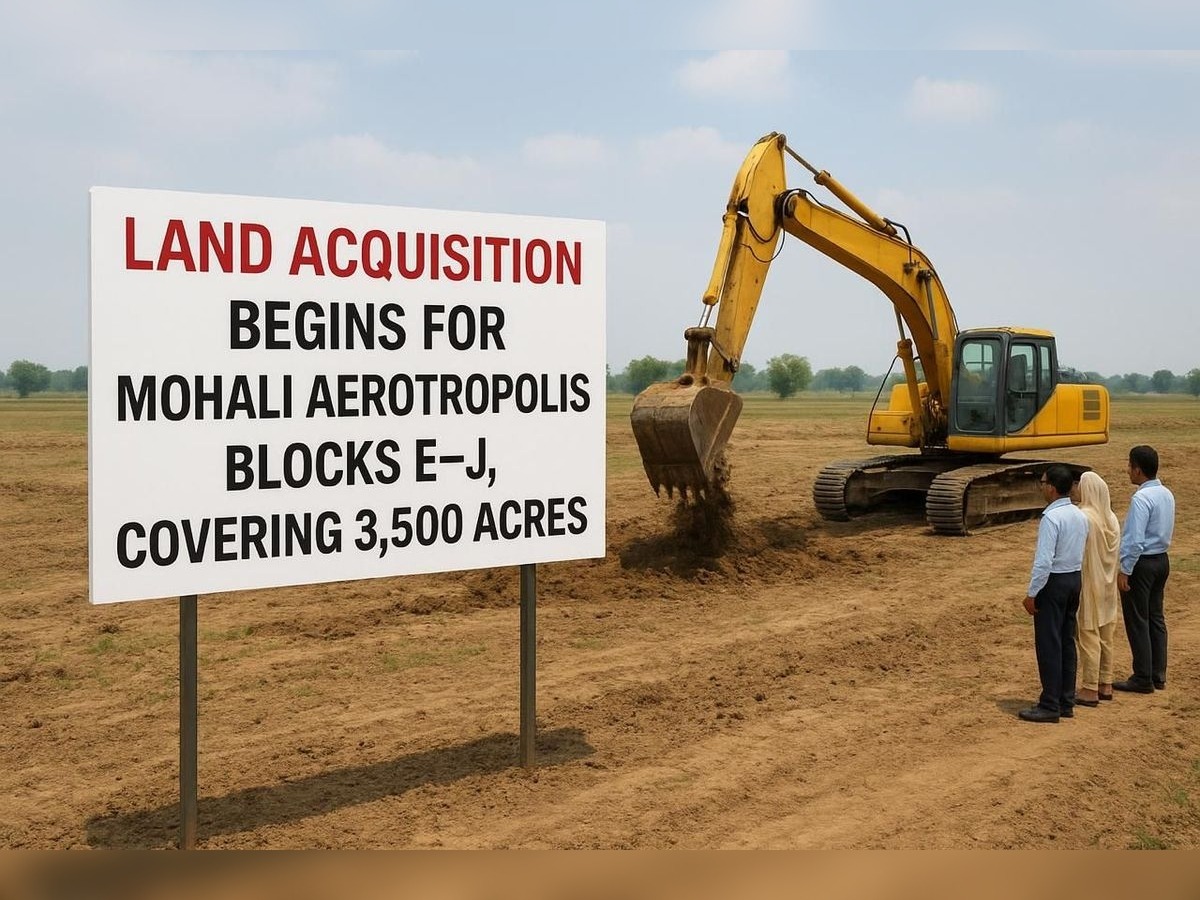
The Punjab and Haryana High Court has initiated a formal review of GMADA’s 5,438-acre land acquisition for the Mohali Aero City Expansion Project. Prompted by farmer petitions alleging a bypass of mandatory consent rules, the judicial scrutiny injects title risks into North India’s most expensive real estate corridor.
CHANDIGARH — The Punjab and Haryana High Court has formally placed the land acquisition proceedings for the multi-thousand-acre Mohali Aero City Expansion Project commercially known as the Aerotropolis under intense judicial scrutiny. A division bench issued comprehensive notices to the Government of Punjab, the Department of Housing and Urban Development, and the Greater Mohali Area Development Authority (GMADA) following a cluster of civil writ petitions filed by local agrarian stakeholders.
The legal challenges allege systemic violations of federal land acquisition laws, a lack of transparency in Social Impact Assessments (SIA), and the forced displacement of thousands of marginal farmers and landless laborers from highly fertile agricultural belts surrounding the Shaheed Bhagat Singh International Airport.
Allegations of Statutory Violations and Coercive Sourcing
The legal friction stems from the scale and methodology of the acquisition initiated by GMADA, which seeks to absorb approximately 5,438 acres of fertile land spanning 14 historical villages including Bakarpur, Kishanpura, Kurari, and Seon to build its premium township extension. The petitioners, representing localized land protection committees, contend that state authorities completely bypassed essential statutory safeguards embedded within The Right to Fair Compensation and Transparency in Land Acquisition, Rehabilitation and Resettlement Act, 2013.
The core legal contentions submitted before the High Court bench include:
Consent Avoidance: Petitioners argue that GMADA improperly classified the massive commercial expansion under Section 2(1)-(e) as a "project for planned development" to legally avoid the mandatory 80 percent landowner consent clause.
Flawed Impact Reports: The lawsuits claim that the published Social Impact Assessment (SIA) reports failed to accurately survey landless scheduled caste laborers and tenant farmers who depend entirely on agricultural leasing for physical survival.
Threats to Food Security: Land owners assert that the state is forcefully acquiring multi-crop irrigated land equipped with active tube wells, directly threatening localized food security frameworks in violation of Section 10 of the 2013 Act.
Market Dynamics and the Financial Strain on GMADA
The judicial intervention comes at a delicate time for Mohali’s booming real estate corridor. The PR-7 Airport Road spine has emerged as the premier investment zone in the Tricity area, with average premium residential plot rates climbing to a bracket of ₹12,900 to ₹18,500 per square foot in 2026. Institutional interest remains high, as evidenced by a recent March 2026 GMADA public e-auction that drew an unprecedented ₹311 crore bid for a single 6.19-acre commercial site.
However, financing this massive expansion has placed visible strain on state urban development bodies. To keep the Aerotropolis project on track and clear early land pool payouts, GMADA was recently forced to secure a ₹2,500 crore internal loan pooled from multiple municipal development funds across Punjab. While the High Court previously turned down a public interest litigation challenging this borrowing configuration, the new focus on the structural validity of the underlying land titles introduces a major layer of financial risk for upcoming commercial allotments.
Official Sources Section
According to official gazette notifications issued by the Government of Punjab Department of Housing and Urban Development and public updates from the Greater Mohali Area Development Authority (GMADA), preliminary declarations under the Land Acquisition Act were finalized for multiple pockets, including Village Kurdi and Village Kishanpura. Court status logs indicate that the High Court division bench has granted the state government and the Land Acquisition Collector a window of four weeks to file a comprehensive return answering the specific statutory violations raised by the land owners.
Quote Section
According to senior legal officials representing the state distribution desk:
"The land acquisition for the Aero City Expansion Project has been executed strictly in accordance with the master plan parameters approved by the Town and Country Planning department. The planned development serves an essential public purpose by scaling up institutional infrastructure. The authority will present a transparent evidentiary record to the High Court to demonstrate compliance with all statutory parameters."
Sardar Jagtar Singh, a senior representative of the local Land Protection Committee, voiced the community's structural grievances outside the courtroom:
"The government speaks of planned development, but for us, it resembles a coordinated land grab that destroys our basic livelihood. They are taking multi-crop, fertile soil and handing it over to private real estate groups. If you take away our fields and displace our agricultural laborers without proper compensation, you destroy entire village economies."
Why It Matters
The High Court's decision to place the Aerotropolis acquisition under scrutiny carries direct practical consequences for retail homebuyers, property developers, and institutional investors. For current property buyers along the PR-7 spine, the legal dispute introduces an immediate warning regarding title verifications, as any future adverse court ruling could stall infrastructure work or trigger prolonged delays in plot handovers.
For the regional farming economy, the litigation represents a critical defense of traditional land rights against urban sprawl. For macroeconomic planners, the case highlights a recurring policy dilemma: balancing the infrastructure demands of a rapidly growing smart city with the preservation of agricultural livelihoods and food security mandates.
Key Facts at a Glance
Judicial Review: The Punjab and Haryana High Court has issued notices demanding full transparency regarding the Aerotropolis land pool.
Target Footprint: The acquisition encompasses 5,438 acres of fertile, multi-crop land distributed across 14 rural villages.
The Consent Dispute: Petitioners allege that GMADA used planning exemptions to bypass the mandatory 80% landowner consent rule.
Massive Financial Risk: The litigation directly impacts a corridor where residential land rates command premiums up to ₹18,500 per square foot.
Funding Interventions: The legal challenge proceeds concurrently with an existing ₹2,500 crore internal loan system raised to prevent development delays.
FAQ Section
Q: What is the main difference between the original Aero City and the new Expansion Project?
A: The initial Aero City project was a smaller township built near the airport road spine. The Expansion Project, also called Aerotropolis, is a massive 5,500-acre residential and commercial ecosystem expanding southwest toward the Zirakpur–Banur belt.
Q: Will this High Court case immediately stop construction work on the Airport Link Road?
A: No. The High Court has placed the land acquisition process under examination but has not issued a blanket stay order on ongoing basic civil works, meaning GMADA's current link road completion timelines remain technically active.
Q: What precautions should property buyers take while investing in this corridor?
A: Given the active litigation, legal experts recommend that buyers perform thorough title verifications, check RERA approval registries, and verify if specific plots fall within contested village blocks before committing growth capital.
Source: Punjab and Haryana High Court Order Repository, Greater Mohali Area Development Authority (GMADA) Public Notices, The Tribune Chandigarh Bureau Reportage.