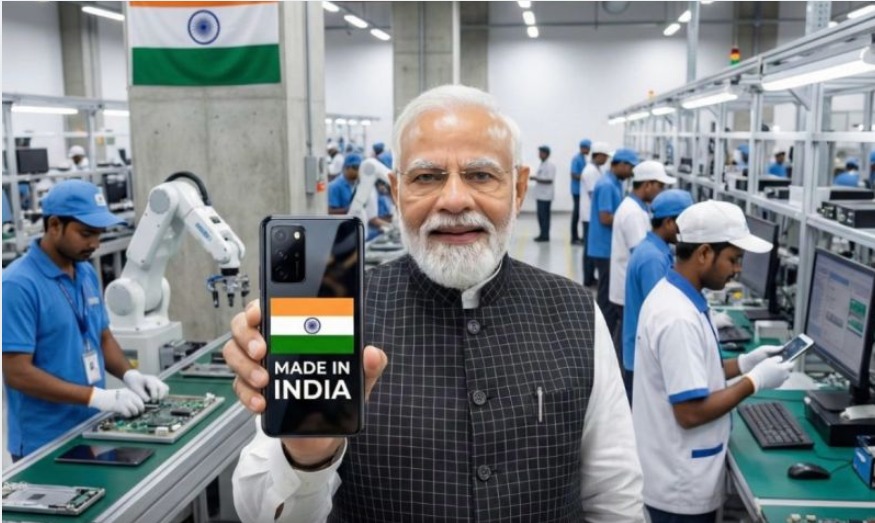
India has achieved the rank of the world's second-largest mobile phone manufacturer. Prime Minister Narendra Modi confirmed this growth while inaugurating a major semiconductor facility in Gujarat, emphasizing the nation's transition toward domestic chip production and a comprehensive electronics value chain under the "Make in India" initiative.
Prime Minister Narendra Modi signals a new era for the "Make in India" initiative as the nation’s electronics sector reaches a landmark scale.
SANAND, GUJARAT — India has officially ascended to become the world’s second-largest mobile phone manufacturer, a milestone that underscores the nation's rapid industrial transformation over the past decade. Prime Minister Narendra Modi confirmed this achievement on Saturday, July 4, 2026, during his visit to Sanand, Gujarat, where he inaugurated the CG Semi Outsourced Semiconductor Assembly and Test (OSAT) facility.
The announcement marks a decisive phase in the "Make in India" roadmap. Moving beyond simple assembly, the government is now focused on domesticating the entire electronics value chain, with a heavy emphasis on semiconductor production. According to official government data, India's total electronics production has grown nearly sevenfold since 2014, while mobile phone production specifically has surged 33-fold.
Expanding the Electronics Roadmap
The inauguration of the CG Semi OSAT facility in Sanand serves as a cornerstone for the next stage of India’s technological journey. The plant, which received cabinet approval in February 2024, began commercial production in record time, showcasing the efficiency of the India Semiconductor Mission (ISM).
"First products, then components, and now semiconductors," the Prime Minister stated during his address. He emphasized that the goal is not merely to assemble finished goods but to produce the high-tech chips that power global electronics, ranging from automobiles and 5G communications to industrial equipment. The facility is expected to produce billions of chips annually, which will not only serve the domestic market but will also be exported to Japan, the United States, and Europe.
Building a Complete Ecosystem
The government’s strategic vision focuses on a cluster-based development model. By fostering an environment where one industrial facility attracts supporting industries—such as chemical manufacturers, testing laboratories, and design startups—India aims to create a self-sustaining electronics ecosystem.
Industry analysts note that this shift is essential for India to integrate more deeply into global supply chains. With electronics exports now rising rapidly, the sector is currently on track to become India’s second-largest exported commodity. The expansion is supported by substantial policy initiatives, including an enhanced ₹40,000 crore outlay for the Electronics Components Manufacturing Scheme (ECMS), designed to deepen domestic capacity.
Official Sources
The details regarding the growth of the electronics sector and the inauguration of the Sanand facility were provided by the Press Information Bureau (PIB) and the Prime Minister’s Office (PMO). Technical infrastructure and project data were confirmed by the India Semiconductor Mission (ISM).
Why It Matters
For India, the transition from an importer of mobile phones to the world’s second-largest manufacturer represents a major shift in economic standing. For global investors and businesses, the development signals that India is establishing the necessary infrastructure—including raw materials, design capabilities, and packaging facilities—to become a viable, high-tech alternative in the global electronics market. This stability is expected to attract further capital and drive job creation, with the sector already employing an estimated 25 lakh people.
Key Facts at a Glance
Production Milestone: India has risen to become the world’s second-largest mobile phone manufacturer.
Sector Growth: Total electronics production in India has increased nearly sevenfold since 2014.
New Infrastructure: The CG Semi OSAT facility in Sanand, Gujarat, will manufacture billions of chips annually for both domestic and international markets.
Economic Impact: The electronics manufacturing industry in India has grown to a ₹13 lakh crore valuation, supporting 25 lakh jobs.
Export Potential: The country is actively transitioning to becoming a top-tier global exporter of electronic goods, with smartphone exports rising significantly in recent years.
FAQ
What is the significance of the CG Semi OSAT facility?
The facility is a key part of India's move toward semiconductor self-reliance, focusing on the assembly, testing, and packaging of chips used in everything from cars to 5G infrastructure.
How has the "Make in India" initiative changed the electronics sector?
The initiative has shifted India’s role from being an importer of finished electronic products to a major global manufacturer and exporter, building a complete value chain from components to semiconductors.
What is the government's long-term goal for electronics?
The government aims to build a complete semiconductor and electronics ecosystem, from design to fabrication, to position India as a global high-tech hub by 2047.
Source: Press Information Bureau, Prime Minister’s Office, India Semiconductor Mission