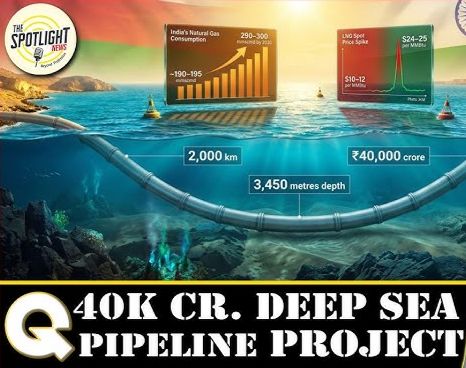
Amid Strait of Hormuz tensions and volatile LNG prices, India is fast-tracking plans for a ₹40,000-crore deep-sea gas pipeline from Oman to Gujarat. The proposed 2,000-km Middle East–India Deep-water Pipeline (MEIDP) would carry 31 mmscmd of gas, bypass maritime choke points and tap massive Gulf reserves at depths of up to 3,450 metres.
Senior petroleum ministry officials told The Economic Times that New Delhi is working off a pre-feasibility study by private consortium SAGE to evaluate a direct subsea link between Oman and India’s west coast. If cleared, the project would be among the world’s deepest gas pipelines and a cornerstone of India’s long-term energy security strategy.
Route, Cost And Timelines
The proposed pipeline will run about 2,000 km under the Arabian Sea from Oman to Gujarat, designed to deliver roughly 31 million metric standard cubic metres per day (mmscmd) of natural gas into Indian markets.
Estimated to cost around ₹40,000 crore (about USD 4.7–4.8 billion), the project is expected to take five to seven years to build once it receives a formal green light.
Bypassing Choke Points, Locking In Gas
The deep-sea route via Oman and the UAE is being planned to avoid geopolitically sensitive regions and transit-country risks associated with traditional land or shallow-water corridors.
Officials say the line would give India more direct access to gas from Oman, the UAE, Saudi Arabia, Iran, Turkmenistan and Qatar—countries that collectively sit on roughly 2,000–2,500 trillion cubic feet of reserves.
One Of The World’s Deepest Pipelines
The MEIDP is envisaged to operate at depths of up to about 3,400–3,450 metres, which would place it among the deepest undersea gas pipelines globally.
SAGE has already laid around 3,000 metres of test pipeline along the intended route at a cost of roughly ₹25 crore to study seabed conditions, and argues that advances in deep-water pipe-laying and repair now make the corridor technically and commercially viable.
From Pre-Feasibility To Diplomatic Track
The petroleum ministry will ask state-run GAIL, Engineers India Ltd (EIL) and Indian Oil Corporation to prepare a detailed feasibility report, building on SAGE’s pre-feasibility work.
A positive report would pave the way for government-level negotiations with Oman and other Gulf partners on supply contracts, financing structures and execution responsibilities, potentially turning the pipeline into a common-carrier “gas highway” for multiple sellers.
Deep-Sea Gas Pipeline Insights
- Proposed 2,000-km Oman–Gujarat deep-sea gas pipeline at an estimated cost of ₹40,000 crore
- Designed capacity of about 31 mmscmd, with build time of five to seven years post-approval
- Route to run via Arabian Sea, avoiding chokepoints and enabling access to vast Gulf gas reserves
- Planned depths up to ~3,450 metres; test segment already laid by SAGE to validate seabed conditions
Sources: Economic Times and Business Today