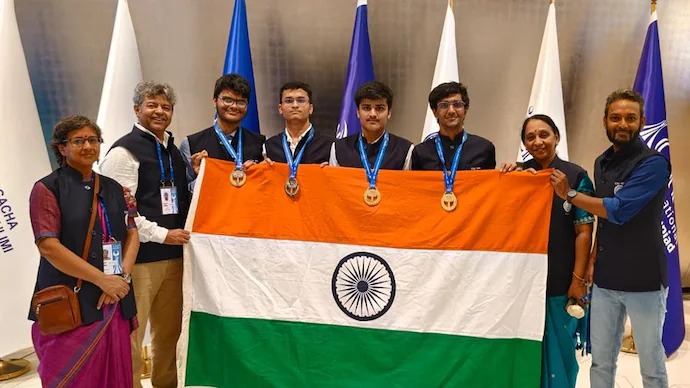
India achieved a historic victory at the 58th International Chemistry Olympiad in Tashkent, securing four gold medals and finishing joint-first. The team of Debadatta Priyadarshi, Harshit Singhal, Kabeer Chhillar, and Sandeep Kuchi outperformed participants from 93 countries, marking India's most successful result in the competition's 27-year history.
Indian students secured four gold medals, achieving a historic joint-first finish at the 58th International Chemistry Olympiad in Tashkent.
TASHKENT – India has achieved a historic milestone at the 58th International Chemistry Olympiad (IChO) 2026, held in Tashkent, Uzbekistan, by securing four gold medals. The performance marks the most successful outing for an Indian delegation in the competition’s 27-year history, with the team finishing in a joint-first position alongside China, Vietnam, and an individual participant from Russia.
The international event, which concluded on July 19, 2026, featured 363 students from 93 countries. India’s historic win at the International Chemistry Olympiad reflects the country's growing academic prowess in STEM disciplines and follows a string of successful performances by Indian delegations at other global science competitions this month.
A Historic Performance by Indian Scholars
The four-member Indian team showcased exceptional knowledge and problem-solving skills throughout the rigorous competition. The gold medallists are Debadatta Priyadarshi from Bhubaneswar, Harshit Singhal from Mandi Gobindgarh, Kabeer Chhillar from Delhi, and Sandeep Kuchi from Hyderabad.
This accomplishment is particularly noteworthy as two of the team members—Priyadarshi and Kuchi—are repeat medallists, having represented India in previous editions of the competition. Additionally, Kabeer Chhillar, who earned his gold at the International Chemistry Olympiad, is also recognized for his recent academic success, having secured All India Rank 2 in the JEE Advanced 2026 examination.
Mentorship and Institutional Support
The team’s preparation was overseen by the Homi Bhabha Centre for Science Education (HBCSE), Mumbai, which serves as the nodal center for the national Olympiad programme. Mentors Prof. Subhajit Bandyopadhyay of IISER Kolkata and Dr. Indrani Das Sen of HBCSE provided extensive guidance, while scientific observers Dr. Anubendu Adhikary from IIT Kharagpur and Dr. Jayasree Gopalakrishnan from NES Ratnam College supported the team during the competition in Uzbekistan.
The national Olympiad programme is heavily supported by the Department of Atomic Energy (DAE) and the Department of Science and Technology (DST). According to officials at the HBCSE, the selection process for the International Chemistry Olympiad is an exhaustive multi-stage procedure that identifies the most promising students from across the country to represent India on the global stage.
Impact on Academic Excellence
This victory at the International Chemistry Olympiad highlights the efficacy of India’s competitive science training infrastructure. For students, these competitions serve as a vital platform for international academic collaboration and skill development. For educational institutions, the consistent performance of Indian teams in global arenas reinforces the country’s status as a hub for high-level scientific training.
This success comes on the heels of other recent achievements by Indian students globally. On the same day, a four-member Indian team secured four medals at the 38th International Biology Olympiad (IBO), and an Indian team recently finished at the top of the leaderboard at the International Physics Olympiad (IPhO) held in Colombia.
Official Sources
Homi Bhabha Centre for Science Education (HBCSE): Information regarding team selection and mentorship.
Department of Atomic Energy (DAE): Support and funding details for the national Olympiad programme.
International Chemistry Olympiad (IChO) Secretariat: Official competition rankings and results.
Why It Matters
The victory at the International Chemistry Olympiad underscores India's strengthening educational foundation in chemistry and related sciences. By achieving the top rank, the Indian delegation has not only validated the rigour of the national selection process but also inspired a new generation of science students. Practical implications include increased institutional focus on advanced science research and international academic prestige.
Key Facts at a Glance
Historic Result: India finished in a joint-first position, winning four gold medals for the first time in its 27-year history at the competition.
Global Participation: The 58th International Chemistry Olympiad featured 363 participants from 93 different nations.
Team Composition: The Indian team consisted of Debadatta Priyadarshi, Harshit Singhal, Kabeer Chhillar, and Sandeep Kuchi.
Institutional Support: The programme is managed by the HBCSE with support from the DAE and the DST.
FAQ
What is the International Chemistry Olympiad? It is an annual competition for the world’s most gifted chemistry students, focusing on theoretical and practical skills.
How are the Indian participants selected? Students undergo a multi-stage national selection process conducted by the Homi Bhabha Centre for Science Education.
What is the significance of this win? It represents India's best-ever performance, solidifying its leadership in global academic science competitions.
Source:
Homi Bhabha Centre for Science Education, Department of Atomic Energy, International Chemistry Olympiad Official Results