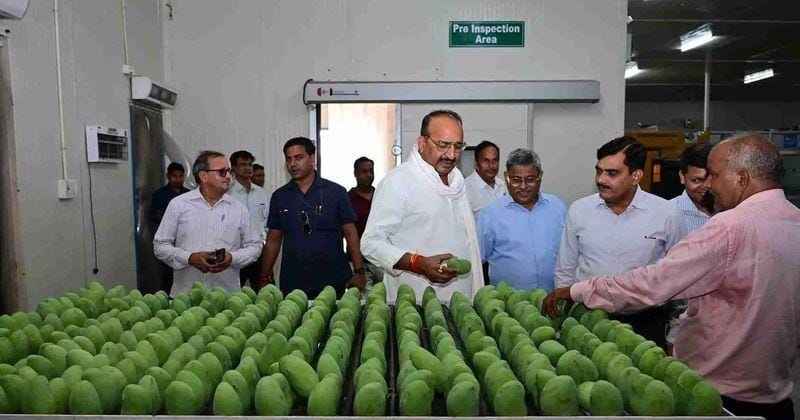
India successfully completed its first commercial sea shipment of 12.5 tonnes of Dashehari and Langra mangoes from Uttar Pradesh to Dubai. Developed by ICAR-CISH and APEDA, the 25-day cold-chain protocol preserved 90% of the fruit, cutting freight expenses and providing growers an extra ₹15–₹20 per kg.
AMROHA, India — India has achieved a major development in agricultural trade following the successful sea route export of Dashehari and Langra mangoes to Dubai. On July 22, 2026, the Union Ministry of Agriculture and Farmers Welfare announced that a 12.5-tonne consignment of premium Uttar Pradesh mangoes was delivered to the United Arab Emirates in a 40-foot reefer container. The successful completion of a 25-day harvest-to-market transit demonstrates that maritime freight can replace expensive air cargo for perishable North Indian fruit, significantly lowering logistics costs while increasing profit margins for domestic fruit growers.
Breakthrough Protocol Enables 25-Day Maritime Transit
The commercial shipment relied on a post-harvest sea protocol developed jointly by the ICAR–Central Institute for Subtropical Horticulture (ICAR-CISH), based in Lucknow, and the Agricultural and Processed Food Products Export Development Authority (APEDA). Harvested on June 22, 2026, in Amroha, Uttar Pradesh, the produce underwent specialized post-harvest treatment using METWASH—a formulation engineered by ICAR-CISH to inhibit decay and extend fruit shelf life.
The mangoes were scientifically graded, packed at the certified Amroha Pack House, and loaded into a temperature-monitored reefer container to preserve a continuous cold chain. Despite maritime delays caused by regional weather disturbances, the container reached its destination in Dubai on July 17, 2026. Upon arrival, inspections confirmed that nearly 90% of the consignment remained in prime marketable condition. The successful shipment validates the commercial feasibility of long-distance sea transport for northern Indian mango varieties.
Economic Benefits for Farmers and Exporters
Transitioning from air cargo to maritime transport addresses a persistent financial constraint in Indian fresh produce exports. Air freight costs have historically inflated retail prices in overseas markets and squeezed procurement margins offered to growers.
By adopting containerized sea transport, exporters drastically lower transportation overheads. According to government findings, freight savings enabled commercial exporters to offer higher farm-gate procurement prices. Mango farmers in Uttar Pradesh realized an additional income of approximately ₹15 to ₹20 per kilogram compared to traditional domestic and air-export marketing channels. This improved profitability offers a scalable business model for regional farmer producer organizations (FPOs) and agricultural businesses.
Expanding Market Access Across the Gulf Region
The successful sea route export of Dashehari and Langra mangoes to Dubai opens opportunities to expand northern Indian fruit trade across the broader Gulf Cooperation Council (GCC) market. While western and southern Indian varieties like Alphonso and Kesar have long utilized sea freight through coastal ports, northern varieties previously faced decay risks during extended journeys.
The validation of cold-chain protocols allows government agencies and commercial exporters to plan larger, standardized sea shipments throughout the peak harvest season. Authorities expect this breakthrough to accelerate commercial adoption across major mango-producing states, driving agricultural export volumes, strengthening rural economies, and positioning Indian fresh produce competitively in international retail chains.
Official Sources Section
According to official announcements issued by the Ministry of Agriculture & Farmers Welfare through the Press Information Bureau, the shipment represents the first successful commercial sea-based delivery of Dashehari and Langra mangoes from Uttar Pradesh under a 25-day transit timeline. Technical guidelines and export monitoring were coordinated via APEDA and ICAR-CISH.
Quote Section
"According to officials from the Ministry of Agriculture and Farmers Welfare, this is the first successful commercial sea shipment of Dashehari and Langra mangoes from Uttar Pradesh to Dubai under an extended 25-day transit period. Officials stated that the achievement demonstrates that premium Indian mangoes can be exported economically through sea freight without compromising quality, thereby enhancing export earnings and boosting farmer livelihoods."
Why It Matters
The shift to maritime logistics significantly lowers freight overheads for Indian agricultural exports, making fresh produce more competitive against international suppliers in Middle Eastern markets. Higher farm-gate procurement prices directly boost rural household incomes, while establishing reliable sea-freight protocols creates a sustainable export pipeline for regional agricultural producers.
Key Facts at a Glance
Export Volume: 12.5 tonnes of Dashehari and Langra mangoes shipped in a 40-foot reefer container.
Transit Timeline: Harvested on June 22, 2026, and delivered to Dubai on July 17, 2026 (25 days total).
Quality Assurance: Nearly 90% of the produce arrived in good marketable condition after METWASH treatment.
Farmer Income Impact: Mango growers earned an extra ₹15–₹20 per kg due to reduced maritime logistics expenses.
Lead Institutions: Protocol developed jointly by ICAR-CISH and APEDA.
FAQ Section
How were the mangoes preserved during the 25-day journey?
The fruit was treated with METWASH, a post-harvest solution developed by ICAR-CISH, and maintained under an unbroken cold chain inside a 40-foot reefer container.
Why is sea freight preferred over air cargo for mango exports?
Sea freight is substantially less expensive than air freight, allowing exporters to reduce logistics costs and offer higher procurement prices to farmers.
How much additional income did growers earn from this trial?
Mango growers realized an additional income of approximately ₹15 to ₹20 per kilogram compared to traditional supply channels.
Which agencies developed the sea export protocol?
The protocol was jointly developed by ICAR–Central Institute for Subtropical Horticulture (ICAR-CISH), Lucknow, and the Agricultural and Processed Food Products Export Development Authority (APEDA).
Source: Press Information Bureau, Ministry of Agriculture & Farmers Welfare, Agricultural and Processed Food Products Export Development Authority (APEDA).