The 1984 meeting between Indira Gandhi and Ladakhi leader Sonam Wangyal has gained new relevance amid his son Sonam Wangchuk’s ongoing hunger strike. Congress leaders are invoking this historical precedent of direct engagement to criticize the current government’s silence, urging state authorities to address the protesters' demands through democratic dialogue.
As Sonam Wangchuk’s hunger strike enters its 20th day, the Congress party has invoked a historic 1984 intervention by Indira Gandhi, sparking a debate on the government's role in engaging with peaceful dissent.
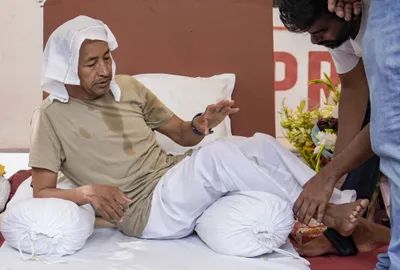
NEW DELHI — Amidst the ongoing indefinite hunger strike by climate activist and educator Sonam Wangchuk at Jantar Mantar, a 42-year-old political episode involving his father, the late Ladakhi leader Sonam Wangyal, has returned to the forefront of national discourse. The revival of this history serves as a pointed critique of the current administration’s perceived indifference toward the protesters' demands.
The 1984 Precedent: A Legacy of Engagement
In 1984, Sonam Wangyal, a prominent Ladakhi leader and former Jammu and Kashmir cabinet minister, undertook an indefinite hunger strike to demand Scheduled Tribe (ST) status for the communities of Ladakh. Recognizing the legitimacy of the peaceful protest, then-Prime Minister Indira Gandhi flew to Leh to meet him directly.
During the meeting, Gandhi assured Wangyal that the government would consider his demands, offering him a soft drink to symbolically end his fast. This proactive outreach fostered a political process that culminated in the Centre granting ST status to several Ladakhi communities in 1989 through a presidential order.
Parallels in the Current Climate
Sonam Wangchuk, currently on his 20th day of a hunger strike (as of July 17, 2026), is protesting alongside the Cockroach Janata Party (CJP) to demand the resignation of Education Minister Dharmendra Pradhan following widespread irregularities in the NEET examination.
The Congress party has leveraged the 1984 historical parallel to highlight what it calls the "callous indifference" of the current Union government. During a recent meeting of the Congress Parliamentary Party, chairperson Sonia Gandhi reportedly referenced the Indira Gandhi-Wangyal interaction to urge the party to adopt a more visible and supportive stance toward Wangchuk’s campaign. Congress spokesperson Pawan Khera noted that democratic governance necessitates engagement with dissent, citing the 1984 meeting and the UPA government’s 2011 talks with Anna Hazare as templates for leadership.
The State of the Protest
As of July 17, 2026, medical professionals have warned that Wangchuk’s health has reached a critical stage, with potential risks of organ damage. Despite these warnings, Wangchuk has refused to end his fast, maintaining that doing so without a government response would undermine the cause. He has shifted his focus toward the upcoming "March to Parliament" scheduled for July 20, the opening day of the Monsoon Session.
Why It Matters
The invocation of this historical event underscores a widening gap between the government and civil society activists. By contrasting Indira Gandhi’s direct outreach with the current government’s silence, critics are framing the issue not merely as a dispute over examination policy, but as a broader test of democratic accountability and the willingness of the state to engage in peaceful, non-violent dialogue.
Key Facts at a Glance
Historical Parallel: In 1984, Indira Gandhi met Sonam Wangyal in Leh to end a hunger strike, leading to the eventual grant of ST status for Ladakh in 1989.
Current Protest: Sonam Wangchuk began his indefinite hunger strike on June 28, 2026, demanding education reforms and accountability for NEET irregularities.
Critical Status: As of July 17, 2026, the strike has entered its 20th day, with doctors warning of potential organ damage.
Planned Action: Protest organizers have announced a peaceful "March to Parliament" for July 20, 2026.
Frequently Asked Questions
Q: Why is the Congress party invoking the 1984 meeting?
A: To critique the current government’s silence and emphasize that previous governments traditionally engaged with peaceful protesters as a matter of democratic duty.
Q: What is Sonam Wangchuk demanding in 2026?
A: He is seeking the resignation of Education Minister Dharmendra Pradhan over alleged irregularities in the NEET examination.
Q: Has the government responded to the hunger strike?
A: As of July 17, 2026, there has been no official acknowledgment or direct engagement from the central government regarding the strike.
Source: LiveMint, The Hindu, NewsGram, Al Jazeera