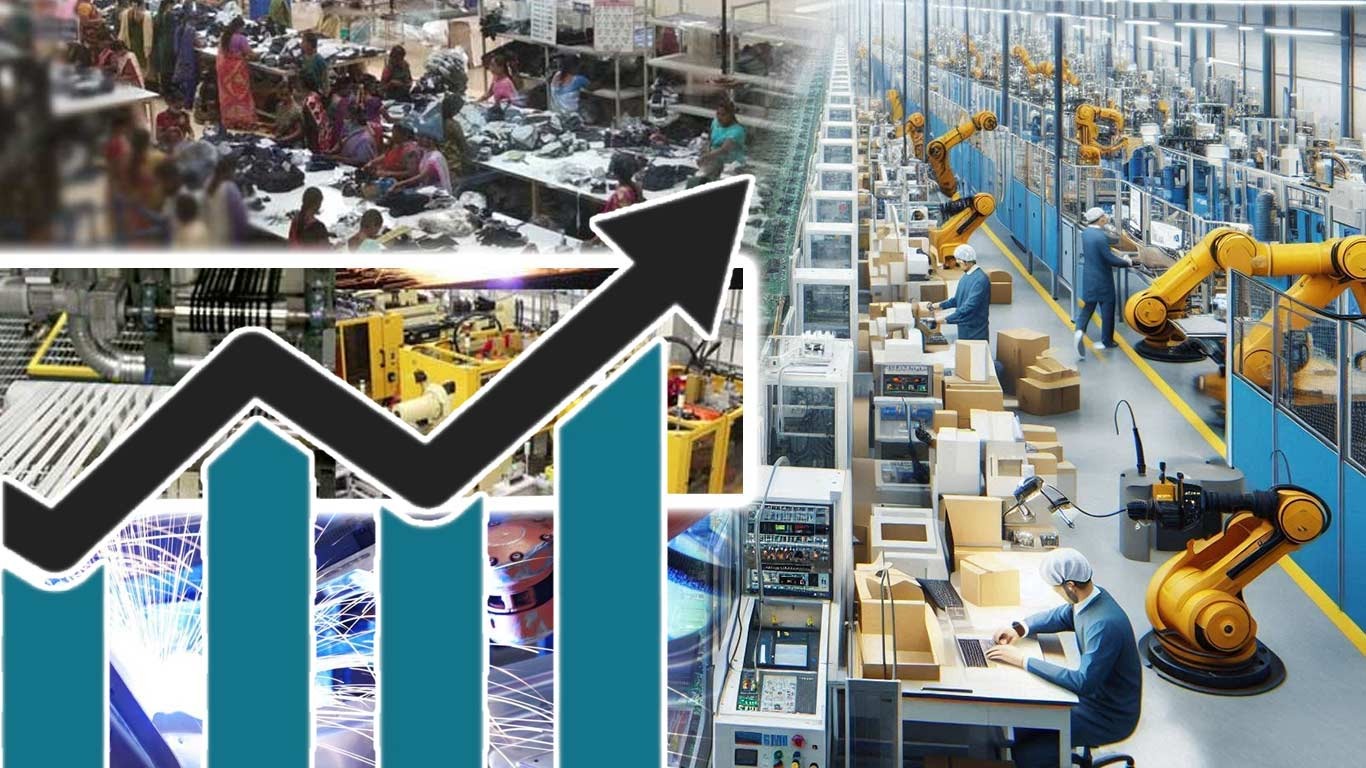
India’s industrial output grew by 5.1% in May 2026, exceeding market forecasts of 4.5%. This growth was primarily driven by a 5.5% expansion in the manufacturing sector. The data, calculated using a new 2022-23 base year, reflects strong factory activity and resilience in the face of ongoing global economic challenges.
India’s industrial output saw a robust expansion of 5.1% in May 2026, according to official government data released on Monday. The figures, which represent a significant performance over the 4.9% growth recorded in April, surpassed the expectations of economists who had projected a more modest 4.5% year-on-year growth.
The Ministry of Statistics and Programme Implementation (MoSPI) reported that the manufacturing sector—the primary engine of India’s industrial economy—recorded a growth of 5.5% during the month. This upward trajectory in the Index of Industrial Production (IIP) comes as the government transitions to a new, more comprehensive series of industrial measurement, utilizing a 2022-23 base year to better capture the current dynamics of the nation's evolving industrial landscape.
Sectoral Performance and Economic Drivers
The growth in the IIP for May was characterized by a healthy performance in core manufacturing, even as the mining sector faced slight headwinds. Under the revised index, which incorporates a broader scope of industrial activities, the government aims to provide a more accurate reflection of the country's economic progress.
The expansion is largely attributed to sustained demand across several key industrial groups, including automotive, electrical equipment, and machinery. This growth supports the view that despite fluctuations in global energy prices and macroeconomic volatility, domestic factory activity remains a cornerstone of India's economic resilience in 2026.
Modernizing Economic Measurement
This release is particularly noteworthy as it reflects the government’s shift toward a rebalanced IIP series. According to official announcements from the MoSPI, the new series includes refined measurement approaches and replaces older deflators with the Output Producer Price Index (Output PPI), providing a clearer picture of real industrial output.
Analysts note that this methodological upgrade is essential for policymakers and investors to gauge the true "pulse" of the economy. By capturing emerging sectors—such as advanced manufacturing, renewable power generation, and specialized waste management—the government is attempting to align its high-frequency indicators with the reality of India’s $4 trillion-plus economy.
Why It Matters
The industrial production data serves as a vital barometer for both domestic and international stakeholders. For businesses, the 5.1% growth suggests that supply chains are functioning with improved efficiency, while investors view these figures as a sign of underlying strength in capital investment.
For the broader economy, the ability of the manufacturing sector to maintain a 5.5% growth rate—despite global headwinds—provides a cushion against inflationary pressures and supports the government’s ongoing infrastructure-led growth strategy. As the nation targets accelerated development, the consistent performance of factory output is expected to influence future monetary policy decisions by the Reserve Bank of India (RBI).
Key Facts at a Glance
Industrial Growth: The IIP grew by 5.1% year-on-year in May 2026, exceeding the 4.5% forecast.
Manufacturing Surge: The manufacturing sector, a critical component of the IIP, recorded a growth rate of 5.5%.
Methodological Shift: The data reflects a new series with a 2022-23 base year, aiming to better capture emerging industrial segments.
Comparison: The growth rate improved from the 4.9% recorded in April 2026, indicating sustained momentum.
FAQ
What is the Index of Industrial Production (IIP)?
The IIP is a composite indicator that measures the growth rates in different industry groups of the economy in a fixed period of time. It is a key tool used by the government to track industrial health.
Why did the government change the base year to 2022-23?
The change to a 2022-23 base year was implemented to make the index more representative of the current structure of India’s industrial sector, including new industries and refined measurement standards.
How does this data impact the average citizen?
While industrial output is a macroeconomic indicator, sustained growth in this area typically correlates with increased job creation, stable supply of goods, and long-term economic stability, which directly influences national prosperity.
Source: Ministry of Statistics and Programme Implementation (MoSPI), The Economic Times, Investing.com