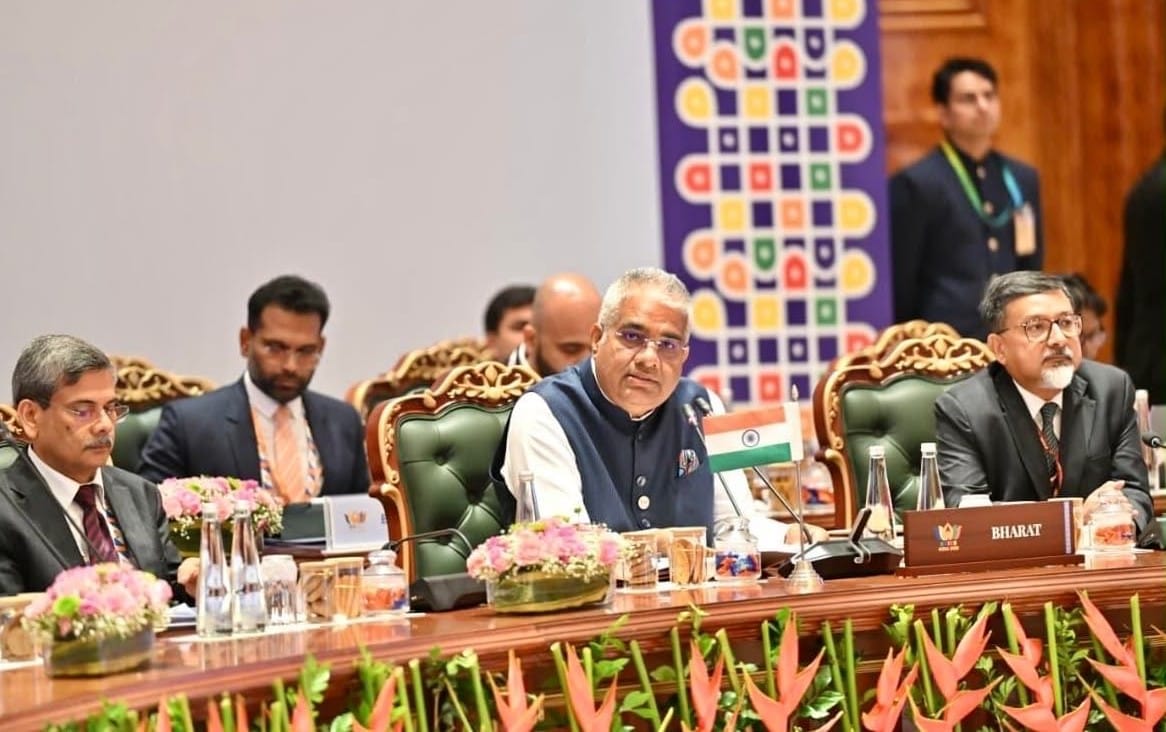
India hosted the 12th BRICS Environment Ministers' Meeting in New Delhi on August 18, 2026, calling for people-centric climate action. Led by Union Minister Bhupender Yadav, member nations adopted a Joint Ministerial Statement and four action plans focusing on forest fire management, circular economy, sustainable lifestyles, and community adaptation.
NEW DELHI — India called for stronger, people-centric, and implementation-oriented environmental strategies during the 12th BRICS Environment Ministers' Meeting held at Bharat Mandapam in New Delhi on August 18, 2026. Presiding over the high-level summit under India’s 2026 BRICS Chairship, Union Minister for Environment, Forest and Climate Change Bhupender Yadav urged member nations to align ecological conservation directly with human development and the developmental priorities of the Global South.
The two-day summit concluded with the consensual adoption of a Joint Ministerial Statement alongside four specialized knowledge compendiums aimed at institutionalizing climate resilience, circular economy practices, and community-led adaptation. The development comes as developing nations face growing climate vulnerabilities, escalating biodiversity loss, and severe economic disruptions from extreme weather events.
Four Strategic Pillars Guide India's 2026 Chairship
Delivering the keynote address, Union Minister Bhupender Yadav highlighted Prime Minister Narendra Modi's vision of redefining BRICS cooperation around the theme "Building for Resilience, Innovation, Cooperation and Sustainability". Under India’s leadership, member states agreed to focus operational efforts on four core priority pillars:
Promoting Sustainable Lifestyles: Driving global adoption of mindful consumption patterns and community stewardship, anchored by India's Mission LiFE initiative.
Afforestation and Disaster Resilience: Establishing shared frameworks for early warning systems, wildfire management, rapid emergency responses, and cross-border land restoration.
Circular Economy Transitions: Scaling resource efficiency, technical knowledge networks, and Extended Producer Responsibility (EPR) policy guidelines.
Community-Led Adaptation: Integrating traditional indigenous knowledge with modern climate science to safeguard vulnerable local populations.
The meeting also featured dedicated sessions on greening landscapes and the BRICS High-Level Dialogue on Climate Change, which underscored the necessity of securing predictable climate finance and technology transfers for global transition efforts.
Impact on Citizens, Businesses, and Global Markets
The adoption of localized, implementation-focused environmental frameworks offers direct practical implications for communities and market participants across BRICS member states:
For local communities and farmers, the emphasis on forest fire management and landscape restoration provides better protection against disaster-driven loss of livelihoods. For businesses and industrial investors, standardized circular economy principles and Extended Producer Responsibility rules create predictable regulatory environments for waste management, recycling, and clean-tech manufacturing investments. Consumers will see expanded support for sustainable lifestyle choices as governments incentivize energy-efficient appliances and reduced resource consumption under shared policy frameworks.
Official Statements and Sourcing
Official announcements from diplomatic representatives confirm the collaborative outcomes of the ministerial talks:
According to official releases from the Ministry of Environment, Forest and Climate Change:
"The 12th BRICS Environment Ministers' Meeting concluded with the adoption of a Joint Ministerial Statement and four outcome documents covering sustainable lifestyles, integrated landscape management, forest fire response, and community-led climate adaptation."
Union Minister for Environment, Forest and Climate Change, Bhupender Yadav, stated during his opening address:
"Environmental cooperation must focus on building resilience and innovation while keeping sustainability at the centre of development. Ecological restoration and human development can progress together when guided by public participation and community ownership."
South Africa's Deputy Minister of Forestry, Fisheries and the Environment, Narend Singh, noted during ministerial interventions:
"Across the Global South, communities continue to experience severe climate impacts. We commend India's leadership in advancing a practical, forward-looking, and people-centred environmental agenda that resonates strongly with developing nations."
Why It Matters
As global climate negotiations face political hurdles, the expanded BRICS bloc represents a massive share of the world's population, industrial production, and natural biodiversity. By shifting the international consensus from abstract pledges toward action-oriented, community-led initiatives, BRICS member states are creating an independent operational template for sustainable growth that protects livelihoods while safeguarding natural ecosystems.
Key Facts at a Glance
Event: 12th BRICS Environment Ministers' Meeting.
Date & Venue: August 18, 2026, at Bharat Mandapam, New Delhi, India.
Presiding Chair: Bhupender Yadav, Union Minister for Environment, Forest and Climate Change, India.
Key Outcome: Unanimous adoption of the Joint Ministerial Statement and four knowledge compendiums.
Primary Focus: Sustainable lifestyles (Mission LiFE), wildfire management, circular economy, and community climate adaptation.
Frequently Asked Questions
What was the main outcome of the 12th BRICS Environment Ministers' Meeting?
The meeting concluded with the unanimous adoption of a Joint Ministerial Statement and four knowledge compendiums focusing on sustainable lifestyles, landscape management, forest fire preparedness, and community-led climate adaptation.
What are the four priorities under India's 2026 BRICS Chairship?
India's environmental priorities for 2026 are promoting sustainable lifestyles, strengthening afforestation and disaster resilience, driving circular economy transitions, and advancing climate adaptation.
Where was the ministerial summit held?
The event took place at Bharat Mandapam in New Delhi, India, hosted by the Ministry of Environment, Forest and Climate Change.
Source: Official press statements released by the Ministry of Environment, Forest and Climate Change, the Press Information Bureau, and official proceedings published by the Department of Forestry, Fisheries and the Environment of South Africa.