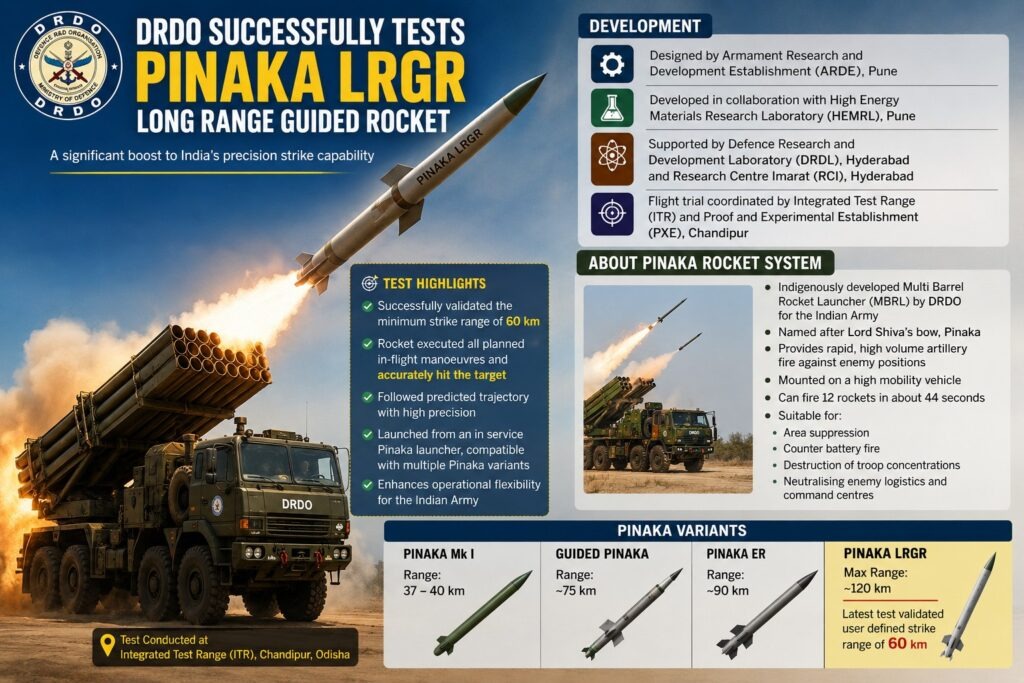
The DRDO successfully test-fired the Pinaka Long-Range Guided Rocket from the Integrated Test Range in Chandipur, Odisha. The test validated a 60-km minimum operational range for the 120-km class precision weapon, confirming it can eliminate close-range dead zones while using standard, in-service launch vehicles.
BALASORE, India — In a major step forward for its indigenous artillery capability, India successfully conducted a flight test of the Pinaka Long-Range Guided Rocket (LRGR) off the coast of Odisha.
The precision-strike trial was carried out on July 8, 2026, by the Defence Research and Development Organisation (DRDO) from the Integrated Test Range (ITR) in Chandipur. According to formal statements released by the Union Ministry of Defence, the high-altitude rocket completed all planned in-flight maneuvers and struck its maritime target with textbook precision, marking an intentional shift toward highly versatile, deep-strike military hardware.
Technical Validation of the Expanded Engagement Envelope
The primary engineering objective of the Chandipur test was to validate the Pinaka LRGR's user-defined minimum operational range of 60 kilometers. For long-range rocket artillery, clearing a minimum-range threshold is considered just as crucial as hitting maximum distance parameters. A platform engineered to travel up to 120 kilometers must shed immense energy and execute steep tactical adjustments to hit a target situated only half that distance away.
By successfully clearing the 60-kilometer envelope, the DRDO proved that the weapon has no operational "dead zone" immediately in front of its deployment lines, providing seamless coverage across its entire 60-to-120 kilometer strike radius.
The physical launch was executed using a standard, in-service Pinaka launcher vehicle. This operational approach confirmed that variants of different ranges can be fired from the same platform without requiring modified launch systems or newly built battery vehicles.
Throughout its flight path, the artillery rocket was actively tracked by an array of high-fidelity range instruments, including telemetry systems, tracking radars, and electro-optical targeting pods, all of which confirmed that the weapon followed its predicted trajectory.
Inter-Laboratory Collaboration and Mass Production Integration
The development of the Pinaka Long-Range Guided Rocket represents a multi-institutional effort across the DRDO’s specialized research divisions:
Armament Research and Development Establishment (ARDE): Led the primary structural design and physical system integration.
High Energy Materials Research Laboratory (HEMRL): Formulated the high-impulse solid propellant motors required to push past the 100-kilometer barrier.
Research Centre Imarat (RCI) & DRDL: Provided the specialized guidance packages, matching the missile's micro-navigation fins with the Indian Regional Navigation Satellite System (IRNSS/NavIC) grid.
The successful trial directly accelerates the Indian Army’s long-term plan to modernize its border artillery divisions. The military currently operates seven active Pinaka regiments, with an eighth scheduled to achieve operational status by late 2026.
The defense acquisition roadmap calls for expanding this deployment to 22 regiments over the coming years. This rollout will progressively phase out aging, Soviet-era BM-21 Grad area-saturation systems with highly accurate, indigenous precision-guided assets capable of operating effectively along the high-altitude northern and western borders.
Official Sources Section
Operational test data, design groups, and technical telemetry parameters correspond to formal press releases distributed by the Press Information Bureau (PIB) on behalf of the Ministry of Defence. Strategic acquisition timelines match long-term procurement proposals vetted under the supervision of the Defence Acquisition Council (DAC).
Defense and Leadership Commentary
"The successful flight test of the Pinaka Long-Range Guided Rocket is another milestone towards enhancing the precision-strike capability of the Indian Army," stated Union Defence Minister Rajnath Singh in a commendation note issued to scientists. "This successful trial underscores our growing indigenous capabilities to design, refine, and deploy advanced long-range rocket systems that reduce foreign dependencies."
"According to officials who monitored the Chandipur launch, the integration of advanced navigation modules has successfully transformed the Pinaka from an area-bombardment saturation tool into a pinpoint counter-battery weapon. This allows field commanders to neutralize enemy command links, supply lines, and radar hubs deep within hostile territory while using existing launcher frameworks."
Why It Matters
For frontline military personnel and national defense planners, the successful induction of the 120-km class guided Pinaka doubles the reach of standard domestic rocket artillery, giving troops strong "shoot-and-scoot" capabilities to counter threats without exposing launcher vehicles to enemy return fire. For the domestic aerospace sector, the weapon's proven accuracy boosts its profile in international defense markets, where countries like Armenia have already placed multi-million dollar orders for the platform.
Key Facts at a Glance
Test Benchmark: Pinaka Long-Range Guided Rocket cleared its user-defined minimum strike range of 60 km.
Maximum Reach: The upgraded guided projectile features a deep-strike range extending up to 120 km.
Platform Versatility: Fired from an in-service launcher, proving multiple variants can utilize identical infrastructure.
Fleet Expansion: The Indian Army plans to scale its rocket artillery fleet from seven to 22 regiments over the long term.
Frequently Asked Questions
How does a guided rocket differ from a conventional artillery rocket?
Conventional rockets are unguided area-saturation weapons designed to blanket a broad grid. Guided variants integrate nose-mounted control fins, sensors, and satellite navigation to adjust their path mid-flight, hitting specific targets with high accuracy.
Why is testing a 'minimum range' important for this long-range system?
Validating the minimum range ensures that a weapon built for long distances can shed energy to hit closer targets. This removes any close-range "dead zone" in front of the launcher battery.
Which corporate entities manufacture the Pinaka system components?
While designed by the DRDO, mass assembly is handled by Indian industry partners, including Larsen & Toubro (L&T) and Tata Advanced Systems, under technology transfer frameworks.
Source: Official testing summaries published by the Press Information Bureau, engineering layout indices archived by the Armament Research and Development Establishment, and defense procurement registers monitored by the Ministry of Defence.