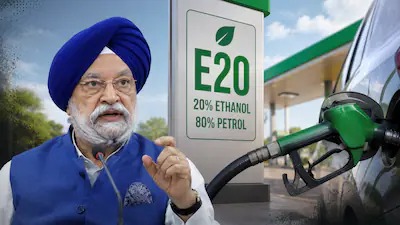
Union Petroleum Minister Hardeep Singh Puri has dismissed concerns over E20 fuel, labeling claims of engine damage as "misinformation." Backed by automobile industry data and scientific testing, the government reaffirmed the safety of ethanol blending, emphasizing its role in reducing India's crude oil imports and boosting the agricultural economy.
Union Petroleum Minister dismisses social media rumors, reaffirming that India’s ethanol-blended petrol is scientifically tested and safe for vehicles.
NEW DELHI — Union Minister for Petroleum and Natural Gas Hardeep Singh Puri has categorically rejected recent social media claims suggesting that E20 ethanol-blended fuel causes engine damage or mechanical failure. During a press briefing in Jodhpur and subsequent clarifications in New Delhi this week, the Minister dismissed the allegations as "misinterpretation" and urged citizens to rely on scientific evidence rather than anecdotal misinformation.
The controversy surrounding E20 fuel—petrol blended with 20% ethanol—has gained traction in recent weeks, driven by viral social media posts and political commentary claiming reduced mileage and engine performance issues. Addressing these concerns, Minister Puri stated that the government remains open to constructive, fact-based criticism but labeled the circulating narratives regarding pests, fuel pump failures, and engine degradation as "rumors."
Scientific Backing and Industry Consensus
Minister Puri emphasized that the national rollout of E20 fuel was not an overnight decision but a result of extensive research and consultation with automobile manufacturers. According to the Minister, there are currently 20 crore two-wheelers and 20 lakh four-wheelers operating on E20 fuel across India, with no widespread reports of failure from service centers or Original Equipment Manufacturers (OEMs).
Leading automakers, including Maruti Suzuki, Toyota Kirloskar, and Hero MotoCorp, have publicly corroborated the government's stance. Industry representatives, citing millions of kilometers of real-world data and laboratory testing, have confirmed that vehicles calibrated for E20 perform efficiently without accelerated wear and tear.
"The automobile manufacturers, as well as the people who service these vehicles, all say there is no difficulty," Puri remarked. He further noted that the ethanol blending program is a long-standing initiative, with India having successfully transitioned from E15 to E20 fuel over the past three and a half years.
Future Blending Targets and E25 Testing
Responding to public speculation regarding a potential move toward higher ethanol blends, such as E25, the Minister clarified that no decisions have been finalized. He stated that the government is currently conducting comprehensive tests on E25 fuel and that any future shift in policy would be strictly contingent upon the results of these scientific evaluations and collaborative discussions with industry stakeholders.
The government’s ethanol program serves as a strategic pillar for India's energy security. By increasing the use of biofuels, the Ministry of Petroleum and Natural Gas aims to reduce the nation's reliance on imported crude oil, stabilize energy costs, and provide additional income streams for the domestic agricultural sector, particularly sugarcane farmers.
Official Sources and Stance
According to official announcements, the E20 mandate is supported by rigorous testing conducted by the Automotive Research Association of India (ARAI) and the Society of Indian Automobile Manufacturers (SIAM). These agencies have consistently maintained that E20-compatible vehicles meet high safety and durability standards. The government also clarified that insurance companies and OEMs have affirmed that the use of E20 fuel does not void vehicle warranties.
Why It Matters
The push for E20 fuel is vital for India’s economic and environmental goals. Beyond curbing crude oil import bills—which shields the economy from global market volatility—the transition to bio-blended fuel is a critical component of India’s decarbonization strategy. As the country balances energy demands with sustainability, the government's insistence on evidence-based policy underscores a commitment to maintaining consumer confidence while fostering green energy adoption.
Key Facts at a Glance
Safety Assurance: Government and industry leaders confirm E20 fuel is scientifically tested and safe for compatible vehicles.
Market Reach: Over 20 crore two-wheelers and 20 lakh four-wheelers are currently utilizing E20 fuel.
No Warranty Impact: Insurance providers and manufacturers have clarified that using E20 does not affect vehicle insurance or warranty coverage.
Future Policy: Any transition to E25 or higher blends remains subject to ongoing testing and stakeholder consultation.
Economic Goals: The program aims to reduce dependency on crude oil imports and support domestic agriculture.
FAQ Section
1. Is E20 fuel safe for my vehicle?
Yes, industry experts and the government state that E20-compatible vehicles have undergone rigorous testing and can safely use the fuel without engine damage.
2. Why do some people claim E20 causes engine damage?
Officials attribute these claims to misinformation. Manufacturers note that there is no empirical evidence linking E20 fuel to increased engine wear, and many viral reports are based on unverified anecdotal claims.
3. Does using ethanol-blended fuel void my vehicle's warranty?
No, OEMs and insurance providers have clarified that using E20 fuel in compatible vehicles does not void warranties or affect insurance claims.
4. Is the government planning to increase ethanol blending beyond 20%?
While tests on E25 are underway, the government has stated that any decision to increase blending will only occur after thorough scientific review and consultation with industry partners.
Source: Ministry of Petroleum and Natural Gas, Press Information Bureau (PIB), Automotive Research Association of India (ARAI), Society of Indian Automobile Manufacturers (SIAM)