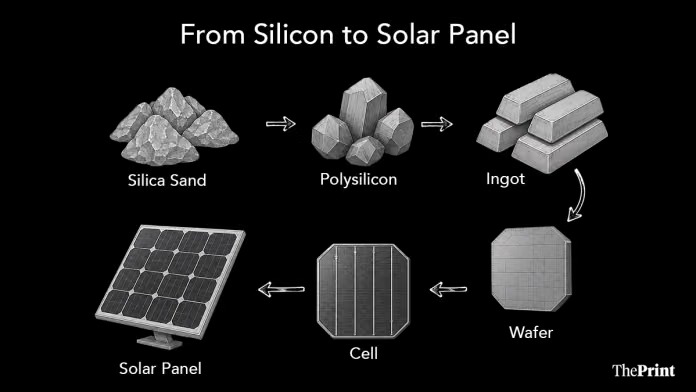
India is moving to establish a domestic polysilicon manufacturing base targeting 30 GW of capacity to strengthen its clean energy supply chain. As the country scales its renewable infrastructure to meet long-term decarbonization goals, policymakers are shifting focus from downstream module assembly to upstream material production.
Expanding the Domestic Solar Value Chain
While India has rapidly expanded solar photovoltaic module and cell capacities over recent years, upstream segments such as ingots, wafers, and polysilicon remain heavily dependent on imports. To bridge this industrial gap, the Ministry of New and Renewable Energy (MNRE) is designing targeted policy support to incentivize domestic production of critical raw materials.
According to official briefings shared at industry forums hosted by the Confederation of Indian Industry (CII), the strategic push aims to build an integrated manufacturing ecosystem. By encouraging domestic polysilicon output alongside ingot and wafer fabrication units, policymakers seek to insulate the domestic renewable sector from global supply chain vulnerabilities and pricing volatility.
Strategic Goals and Industrial Impact
The scaling of upstream solar manufacturing carries significant implications for domestic manufacturers, project developers, and national energy security:
Reducing Import Concentration: Establishing local polysilicon plants aims to diversify sourcing channels and reduce reliance on dominant international suppliers.
Policy Integration: The proposed frameworks complement existing production-linked incentive schemes, aligning module assembly targets with upstream material self-reliance.
Long-Term Cost Stability: Localized production of foundational solar inputs helps protect domestic developers from external supply disruptions.
Official Sources Section
"According to official statements from ministry representatives, strengthening upstream manufacturing capabilities is essential to ensure long-term industrial resilience and support India's expanding clean energy infrastructure."
Why It Matters
For clean energy investors and domestic manufacturers, establishing a domestic polysilicon supply chain eliminates a critical bottleneck in solar panel production. Securing local access to high-purity polysilicon ensures that India's massive renewable installation pipeline remains resilient against international trade friction and supply shortages.
Key Facts at a Glance
Strategic Target: Expanding domestic polysilicon and upstream component manufacturing capacity.
Core Objective: Reducing import dependence and building a fully integrated solar supply chain.
Key Stakeholders: Ministry of New and Renewable Energy and domestic industrial associations.
Broader Context: Supporting India's long-term non-fossil fuel capacity expansion goals.
Frequently Asked Questions
Why is polysilicon important for solar manufacturing?
Polysilicon serves as the fundamental raw material required to manufacture silicon wafers and solar cells, making it the bedrock of photovoltaic technology.
What challenges does India's current solar manufacturing sector face?
While India possesses extensive module and cell assembly capacity, it relies heavily on imports for upstream materials like polysilicon, ingots, and wafers.
How does the government plan to encourage domestic production?
Policymakers are formulating targeted production-linked incentive structures and regulatory frameworks to attract private investments into upstream solar manufacturing facilities.
Source: Ministry of New and Renewable Energy, Confederation of Indian Industry, The Economic Times Energy