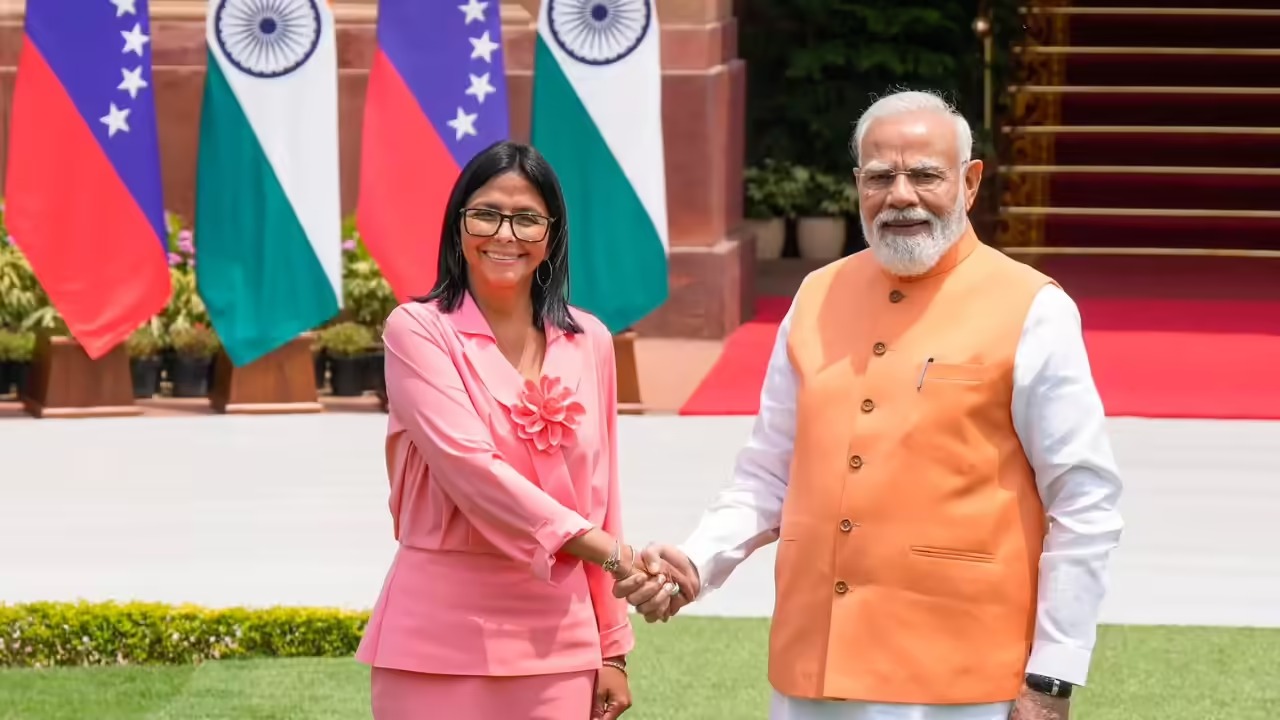
India is expanding its energy footprint in Venezuela, deploying a technical delegation to explore upstream and downstream opportunities following an official invitation from Acting President Delcy Rodríguez. This initiative aims to strengthen India's energy security and diversify import channels amid ongoing geopolitical disruptions in traditional West Asian supply routes.
NEW DELHI — India's Ministry of Petroleum and Natural Gas has announced that Indian commercial entities are prepared to expand their operational presence in Venezuela following a high-level diplomatic summit in the capital. Venezuela's Acting President Delcy Rodríguez extended an official invitation for an Indian energy delegation to visit the country and explore fresh hydrocarbon opportunities. This strategic move arrives as India aggressively broadens its global crude oil supply network to shield domestic markets from intensifying shipping bottlenecks and price swings in West Asia.
Strategic Shift Drives Supply Diversification Efforts
As geopolitical conflicts complicate standard transit paths through the Strait of Hormuz, India the world's third-largest oil importer is prioritizing import diversification to guarantee price stability at home. Union Minister for Petroleum and Natural Gas Hardeep Singh Puri detailed that India’s advanced refining facilities and deep market demand match perfectly with Venezuela’s vast proven heavy oil reserves, creating a highly stable economic link.
Recent industrial indicators reveal that Venezuela has rapidly climbed to become India's third-largest crude supplier through spot purchases. Both sovereign nations are now looking to transform this temporary commercial surge into fixed, long-term energy contracts spanning both upstream exploration and downstream distribution channels.
Technical Mission Prepares for On-Site Resource Assessments
To transition these state-level talks into firm projects, Minister Puri confirmed that a specialized Indian technical team will soon travel to Caracas. This delegation, comprised of technical experts and executives from top Public Sector Undertakings (PSUs), will evaluate idle fields, assess production infrastructure, and pinpoint fresh development tracts within the Orinoco Belt.
Indian state enterprises like ONGC Videsh Limited (OVL) hold historical project shares in the San Cristóbal and Carabobo blocks. The upcoming technical mission intends to resolve standing dividend repatriation hold-ups while introducing modern execution frameworks designed to revive underperforming fields.
Official Sources Section
Bilateral benchmarks and logistical timelines were finalized using official statements issued by the Ministry of External Affairs (MEA) alongside joint ministerial updates released directly by the Ministry of Petroleum and Natural Gas. The primary state corporate entities slated to direct these joint commercial operations include:
Quote Section
"Venezuela possesses the biggest proven reserves of oil in the world, while India not only possesses huge demand for energy, but also has the technological expertise and manpower to refine Venezuelan crude in our refineries. Our technical team will visit Venezuela soon to further explore this potential."
— Hardeep Singh Puri, Union Minister for Petroleum and Natural Gas
"The message that came across very clearly from the Venezuelan side is that they are open for business, they are reforming their industry, so there are great opportunities for India. And our response to that was that we are willing, our companies are willing, and we will take steps to facilitate that as a government."
— Rudrendra Tandon, Secretary (East), Ministry of External Affairs
Why It Matters
For Indian consumers and corporate businesses, broadening energy ties with South America provides a direct buffer against inflationary shocks at the pump. By expanding direct ownership in overseas fields and securing long-term supply volumes, Indian refiners can stabilize fuel production expenses. This structural shield helps keep retail transportation, logistics, and manufacturing operations running smoothly across the country during global energy supply shortfalls.
Key Facts at a Glance
Delegation Scheduled: A specialized technical team from India will soon visit Venezuela to inspect upstream oil assets.
Top-Tier Supplier: Easing trade flows pushed Venezuela up to become India’s third-largest crude supplier in recent weeks.
Infrastructure Synergy: India provides advanced refining infrastructure optimized to process the heavy crude varieties native to Venezuela.
Existing Footprint: Major Indian state firms like OVL, IOCL, and OIL intend to expand their existing joint-venture assets.
FAQ Section
Why is an Indian energy delegation traveling to Venezuela?
Following a direct invitation from Venezuela's leadership, the technical delegation will analyze active fields, resolve operational challenges, and identify new exploration partnerships to strengthen long-term import security.
How does heavy crude from Venezuela fit Indian refineries?
Indian public and private refiners operate some of the most advanced complex processing plants worldwide, which are uniquely configured to process heavy, dense Venezuelan crude efficiently.
Which Indian companies are steering this energy push?
State-run enterprises including ONGC Videsh Limited (OVL), Indian Oil Corporation (IOCL), and Oil India Limited (OIL) are leading the expansion of India's commercial presence.
Why is diversifying oil sources vital for India right now?
India imports roughly 90% of its crude supply. Disruptions along conventional shipping corridors in West Asia require securing alternative, stable supply points to keep domestic fuel costs under control.
Source: Ministry of External Affairs Official Briefings, Ministry of Petroleum and Natural Gas Statements.