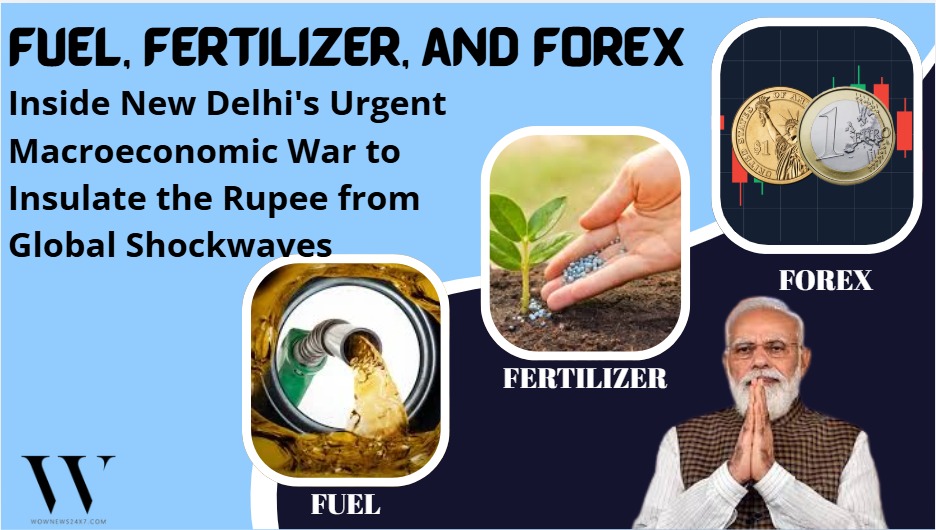
India is actively addressing its "3F" macroeconomic vulnerabilities—Fuel, Fertilizer, and Foreign Exchange—as geopolitical tensions in West Asia impact global commodity markets. The government's strategy focuses on stabilizing the rupee, optimizing agricultural subsidies, and curbing non-essential imports to shield the domestic economy from imported inflation and protect its national reserves.
NEW DELHI, India — The Union Government has mobilized an urgent policy framework addressing the interconnected "3F" macroeconomic challenges—Fuel, Fertilizer, and Foreign Exchange. In official statements delivered during late May and early June 2026, Union Finance Minister Nirmala Sitharaman flagged these sectors as primary external-sector vulnerabilities. Ongoing shipping disruptions and elevated commodity prices linked to the West Asia conflict continue to pressure India's trade balance.
As the crucial Kharif sowing season advances across the subcontinent, policymakers face an essential balancing act. The administration must prevent volatile global energy prices from triggering domestic food inflation while concurrently slowing the depletion of national foreign exchange reserves. This development highlights India’s immediate focus on conserving external capital buffers and accelerating structural import substitution.
The Fuel and Fertilizer Dependency Blueprint
India's exposure to international commodity shocks stems from deep structural dependencies on imported raw materials. According to data compiled by the Ministry of Petroleum and Natural Gas, India imports approximately 88.5% to 89% of its total crude oil requirements. With international Brent crude benchmarks hovering above the $100-per-barrel threshold due to maritime transit risks in the Gulf region, the country's annual energy import bill faces substantial upward revisions.
Simultaneously, the agricultural sector remains highly sensitive to global input pricing. India depends heavily on international suppliers for finished chemical fertilizers and foundational chemical feedstocks, including liquefied natural gas (LNG), ammonia, and rock phosphate.
To prevent these surging input costs from directly impacting rural farmers and escalating food item pricing, the government has substantially increased its budgetary allocations for agricultural subsidies. However, absorbing these costs at the state level places additional strain on the country's fiscal deficit targets.
Managing Forex Reserves and Stabilizing the Rupee
The third element of the 3F framework involves managing India's foreign exchange assets. Increased dollar outflows required for high-value oil and fertilizer shipments have expanded the Current Account Deficit (CAD). Consequently, the Indian Rupee has experienced downward pressure, crossing the 95-per-dollar threshold in recent exchange sessions.
To counter rapid currency depreciation, the Reserve Bank of India (RBI) intervened actively in currency markets by selling dollars to smooth excess volatility. These operations, alongside record spending on gold imports and outbound discretionary travel, contributed to a noticeable contraction in total reserves:
| National Macroeconomic Metric | Registered Value (May-June 2026) | Strategic Policy Context |
| Total Foreign Exchange Reserves | Approx. $690.69 Billion | Down $38 billion over a two-month period |
| Crude Oil Import Dependence | 88.5% - 89.0% | Major driver of inelastic dollar demand |
| Gold Import Valuation (FY26) | $71.98 Billion | Highest historical outbound gold drain |
| Revised Gold Import Duty | 15% Baseline | Hiked from 6% to compress non-essential trade |
Data source: Reserve Bank of India and Ministry of Commerce Statistical Bulletins, May 2026.
Official Sources Section
The economic data, import dependencies, subsidy considerations, and policy responses detailed in this report are sourced from official disclosures by the Press Information Bureau (PIB), regulatory data sets from the Reserve Bank of India (RBI), and ministerial briefings presented by the Ministry of Finance and the Ministry of Commerce & Industry.
Quote Section
"According to officials from the Ministry of Finance, managing external sector pressure requires targeted demand management rather than blanket import restrictions that could inadvertently choke off essential industrial inputs."
Why It Matters
For everyday consumers, domestic businesses, and international investors, the management of the 3F crisis directly impacts daily operating costs. If the rupee continues to weaken against the US dollar, the cost of imported components—ranging from industrial machinery to electronic chipsets—will rise, driving up retail inflation.
By executing strategic interventions, such as adjusting import duties on luxury items like gold and scaling up domestic ethanol blending to substitute crude imports, the government aims to keep transport logistics and food distribution networks stable without increasing retail fuel prices.
Key Facts at a Glance
The 3F Vulnerability: The Ministry of Finance has categorized Fuel, Fertilizer, and Foreign Exchange as the three main external risk channels for the domestic economy.
Forex Corrections: India's primary foreign exchange reserves adjusted to $690.69 billion by May 2026 due to essential market interventions and rising import bills.
Subsidized Reallocation: With international urea prices touching $935 per tonne, state interventions prioritize agricultural input stability to protect domestic food security.
Duty Interventions: The baseline import duty on gold was raised to 15% to actively discourage non-productive outbound capital flows.
Alternative Fuel Gains: Official records indicate that the national ethanol blending program has successfully saved over ₹1.84 lakh crore in foreign exchange to date.
FAQ Section
Q1: Why is the West Asia crisis impacting India’s domestic fertilizer prices?
India relies on the Gulf region for critical fertilizer raw materials like ammonia, sulfur, and natural gas. Shipping re-routings and regional tensions have increased global transit fees and supply constraints, raising international spot prices.
Q2: How does the national ethanol blending program help conserve foreign exchange reserves?
By blending locally produced sugarcane and grain-based ethanol into commercial petrol, India substitutes a portion of its refined petroleum products with domestic biofuels, lowering the total volume of crude oil that must be purchased using US dollars.
Q3: What are the risks of using aggressive import reduction strategies to save foreign exchange?
Leading economic analysts note that broad import cuts can restrict access to crucial intermediate capital goods, semiconductors, and specialized manufacturing inputs, which could slow down domestic factory output and broader GDP growth.
Source: Ministerial notifications issued via the Press Information Bureau (PIB); statistical balance sheets published by the Reserve Bank of India (RBI); and current global trend briefs from the International Monetary Fund.