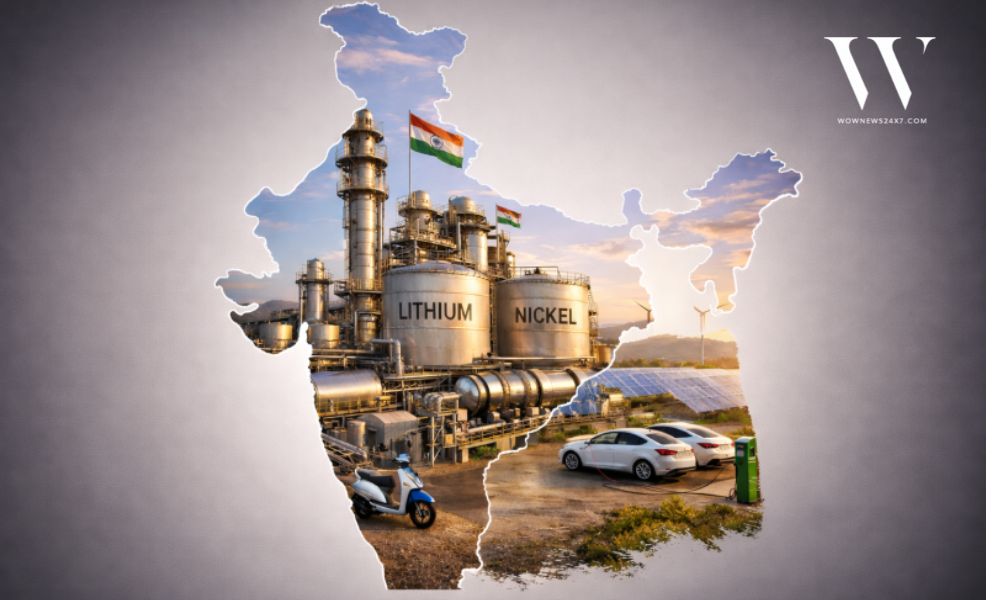
India is set to unveil a ₹30 billion incentive package to boost domestic lithium and nickel processing. The plan offers a 15% capital subsidy starting April 2026 to build crucial midstream refining capacity, aiming to secure local EV battery supply chains and reduce total import dependence on dominant global suppliers.
NEW DELHI, India — The Government of India is preparing to launch a new financial incentive package with an estimated outlay of ₹30 billion (approximately $360 million) to establish domestic industrial units for processing lithium and nickel. According to official government documents and sources familiar with the matter, the proposal has been drafted by the Ministry of Mines under the broader framework of the National Critical Mineral Mission. The high-stakes policy intervention is designed to urgently seed midstream refining infrastructure within the country, addressing a major structural vulnerability in India's clean energy transition and advanced manufacturing sectors.
Subsidizing the Midstream Critical Mineral Bottleneck
The upcoming incentive scheme directly targets India's lack of commercial-scale refining facilities for battery-grade materials. While the country has aggressively accelerated the upstream auctioning of raw critical mineral blocks over the past year, it currently possesses negligible capacity to chemically process raw lithium and nickel into precursor components like lithium carbonate or nickel sulphate.
According to a copy of the government presentation reviewed by Reuters, the policy intends to correct this imbalance by offering a direct 15% capital subsidy for eligible processing projects. To ensure that public funds are explicitly tied to physical manufacturing output rather than passive capacity hoarding, the subsidy disbursements will be phased. The financial support will be strictly capped as a share of annual sales up to 40% for lithium refining installations and 25% for nickel plants.
The program is structured to run for a duration of five years, specifically targeting projects that commence commercial operations on or after April 1, 2026. Initially, the ₹30 billion fiscal pool is expected to fully back the establishment of two large-scale lithium and two nickel processing facilities, creating a blueprint for private sector replication.
Countering Global Supply Concentrations
The introduction of these midstream incentives comes at a time of acute geopolitical urgency. Data compiled in the 2024–25 Economic Survey, tabled before Parliament by the Ministry of Finance, revealed that India remains 100% dependent on foreign imports for its entire primary supply of lithium, nickel, and cobalt. Most of this supply is heavily concentrated within Chinese processing corridors, which control over 70% of global rare earth mining and up to 90% of refined chemical processing.
This structural dependency poses a direct systemic threat to India’s stated automotive milestones, which target an electric vehicle penetration rate of 30% for private passenger cars and 80% for two-wheelers by 2030. Industry projections from the Council on Energy, Environment and Water (CEEW) indicate that domestic demand for these refined transition minerals will exceed 250 kilotonnes annually by the end of the decade. By de-risking the steep upfront capital expenditure required for chemical refining plants, federal policymakers intend to insulate domestic automakers and battery cell gigafactories from sudden export restrictions, arbitrary quota shifts, or coercive market pricing mechanisms implemented by dominant single-source suppliers.
Official Sources Section
The institutional architecture of the incentive framework is coordinated by the Ministry of Mines and implemented in tandem with the National Critical Mineral Mission guidelines. Statutory background data regarding import vulnerabilities and supply chain dependency ratios are anchored in the official gazette reports published by the Press Information Bureau (PIB) and the annual industrial summaries compiled by the Indian Bureau of Mines.
Government Policy Commentary
"According to officials familiar with the draft presentation, the financial program represents a critical paradigm shift from upstream mining exploration to midstream value addition. The government's objective is to ensure that the raw mineral concessions currently being explored across domestic blocks and overseas joint ventures are refined internally, keeping the high-value manufacturing margins within the Indian industrial ecosystem."
Why It Matters
For domestic automotive manufacturers and green energy storage developers, the local processing of lithium and nickel will stabilize input costs and significantly lower logistics lead times for battery cell manufacturing. For international infrastructure investors and chemical conglomerates, the 15% capital subsidy combined with strict volume guarantees provides a highly secure, de-risked regulatory environment to deploy advanced refining technologies within the South Asian subcontinent.
Key Facts at a Glance
Fiscal Outlay: The Indian government has proposed a ₹30 billion financial incentive pool for critical mineral processing.
Subsidy Structure: Eligible refining projects can claim a 15% capital subsidy starting operational runs on or after April 1, 2026.
Production Caps: Financial pay-outs are tied to active sales, capped at 40% for lithium operations and 25% for nickel units.
Capacity Thresholds: Facilities must achieve minimum annual production capacities of 30,000 metric tons for lithium and 50,000 metric tons for nickel.
Strategic Objective: The initiative seeks to insulate India's 2030 electric vehicle targets from total import dependence on single-source foreign processing markets.
Frequently Asked Questions
What are the minimum capacity requirements to qualify for the mineral processing incentives?
To prevent fragmented, sub-scale industrial operations, the Ministry of Mines requires processing facilities to meet strict minimum annual output thresholds: at least 30,000 metric tons for lithium plants and 50,000 metric tons for nickel refineries.
How does this processing scheme connect to India's mining block auctions?
The processing incentives complement upstream mining by ensuring that ore extracted from newly auctioned domestic blocks or secured via overseas state assets can be directly upgraded into battery-grade chemicals inside India.
Where can corporations check official updates and application windows for the critical mineral schemes?
Official circulars, regulatory criteria, and application portals are hosted directly on the institutional websites of the Ministry of Mines and the Press Information Bureau (PIB).
Source: Ministry of Mines Regulatory Drafts, Press Information Bureau Government Releases, Council on Energy, Environment and Water (CEEW) Critical Mineral Research Reports.