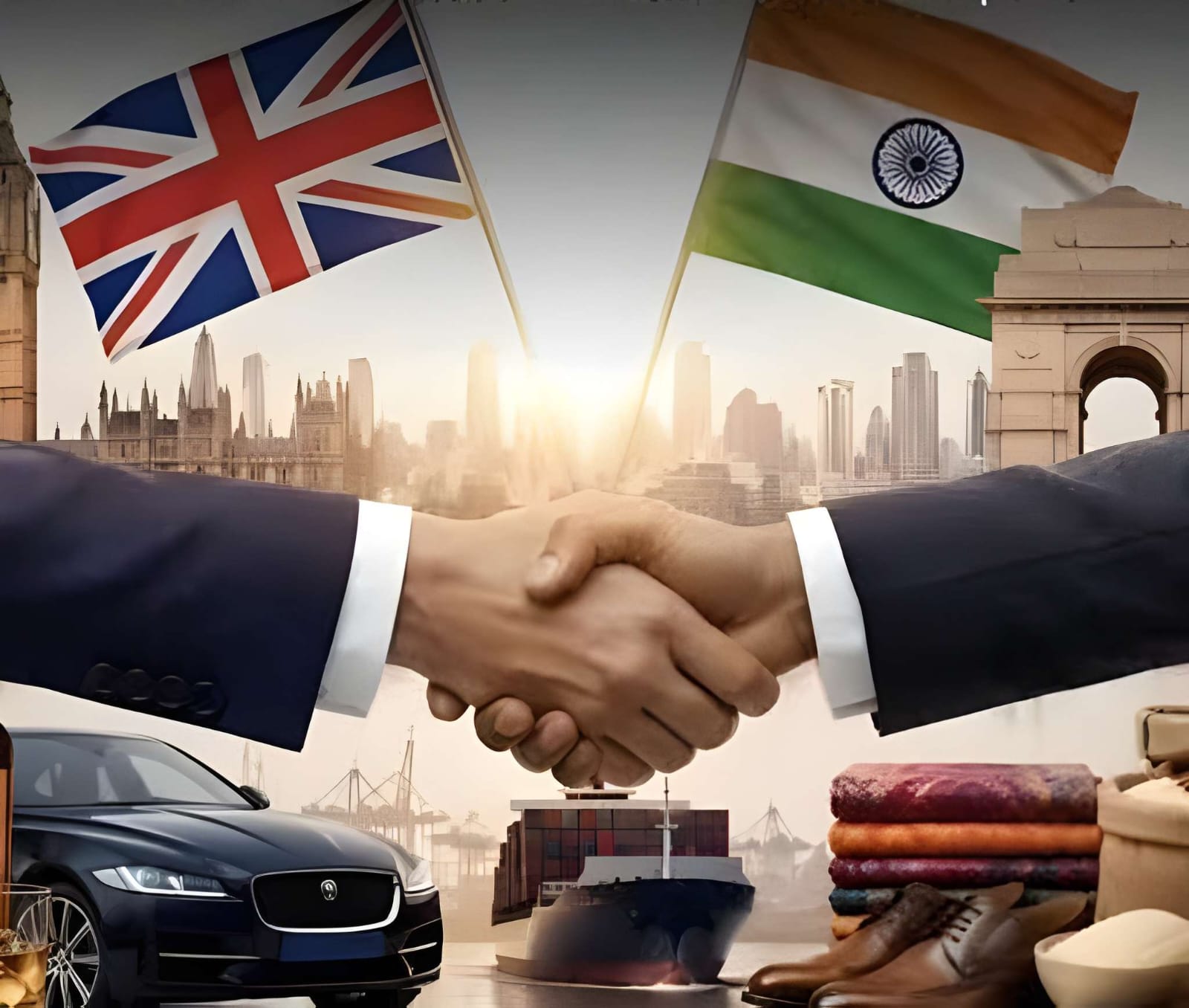
The landmark India-UK Free Trade Agreement will enter into force on July 15, 2026, removing import duties on 99% of Indian exports. The deal also introduces a Double Contribution Convention, redirecting a 25% salary allocation into tax-free Indian Provident Fund accounts for short-term expatriate professionals.
MUMBAI — Union Minister of Commerce and Industry Piyush Goyal announced on Sunday that the historic India-United Kingdom Free Trade Agreement (FTA) will officially enter into force on July 15, 2026. The comprehensive economic and trade agreement removes all British import tariffs on Indian goods and introduces a reciprocal social security framework. This development marks a major shift in bilateral relations, opening market access for Indian manufacturers while directly protecting the earnings of thousands of Indian professionals working temporarily in the UK.
The announcement comes at a crucial moment as both countries look to accelerate post-pandemic growth and diversify global supply chains. Formally known as the Comprehensive Economic and Trade Agreement (CETA), the pact was finalized after fourteen intensive rounds of text-based negotiations. By executing an immediate rollout, the government aims to give Indian exporters an early edge over global competitors in premium Western consumer markets.
Zero Import Duties to Unleash Export Potential
Under the newly finalized trade terms, 99% of Indian merchandise exports entering the United Kingdom will face zero import duty from day one. This tariff elimination is expected to immediately lower costs for small and medium-sized enterprises (MSMEs), domestic industries, and labor-intensive manufacturing clusters. Key sectors such as textiles, footwear, apparel, engineering goods, gems and jewelry, and marine products will see significant competitiveness gains.
According to figures compiled by the Commerce Ministry, the UK imports approximately $3 billion worth of jewelry annually. Industry leaders estimate that removing the standard 2.5% to 4% tariff could help elevate India's annual jewelry exports to the UK toward $2.5 billion, while pushing overall bilateral jewelry trade to nearly $7 billion over the medium term.
Double Contribution Convention Secures PF Benefits
Beyond merchandise trade, Minister Goyal highlighted the implementation of the companion Double Contribution Convention (DCC). Previously, Indian professionals on short-term assignments in the UK had about 25% of their salaries deducted for British social security contributions, receiving no long-term benefits unless they remained in the country for decades.
The new DCC rules change this system for professionals on pre-existing visa routes working in the UK for up to five years. These workers are now completely exempt from making British social security contributions. Instead, that 25% allocation will be safely redirected back into their Employees' Provident Fund (EPF) accounts in India. The funds will earn the standard domestic tax-free interest rate—currently sitting at 8.25% annually—ensuring long-term retirement security for expatriates and their families.
Reciprocal Concessions for British Enterprises
To maintain a balanced trading environment, India has extended matching market access privileges to the United Kingdom. India will reduce or remove tariffs on 90% of its tariff lines for British goods over a phased implementation schedule.
Immediate concessions include cutting the high 150% import tariff on popular British spirits like Scotch whisky down to 75%, with a structured path to reach 40% within ten years. Furthermore, India has introduced a Tariff Rate Quota (TRQ) system for British automobiles. Import duties on internal combustion engine vehicles will drop from over 100% down to a 30% to 50% band initially, before settling at a low 10% rate by the fifth year of the agreement.
Official Sources Section
According to data published by the Ministry of Commerce and Industry and official announcements via the British Department for Business and Trade on the GOV.UK Platform, the pact establishes India's first comprehensive government procurement chapter in an FTA. This clause gives qualified UK firms legal authority to bid for central government procurement contracts worth an estimated £38 billion annually, while legally guaranteeing Indian firms equal access to the UK's procurement system.
Quote Section
"The India-UK trade agreement not only covers merchandise, goods and services but also benefits thousands of Indians working in the UK," Minister Piyush Goyal told reporters during a press conference in Mumbai. "From July 15, any item exported from India to the UK will attract zero import duty. This brings new opportunities and immense possibilities for us all, serving as a testament to Prime Minister Narendra Modi's able leadership."
Why It Matters
The entry into force of this comprehensive trade agreement provides immediate practical advantages for corporate supply chains, tech professionals, and consumer markets alike. By eliminating complex tariff barriers and streamlining customs procedures, the deal provides long-term commercial certainty for businesses looking to diversify their manufacturing networks out of East Asia. For the broader economy, analysts project the pact could help double bilateral trade to approximately $120 billion by 2030, creating high-wage industrial jobs across domestic manufacturing clusters.
Key Facts at a Glance
Launch Date: The India-UK Free Trade Agreement (CETA) and the companion Double Contribution Convention officially take effect on July 15, 2026.
Duty Elimination: Over 99% of Indian exports, including textiles, jewelry, and engineering goods, will enter the UK completely duty-free.
Social Security Victory: Indian professionals on short-term assignments up to five years are exempt from UK social security taxes, saving 25% of their income.
EPF Growth: The retained savings will be deposited into Indian Provident Fund accounts, earning an annual tax-free interest rate of 8.25%.
Reciprocal Tariffs: India will slash high duties on British imports, including dropping Scotch whisky tariffs from 150% down to 75% immediately.
FAQ Section
What items will become cheaper to export to the UK under the FTA?
Starting July 15, almost all Indian goods—most notably textiles, footwear, leather goods, marine items, and gems and jewelry—will enjoy zero import duty, making them highly competitive in the British retail market.
How does the Double Contribution Convention benefit Indian workers?
Indian professionals working temporarily in the UK for up to five years no longer have to pay into the British social security system. Instead, those funds are redirected into their Indian Provident Fund accounts to secure their retirement.
What concessions did India give to British products in return?
India agreed to lower import tariffs on 90% of British product lines over time. This includes an immediate 50% cut on Scotch whisky duties and a phased reduction on high-end British passenger vehicles down to 10% via an annual quota system.
Source: Ministry of Commerce and Industry, GOV.UK Department for Business and Trade, Press Trust of India (PTI).