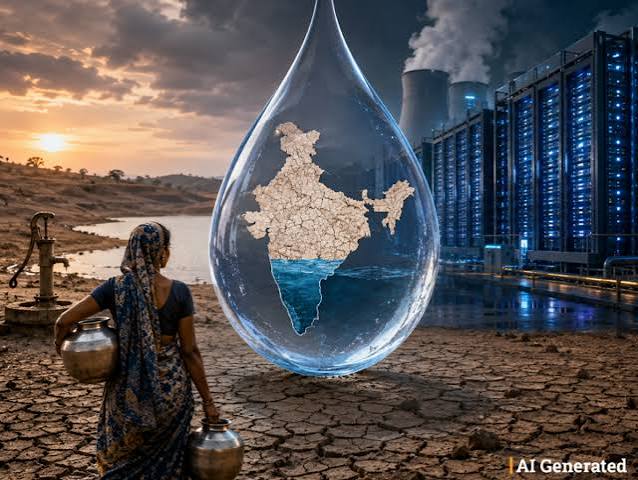
India’s rapid expansion into the AI sector is driving a massive increase in water consumption by hyperscale data centers. With projected water usage reaching 358 billion liters by 2030, the concentration of these facilities in water-stressed cities is fueling a debate over the sustainability of India's digital infrastructure goals.
India is aggressively pursuing a vision to become a world-leading artificial intelligence (AI) hub, fueled by billions of dollars in investments and government-backed tax incentives. However, this digital transformation is creating an unexpected and significant environmental footprint: a massive surge in water consumption. As hyperscale data centers proliferate across the country, experts are warning that the infrastructure required to power the AI economy may be exacerbating water insecurity in India's most populous cities.
The Hidden Cost of AI
Every AI query, whether it is generating an image, drafting text, or processing complex data, occurs within a data center. These facilities house thousands of servers that generate immense heat and require continuous cooling to remain operational.
According to a 2026 report by the Council on Energy, Environment and Water (CEEW), India’s data centers consumed approximately 150 billion liters of water in 2024-25. With the government aiming to reach 6.5 gigawatts (GW) of capacity by 2030, this annual water consumption is projected to more than double to nearly 358 billion liters within four years.
"Data centers are essentially a physical backbone for the digital layer," researchers noted, emphasizing that evaporative cooling—the most common and affordable cooling method—results in a substantial portion of water being lost through evaporation.
Concentration in Water-Stressed Zones
A critical point of contention is the geographical placement of these facilities. Over 65% of India’s data center capacity is currently concentrated in urban centers such as Mumbai, Chennai, Hyderabad, and Bengaluru.
These cities are already struggling with recurring water shortages and declining groundwater levels. For example, Bengaluru, which hosts more than a dozen major data centers, recently navigated a severe water crisis. Critics argue that the current policy framework, which classifies data centers as IT infrastructure rather than large-scale industrial projects, allows these facilities to bypass the rigorous environmental impact assessments required for other major developments.
Official Stance and Governance
Despite growing public concern, a unified national policy governing water use in data centers remains absent. In response to inquiries in Parliament earlier this year, the Ministry of Jal Shakti stated that it had not received specific complaints regarding data center water consumption. Government officials have emphasized that their primary focus remains on strengthening India's digital infrastructure, pointing toward the adoption of advanced cooling technologies like immersion and direct-to-chip cooling as a path forward.
However, independent experts remain skeptical. "There is no publicly available, independently verified evidence of a hyperscale AI data center operating at zero water evaporation for cooling over a sustained period," noted Sangeet Shekhar, an environment policy analyst.
Why It Matters
For citizens, the tension manifests in competing demands for limited municipal water supplies. As data centers occupy peri-urban corridors where agricultural and residential communities rely on shared groundwater, the competition for resources is intensifying. Without a shift toward sustainable cooling technologies—such as reclaimed wastewater or closed-loop systems—or more stringent siting regulations, India risks a future where AI development contributes to the very water scarcity it seeks to solve through computational climate modeling.
Key Facts at a Glance
Surging Demand: Annual water consumption by data centers is expected to rise from 150 billion liters (2024-25) to 358 billion liters by 2030.
High Intensity: A typical 100-megawatt hyperscale data center can consume nearly 2 million liters of water daily for cooling.
Regional Pressure: Nearly 75% of India's data center capacity is located in regions already identified as water-stressed.
Policy Gap: India currently lacks a national binding policy framework specifically targeting water consumption metrics for data center environmental clearances.
FAQ
Why do AI data centers need so much water?
AI processors generate immense heat; data centers use water-based evaporative cooling systems to dissipate this heat to keep servers functioning efficiently.
Are there alternatives to water-based cooling?
Yes, technologies such as closed-loop liquid cooling, immersion cooling, and hybrid dry-cooling exist, though they often involve higher capital expenditure than standard evaporative systems.
Is the government monitoring this?
While state-level policies encourage data center growth, there is currently no federal mandate requiring data centers to report their specific water consumption or to undergo environmental impact assessments.
Source: Council on Energy, Environment and Water (CEEW), Ministry of Jal Shakti (Government of India), Madras Courier, Down To Earth