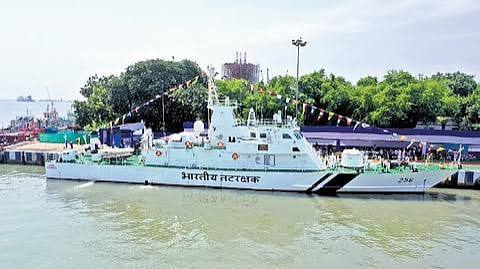
The Indian Coast Guard has commissioned ICGS Akshay, the fourth Adamya-class Fast Patrol Vessel built by Goa Shipyard Limited. Featuring over 65% indigenous content and an innovative Controllable Pitch Propeller propulsion system, the 52-meter vessel is designed to enhance coastal surveillance, anti-smuggling operations, and search and rescue missions.
VASCO, India — The Indian Coast Guard on Saturday officially commissioned Indian Coast Guard Ship (ICGS) Akshay, the fourth vessel in the new-generation Adamya-class series of eight fast patrol vessels (FPVs). The high-speed interceptor platform, designed and manufactured by defense public sector undertaking Goa Shipyard Limited (GSL), was formally inducted into active service during a military ceremony at the GSL facility in Vasco, Goa.
The induction of ICGS Akshay marks a strategic expansion of India’s sovereign maritime patrolling capabilities at a time of escalating regional security requirements. Tasked with safeguarding India's extensive Exclusive Economic Zone (EEZ), the vessel is engineered to immediately address coastal vulnerabilities by executing high-speed interdiction, counter-piracy operations, anti-smuggling drives, fisheries protection, and maritime search and rescue (SAR) operations.
Enhanced Technical Capabilities and Propulsion Innovation
Designated as Yard 1273 during its engineering phase, ICGS Akshay measures 52 meters in length and maintains a structural displacement of approximately 320 tonnes. The ship is engineered to be operated by a specialized complement consisting of six officers and 35 enlisted sailors.
According to technical documentation released by the shipbuilder, the Adamya-class represents the first fleet of FPVs within the Indian Coast Guard to incorporate an advanced Controllable Pitch Propeller (CPP) based propulsion architecture. This specialized system is integrated with twin 3,000 kW marine diesel engines, affording the vessel superior hydrodynamic maneuverability, rapid acceleration profiles, and a operational top speed exceeding 27 knots.
To satisfy the stringent surveillance requirements of coastal law enforcement, the vessel features automated structural frameworks. These include an Integrated Bridge System (IBS), an Integrated Platform Management System (IPMS), and an Automated Power Management System (APMS) to maximize real-time situational awareness.
Indigenous Weaponry and Strategic Deployment
In alignment with federal defense procurement directives, ICGS Akshay features over 65% indigenous component content, illustrating expanding domestic industrial capability in high-end naval architectures. The ship's integrated weapon payload is optimized for close-range maritime combat and enforcement.
The primary armament consists of a stabilized 30mm CRN 91 naval gun mounted on the forward deck. This is supplemented by two 12.7mm stabilized remote-controlled machine guns (SRCG) linked to an optronic fire-control network, enabling precise target tracking under volatile sea states.
Under the operational command of Commandant (Junior Grade) Deepak Choubey, the vessel will bolster fleet readiness along critical shipping lanes. The expansion of this class follows the phased deployments of its sister ships: the lead vessel ICGS Adamya in September 2025, ICGS Akshar in October 2025, and ICGS Amulya in December 2025.
Impact on Maritime Commerce and Logistics
The commissioning of advanced fast patrol vessels exerts a stabilizing effect on commercial maritime stakeholders, global logistics enterprises, and coastal fishing communities. By expanding the density of active patrol assets within territorial waters, the platform minimizes risk metrics for merchant shipping networks susceptible to transnational illicit traffic and piracy. Furthermore, the specialized vessel enhances regional search and rescue safety margins for domestic commercial fishermen operating far offshore during adverse monsoon cycles.
Official Sources Section
The engineering parameters, operational mandates, and administrative details presented in this defense report are corroborated by verified public statements from national authorities. The details of the commissioning event were formalised via institutional logs compiled by the Goa Shipyard Limited Media Bureau.
The broader procurement data, financial evaluations regarding the ₹473 crore contract, and fleet integration strategies are derived from public statements issued by the Ministry of Defence through the Press Information Bureau.
Quote Section
The formal military commissioning was conducted in the presence of senior defense bureaucrats, naval architects, and security commanders.
"According to officials from the Ministry of Defence, the commissioning of ICGS Akshay is a major milestone in the Coast Guard's ongoing fleet modernization programme," the statement noted. "The vessel represents the country's growing self-reliance in state-of-the-art defense manufacturing, directly supporting the Atmanirbhar Bharat and Make in India initiatives to preserve secure and clean seas."
Why It Matters
The steady induction of the Adamya-class series highlights India’s transition away from reliance on foreign shipbuilders for coastal defense assets. By deploying agile platforms equipped with localized supply chains and high indigenous content, the Indian Coast Guard maintains lower lifecycle maintenance costs while achieving rapid operational turnaround times. This self-contained industrial approach ensures long-term defense readiness across India's highly contested maritime borders.
Key Facts at a Glance
Vessel Identity: ICGS Akshay is the fourth of eight contracted Adamya-class Fast Patrol Vessels delivered to the Indian Coast Guard.
Industrial Origin: The vessel was designed, developed, and manufactured indigenously by Goa Shipyard Limited (GSL) under a ₹473 crore contract.
Propulsion Milestone: The class features the first-ever implementation of a Controllable Pitch Propeller (CPP) platform coupled with twin 3,000 kW diesel engines in an ICG FPV.
Localization Metric: The vessel integrates more than 65% indigenous defense components, exceeding baseline local manufacturing benchmarks.
Armament Suite: The combat load includes an automated 30mm CRN 91 naval gun and twin 12.7mm stabilized remote-controlled weapon systems.
Frequently Asked Questions
What does the name 'Akshay' mean for this vessel class?
Derived from traditional Sanskrit terminology, "Akshay" translates to "indestructible." The designation represents the Indian Coast Guard's permanent commitment to maintaining sovereignty, structural resilience, and uninterrupted security across its ocean jurisdictions.
What are the primary operational roles assigned to ICGS Akshay?
The fast patrol vessel is custom-built to execute coastal and offshore surveillance, anti-smuggling and anti-poaching operations, interdiction of illegal vessels, environmental pollution responses, and maritime search and rescue missions.
How does a Controllable Pitch Propeller benefit a fast patrol vessel?
A Controllable Pitch Propeller (CPP) permits operators to alter the pitch of the blades while the engine runs at a constant speed. This allows for sharper maneuverability, rapid deceleration, and better fuel efficiency during high-speed chases or complex rescue operations.
Source: Goa Shipyard Limited Corporate Registry, Ministry of Defence Press Information Bureau.