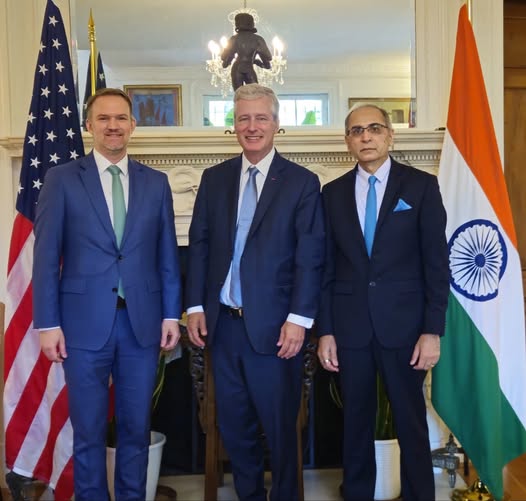
Indian Ambassador to the US Vinay Mohan Kwatra met with Senior Director for Counterterrorism Sebastian Gorka at the National Security Council. The high-level dialogue reviewed global threat matrices and advanced the counter-terrorism directives of the February 2025 India-USA Joint Statement, emphasizing a shared zero-tolerance approach toward regional extremist networks.
WASHINGTON — India’s Ambassador to the United States, Vinay Mohan Kwatra, met with senior US counter-terrorism official Sebastian Gorka on Sunday, June 7, 2026, to evaluate global security matrices and deepen intelligence architectures between the two nations. Held at the National Security Council (NSC) headquarters in Washington, the strategic dialogue prioritized actionable frameworks to curb cross-border militancy and secure maritime corridors. The meeting arrives at a critical juncture as geopolitical shifts and fresh escalations in the Middle East place international security grids under sudden, renewed strain.
Global Threat Matrix Dominates Washington Security Dialogue
The high-level engagement reflects a concerted push by New Delhi and Washington to tighten operational cohesion against asymmetric security challenges. Ambassador Kwatra and Gorka, who serves as Deputy Assistant to the President and Senior Director for Counterterrorism at the NSC, exchanged detailed assessments on changing threats across South Asia and the broader Indo-Pacific.
According to diplomatic communications released following the session, the discussions centered heavily on the operationalization of security clauses formalized during the India-USA Joint Statement of February 2025. Both officials emphasized that keeping a unified defense front is essential to tracking transnational asset networks and preventing localized flashpoints from expanding into broader operational disruptions.
Direct Mandate Targets Transnational Extremist Networks
A major focal point of the bilateral review was the absolute containment of sanctioned regional extremist entities. The diplomats reviewed progress on tracking operational offshoots of global networks alongside prominent regional militant formations.
Official diplomatic statements confirmed that both representatives re-committed their respective enforcement agencies to disrupting groups including:
The joint review directly referenced the historical necessity of preventing catastrophic urban incursions, drawing parallels to the 2008 Mumbai 26/11 attacks and the August 26, 2021, Abbey Gate bombing in Afghanistan. Representatives from both administrations reaffirmed their shared resolve to utilize international regulatory bodies to freeze financing channels and speed up active judicial processes, including the pending domestic extradition procedures of key regional conspiracy suspects.
Official Sources Section
Embassy of India, Washington, D.C.: Diplomatic post-session brief and official social statements by Ambassador Vinay Mohan Kwatra.
National Security Council (NSC): Strategic counter-terrorism outline and protocol briefs.
Ministry of External Affairs (MEA), New Delhi: Bilateral security cooperation tracking archive.
Quote Section
"Had an engaging conversation with Sebastian Gorka, Deputy Assistant to the President and Senior Director for Counterterrorism, National Security Council. We shared perspectives on the threats of terrorism, and our counter-terrorism cooperation outlined in India-USA Joint Statement."
— Vinay Mohan Kwatra, Indian Ambassador to the United States
Why It Matters
The formal meeting between Envoy Kwatra and a top US security strategist establishes that despite shifting trade priorities or domestic political pressures, counter-terrorism alignment remains the foundational bedrock of the India-US comprehensive global partnership. For businesses, international travelers, and digital enterprises, these intelligence-sharing frameworks help stabilize cross-border supply chains and secure electronic commerce networks against malicious non-state interventions.
Key Facts at a Glance
Bilateral Check-In: The meeting served as the primary ministerial evaluation of the counter-terrorism goals established under the February 2025 India-USA Joint Statement.
Key Entities Identified: Enforcement groups from both nations pledged synchronized containment strategies against ISIS, Al-Qaida, LeT, and JeM.
Focus on Past Precedents: Official briefs noted a shared resolve to eliminate the logistical loopholes that led to historical attacks like the 26/11 Mumbai strikes and the Kabul Abbey Gate bombing.
WMD Containment: The defense dialogue reiterated an ongoing commitment to prevent terrorists and non-state actors from accessing weapon systems and advanced drone configurations.
FAQ Section
What was the primary purpose of Ambassador Kwatra's meeting with Sebastian Gorka?
The primary goal was to evaluate global security trends and review the counter-terrorism cooperation initiatives originally outlined in the India-USA Joint Statement. The leaders focused on practical intelligence exchanges to prevent regional militancy.
Which specific security threats were prioritized during the NSC meeting?
The dialogue prioritized the active disruption of transnational extremist networks, including Al-Qaida, ISIS, Lashkar-e-Tayyiba, and Jaish-e-Mohammad, alongside tracking illicit financial pipelines and limiting non-state access to weapons technology.
How does this security dialogue affect broader bilateral relations?
The engagement reinforces the deep institutional ties between New Delhi and Washington's national security wings. It ensures that both democracies continue to operate with a unified policy regarding cross-border terrorism, asset freezing, and international extraditions.
Source: Official diplomatic logs published by the Ministry of External Affairs, press engagement updates distributed by the Embassy of India in Washington, and organizational bulletins archived by the National Security Council.