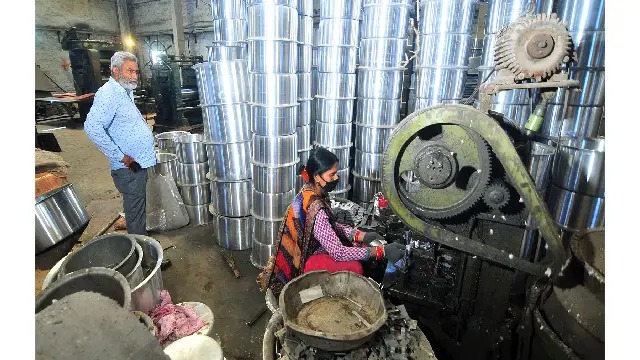
India's top four listed steelmakers are raising their combined annual capital expenditure by 40 per cent to 700 billion rupees ($7.5 billion). Supported by strong domestic infrastructure demand and protective import tariffs extended through 2028, the multi-year capex cycle aims to expand India's total steelmaking capacity from 220 million tonnes to a targeted 300 million tonnes by 2030.
NEW DELHI — India’s primary steel producers are embarking on an extensive, multi-year investment cycle aimed at expanding the nation’s aggregate production capacity to 300 million tonnes by 2030, a major institutional research report confirmed on Tuesday. The heavy capital push comes as soaring local demand for reinforcing bars and structural steel components drives steelmakers to rapidly scale operations.
Aggregate Sector Spending to Hit 700 Billion Rupees
According to a dedicated industrial sector brief published on Tuesday, June 9, 2026, by S&P Global Ratings, the country's top four listed steel producers have authorized a combined 40 per cent year-on-year increase in aggregate capital expenditure (capex) for the 2027 fiscal year. The expanded deployment represents an immediate, one-year investment pipeline of 700 billion rupees ($7.5 billion), up significantly from the 500 billion rupees recorded during the previous 2026 fiscal cycle.
The prominent producers driving this capital deployment JSW Steel Limited, Tata Steel Limited, Steel Authority of India Limited (SAIL), and Jindal Steel and Power Limited collectively control more than half of India’s raw metallurgical output. Industry data shows that the country's operational steelmaking capacity climbed to roughly 220 million tonnes per annum (MTPA) by the close of March 2026. Meeting the central government's National Steel Policy target of 300 MTPA by 2030 will require an estimated annual investment of $15 billion over the next five years, making this current cycle the most capital-intensive expansion phase in regional manufacturing history.
Infrastructure Tailwinds and Protective Import Tariffs
The massive capital deployment aligns with a period of strong operational momentum for the domestic steel sector. Fresh production data released by the Ministry of Steel and the Press Information Bureau (PIB) reveals that finished steel consumption reached 165 million tonnes in the recently concluded fiscal year, supported by active public outlays for railway networks, urban metro lines, highways, and affordable housing. S&P Global analysts forecast that India’s annual steel consumption will expand by more than 50 million tonnes over the next five years.
Furthermore, domestic producers are executing these multi-crore mill expansions under favorable trade conditions:
Suppressed Overseas Competition: Local manufacturers are shielded from low-priced overseas supply blocks due to continuing safeguard duties on cheaper imports.
Tariff Extensions: Originally enacted provisionally in April 2025, the 11 per cent to 12 per cent import duties on select foreign steel classes were officially extended through April 2028 in early 2026.
Price Resilience: This protection has allowed regional mill operators to maintain stable price floors despite broader global shifts.
The combination of trade barriers and strong underlying domestic demand has significantly increased sector-wide earnings. The country's core sample set of steelmakers recorded an aggregate 25 per cent increase in EBITDA, which successfully pushed their collective debt-to-EBITDA ratio down to a multi-year conservative low of 2.4x, giving firms a substantial financial cushion to absorb upfront construction costs.
Active Infrastructure Milestones Across Key States
Major infrastructure projects are already progressing rapidly across several states to meet the newly adjusted capacity milestones. In public corporate declarations, the state-run Steel Authority of India Limited approved an expansion of its Bhilai Steel Plant in Chhattisgarh, targeting a capacity increase from 6.8 MTPA to 10.2 MTPA. Concurrently, JSW Steel recently initiated construction on its phased, integrated steel plant in Paradip, Odisha, while Tata Steel is preparing to expand operations at its Kalinganagar facility.
However, researchers note that the rapid transition brings clear structural challenges. An economic analysis by the Institute for Energy Economics and Financial Analysis (IEEFA) highlights that approximately 64 per cent of India's new capacity under development relies on traditional coal-based blast furnace technology. Because India imports roughly 90 per cent of its coking coal requirements predominantly from Australia reaching the 300 MTPA threshold could increase coking coal imports to 149 million tonnes by 2035, introducing noticeable long-term raw material import risks if international energy benchmarks fluctuate.
Official Sources Section
The capacity benchmarks, investment metrics, and corporate debt statistics were authenticated via the global sector brief issued by S&P Global Ratings and verified through monthly steel production logs published by the Ministry of Steel.
Quote Section
"According to reports from S&P Global Ratings, sector-wide earnings are rising in the Indian steel industry, supported by firm domestic steel prices and healthy demand, making local companies well-positioned to absorb heavy capital outlays beyond fiscal 2027."
Why It Matters
For heavy manufacturing businesses, engineering firms, and construction contractors, the massive domestic capacity expansion ensures a highly stable, locally sourced supply of core structural steel inputs. For capital market participants and institutional investors, the sector's improved debt-to-EBITDA ratio of 2.4x demonstrates that Indian steelmakers are expanding via strong internal cash generation rather than over-leveraging their corporate balance sheets. For everyday citizens, the massive factory expansions create thousands of high-skill industrial jobs across major manufacturing hubs while providing the structural materials needed to build the country’s next generation of public transit networks and modern urban centers.
Key Facts at a Glance
Capital Outlay Expansion: India's top four listed steelmakers are lifting their combined annual capital expenditure by 40 per cent to 700 billion rupees ($7.5 billion).
Strategic Objective: The heavy investment push serves as the launchpad to transition India's total steelmaking capacity from 220 MTPA to a targeted 300 MTPA by 2030.
Macro Balance: Driven by major public infrastructure programs, domestic finished steel consumption reached an impressive 165 million tonnes during the previous fiscal year.
Trade Isolation: Local manufacturers remain protected from cheap foreign dumping by a 11 per cent to 12 per cent import tariff framework active through April 2028.
Leverage Alignment: Strong operational profits have brought the industry's aggregate debt-to-EBITDA ratio down to a healthy multi-year low of 2.4x.
Frequently Asked Questions (FAQ)
What is causing the sudden spike in Indian steel capex?
The 40 per cent increase in capital expenditure is driven by a massive surge in domestic steel demand for public infrastructure projects, alongside a long-term national policy target to reach 300 million tonnes of production capacity by 2030.
Which specific companies are leading this multi-billion-rupee investment cycle?
The investment cycle is led by the country's top four listed producers: JSW Steel Limited, Tata Steel Limited, Steel Authority of India Limited (SAIL), and Jindal Steel and Power Limited.
Are cheap international steel imports a threat to this domestic expansion?
No. The central government extended protective import duties of 11 per cent to 12 per cent through April 2028, effectively insulating domestic steelmakers from low-priced overseas supply during their capacity build-out.
What are the main long-term risks associated with the 300 MT target?
The primary operational risks include potential overcapacity if domestic infrastructure growth slows down unexpectedly, alongside an increased reliance on imported coking coal from international markets to fuel traditional blast furnaces.
Source: S&P Global Ratings Regulatory Newsroom, Ministry of Steel Industrial Data Portals, Press Information Bureau (PIB) Government of India updates, and corporate expansion filings published on June 9, 2026.