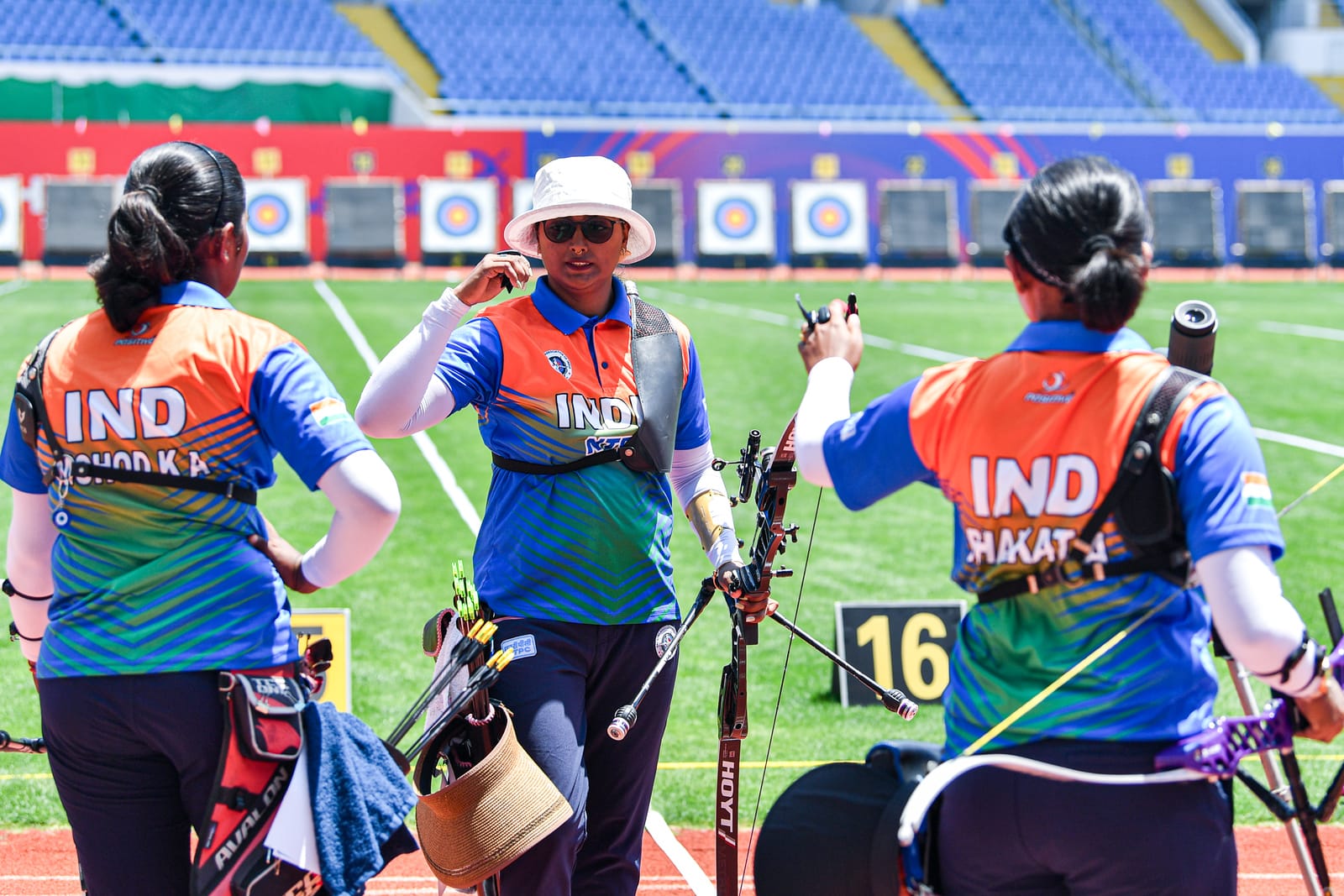
India's women's recurve team — Deepika Kumari, Ankita Bhakat, and 17-year-old debutant Kumkum Mohod — defeated hosts China 28-26 in a nerve-shredding final to clinch gold at the 2026 Hyundai Archery World Cup Stage 2 in Shanghai. This is not just a medal — it is a declaration that Indian archery's golden generation has truly arrived.
In the electrifying lanes of Shanghai's Yuanshen Sports Centre, where the crowd roared for China and the pressure was thick enough to warp a bowstring, three Indian women stood steady, breathed deep, and shot their way into history. Every arrow was a story — of sacrifice, of early mornings, of a sport finally stepping out of cricket's long shadow. When the final score flashed 28-26 in India's favour, the arena fell silent. India had done the unthinkable.
Meet The Golden Three
Deepika Kumari — India's most decorated recurve archer and a five-time Olympian — anchored the team with the authority only experience can provide. At the most critical moments of the final, it was Deepika who delivered the clutch shots, providing stability when the pressure threatened to overwhelm. She remains the heartbeat of Indian women's recurve archery.
Ankita Bhakat, fresh off a stunning Asian Archery Championships gold in 2025 where she defeated Paris Olympics silver medallist Nam Suhyeon of South Korea 7-3, was the team's sharp edge in Shanghai. Her ability to perform under pressure on big occasions has made her one of India's most reliable arrows in the quiver.
Then there is Kumkum Mohod — just 17 years old, competing at her very first Archery World Cup final, and utterly unafraid. The teenage prodigy from Odisha displayed remarkable composure throughout the match, maintaining her rhythm and accuracy in a high-octane clash that would have tested far more seasoned archers. Her performance is the stuff legends are made of.
The Road To The Final
India's campaign in Shanghai was built on a foundation of relentless consistency. In the semifinals, they dismantled a formidable South Korea 5-1 — the same Korean side that has dominated women's recurve archery for over a decade — to book their place in the gold medal match. That result alone announced India's intent to the world.
Meanwhile, Simranjeet Kaur made history earlier in the tournament by becoming the first Indian to reach the individual recurve women's final four at a World Cup stage, defeating her Chinese Taipei opponent in straight sets with scores of 27, 28, and 29. Her journey through the competition added further depth and momentum to India's overall campaign.
The Final Showdown — Arrow By Arrow
The gold medal match against China was a masterclass in mental fortitude. Competing in front of a fiercely partisan home crowd at the Yuanshen Sports Centre, China arrived as heavy favourites with Olympic pedigree and the psychological advantage of familiar ground. India refused to read that script.
From the opening ends, India matched China arrow for arrow. Deepika controlled the tempo, Ankita delivered precision under fire, and young Kumkum — inexperienced on paper but ice-cool in execution — held firm. As the match entered its closing ends, India edged ahead to seal the 28-26 victory that left Shanghai stunned and an entire nation erupting in celebration.
The Rest Of The Squad
The Indian squad in Shanghai was a well-rounded 16-member contingent. The recurve men's team featured Dhiraj Bommadevara (world-ranked 10), Tarundeep Rai, Atanu Das, and Yashdeep Bhoge. In compound events, Sahil Jadhav lit up the tournament by winning an individual bronze — his first-ever World Cup medal — defeating Denmark's Martin Damsbo 147-144 in the bronze medal match. Jyothi Surekha Vennam, Aditi Swami, Ojas Deotale, and Kushal Dalal also featured prominently across categories.
Why This Win Matters Beyond The Medal
This gold is about more than the scoreboard. Archery in India has long been a sport of quiet achievers — producing world-class talent from the tribal belts of Jharkhand, Odisha, and Manipur, yet rarely commanding the headlines its performers deserve. A gold against China, in China, changes that narrative overnight.
For a 17-year-old like Kumkum Mohod, competing without fear on the world's biggest stage, this result sends a powerful message to thousands of young archers training on rural ranges across India — that the path from village fields to World Cup podiums is not a dream. It is a direction.
With the 2028 Los Angeles Olympics on the horizon, Deepika, Ankita, Kumkum, and the entire Indian archery programme have just told the rest of the world exactly where they stand — not in words, but in arrows. Golden ones.
Sources: World Archery Federation, Times Now, Olympics.com, GK Today, The Bridge