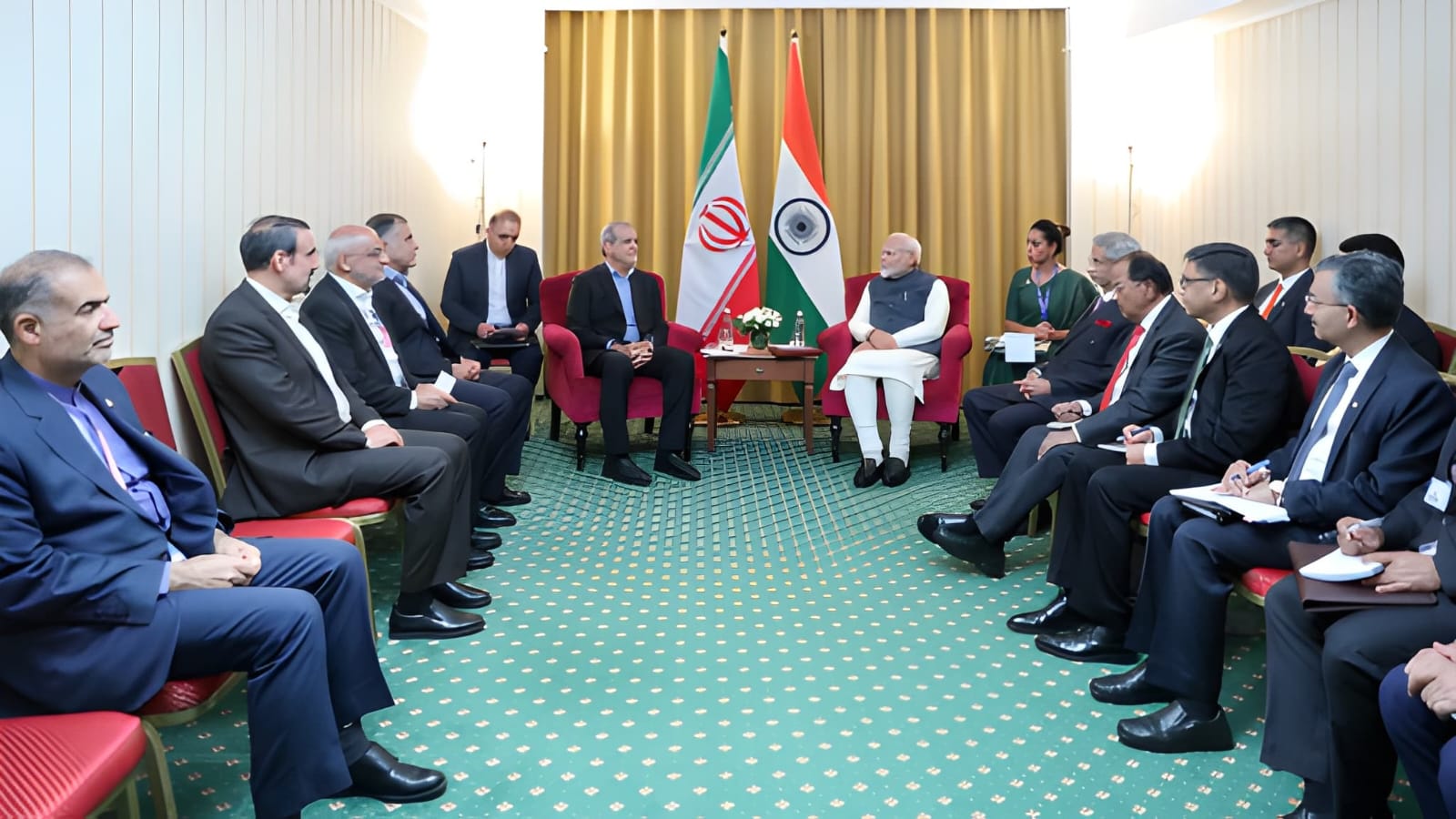
Iranian President Masoud Pezeshkian has formally communicated to Indian Prime Minister Narendra Modi Iran’s commitment to expanding comprehensive bilateral ties. The outreach emphasizes enhanced trade mechanisms, strategic transit cooperation through the Indian-operated Chabahar Port, and coordinated diplomatic engagement within the multilateral BRICS framework.
TEHRAN / NEW DELHI — Iranian President Masoud Pezeshkian reaffirmed Tehran’s commitment to expanding all-round relations with India, signaling a concerted effort by Iran to deepen strategic, economic, and regional transit cooperation with New Delhi. In an official letter addressed to Indian Prime Minister Narendra Modi on the occasion of India's 79th Independence Day, President Pezeshkian highlighted shared civilizational heritage as a cornerstone for future collaboration.
The diplomatic outreach comes ahead of the scheduled 18th BRICS Summit in New Delhi, where both leaders are set to advance high-level bilateral discussions. With both nations seeking to navigate volatile global trade environments and regional security challenges, Tehran’s formal push underscores the strategic imperative of joint transit routes, economic diversification, and maritime security in West Asia.
Expanding Bilateral and Multilateral Strategic Engagement
The communication from Tehran underscores a broader initiative to align foreign policy priorities between Iran and India. During recent diplomatic exchanges, President Pezeshkian emphasized the importance of utilizing multilateral frameworks, particularly within the expanded BRICS coalition, to counter global economic imbalances and foster South-South trade.
According to statements released by the Iranian presidency, the bilateral relationship is built upon historical, cultural, and economic connections. Both administrations have engaged in high-level discussions focusing on removing administrative hurdles for businesses, accelerating joint infrastructure investments, and ensuring trade route security.
Infrastructure and Trade Logistics Focus
Central to the bilateral partnership is the development of the strategic Chabahar Port in southeastern Iran. Operated by India Ports Global Limited (IPGL), the port serves as a critical gateway connecting Indian trade to landlocked Central Asia and Eurasia, bypassing traditional maritime chokepoints.
Economic cooperation discussions between Iranian and Indian trade officials have focused on:
Chabahar Port Expansion: Capital investments managed by IPGL aimed at upgrading terminal operations and expanding freight throughput capacity.
International North-South Transport Corridor (INSTC): Enhancing multimodal transportation networks linking the Indian Ocean through Iran to Russia and Europe.
Trade Working Groups: Resuming joint economic committees to review bilateral trade mechanisms and enable non-dollar transaction settlements.
Official Statements
Details of the high-level communications were made public via official statements from the Iranian presidency portal and the Ministry of External Affairs of India.
According to official releases from Tehran, President Masoud Pezeshkian stated:
"The Islamic Republic of Iran is ready, in the light of mutual trust and respect, and by leveraging vast existing capacities, to take more effective steps to strengthen relations between the two countries and ensure their mutual interests."
Addressing broader economic and multilateral cooperation, Iranian diplomatic representatives stated that friendly nations can rely on Tehran for commercial safety and security in regional transit routes, including the Strait of Hormuz.
Why It Matters
The diplomatic engagement between Tehran and New Delhi carries direct economic and geopolitical implications across several sectors:
For Exporters and Logistics Operators: Expanded operations at Chabahar Port provide Indian and Iranian shipping companies with lower transit times and reduced freight costs toward Central Asian markets.
For Regional Trade Dynamics: Strengthened Iran-India relations reinforce alternative trade corridors, facilitating supply chain resilience outside traditional Western transit frameworks.
For Multilateral Policy: Cooperation inside BRICS allows both nations to coordinate on international trade standards, energy security, and regional conflict de-escalation.
Key Facts at a Glance
Diplomatic Communication: Iranian President Masoud Pezeshkian issued a formal message to Indian Prime Minister Narendra Modi calling for expanded bilateral ties.
Key Infrastructure: Strategic focus remains centered on Chabahar Port, operated by India Ports Global Limited (IPGL).
Multilateral Integration: Both countries are leveraging BRICS mechanisms to deepen economic and energy trade cooperation.
Upcoming Summit: High-level talks between both leaders are slated to continue around the 18th BRICS Summit hosted by India.
Frequently Asked Questions
What is the primary focus of Iran's diplomatic push toward India?
The primary focus is expanding bilateral economic cooperation, improving regional transit networks such as the Chabahar Port, and strengthening multilateral engagement through BRICS.
Why is Chabahar Port significant for India and Iran?
Chabahar Port provides India with direct access to Central Asian and Eurasian markets while allowing Iran to serve as a central regional transit and trade hub.
How does BRICS play a role in Iran-India relations?
Following Iran's full entry into BRICS in 2024, both nations utilize the bloc to discuss trade settlement mechanisms, energy cooperation, and economic ties independent of traditional Western trade routes.
Source: Official statements from the Presidency of the Islamic Republic of Iran, press briefs from the Ministry of External Affairs of India, and reporting by Trend News Agency.