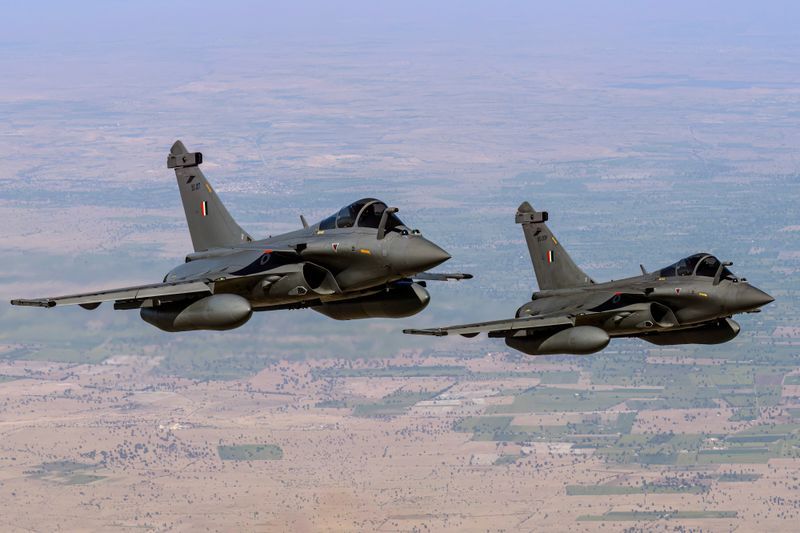
Foreign Secretary Vikram Misri announced that India's talks with France for 114 Rafale fighter jets have advanced, with a strict focus on local manufacturing. The proposed ₹3.25 lakh crore deal will see 94 jets built in India with 50% localization, marking the platform's first production line outside France.
NICE, FRANCE — India has fundamentally altered the parameters of its long-term defense trade with Western Europe. Moving decisively past straightforward overseas purchase models, New Delhi has advanced its mega-defense negotiations with Paris for 114 multirole fighter aircraft, establishing a strict regulatory framework that demands the Rafale fighter jets be manufactured locally within India.
Announcing the milestone during a high-profile diplomatic briefing following delegation-level discussions in Nice on Sunday, June 14, 2026, Indian Foreign Secretary Vikram Misri confirmed that bilateral defense talks have entered advanced stages. The structural shift is critically important today as the Indian Air Force (IAF) faces a severe, multi-year deficit in its operational combat squadron strength. By locking the multi-billion dollar program into a localized infrastructure, the state ensures rapid fleet modernization while protecting domestic industrial jobs and establishing an independent aerospace supply ecosystem.
Technical Allocation of the Joint Manufacturing Program
The proposed multi-role combat aircraft acquisition outlines a clear transition from ready-made imports to extensive domestic assembly lines.
According to data points verified by the Ministry of External Affairs (MEA), India recently issued a formal Letter of Request (LoR) to the French government, initiating a multi-year government-to-government (G2G) contract estimated at approximately ₹3.25 lakh crore ($39 billion). Under the framework, 94 out of the 114 advanced 4.5-generation-plus aircraft are slated to be manufactured on Indian soil through a deep manufacturing partnership between French aerospace giant Dassault Aviation and a shortlisted Indian industrial enterprise.
Advancing ‘Make in India’ in High-Tech Defense
The corporate layout of the deal marks the first time that the highly sought-after Rafale fighter jets will be built outside of French borders, bringing advanced engineering standards to the domestic private sector.
Co-Development, Systems Integration, and MRO Ecosystems
The bilateral talks, led directly by Prime Minister Narendra Modi and French President Emmanuel Macron, moved beyond basic procurement to emphasize long-term technical self-reliance.
According to procurement outlines tracked by The Economic Times, the updated industrial integration map highlights:
Four Pillars of Progress: Future defense partnerships are strictly governed by a four-pronged strategy focusing on co-development, co-design, co-production, and co-manufacturing.
Weaponry Autonomy: The Indian armed forces retain unrestricted authority to integrate indigenous weapons systems—including the Astra long-range air-to-air missile—directly onto the French airframe.
The MRO Network: Advanced maintenance, repair, and overhaul (MRO) centers are being set up concurrently, building on the newly opened Safran facility in Hyderabad to service aircraft engines locally.
Private Industry Contenders: Domestic infrastructure majors, including Tata Advanced Systems and Larsen & Toubro, are being evaluated as key local assembly operators.
Re-balancing Squadron Assets and Regional Air Security
The strategic push arrives as a direct counter-measure to growing regional airspace vulnerabilities, where maintaining localized assembly centers offers a huge logistical advantage over traditional, slow foreign supply streams.
According to regional military data compiled by ANI News, the addition of the new batch will eventually push India's total Rafale inventory past 200 aircraft across the Air Force and Navy. Production timelines reveal that while the first naval-variant Rafale Marines are scheduled to arrive in 2028, the locally manufactured Air Force variants will follow roughly three and a half years from now, giving local defense clusters plenty of time to prepare their high-tech assembly floors.
Institutional Validation and Strategic Diplomacy
Top diplomatic officials emphasize that the massive manufacturing project will operate with absolute clarity, completely removing any private intermediaries from the transaction.
"According to executive briefings managed by the Ministry of Defence, the entire deal is structured as a direct, government-to-government transaction to guarantee absolute financial transparency. The inclusion of a 50% localization clause ensures that half of the multi-billion dollar investment flows directly back into domestic manufacturing hubs."
Foreign Secretary Vikram Misri noted that because the IAF already operates an active fleet of Rafales, the foundational operational dialogue between the two air forces is already well-advanced. The recent high-level talks coincided with the launch of the 'Bharat Innovates 2026' conclave in Nice, further cementing the expanding scientific and industrial ties between the two partner nations.
Why It Matters
For private domestic industries, engineering graduates, and local manufacturing hubs, this historic defense deal opens up thousands of high-skilled aerospace jobs inside the country. By anchoring a massive global supply chain on Indian soil, the project forces top-tier tech transfer and gives local manufacturers rare, hands-on experience building complex 4.5-generation fighter platforms.
For the country's broader strategic position and financial stability, building fighter jets locally provides a permanent shield against sudden global supply line blockades. Eliminating middle-men through a transparent government-to-government deal ensures that taxpayers' money is spent efficiently, building a highly reliable, independent air defense fleet that can be upgraded and maintained inside national borders during critical defense emergencies.
Key Facts at a Glance
The Local Directive: Foreign Secretary Vikram Misri confirmed that advanced Rafale talks with France are centered heavily on local manufacturing.
Production Split: Out of 114 fighter jets in the proposed ₹3.25 lakh crore deal, 94 will be built in India by Dassault Aviation and a local partner.
Global First: This deal marks the first time that the premier Rafale platform will establish a manufacturing footprint outside of France.
Deep Local Content: The contract enforces a strict 50% indigenization standard, alongside full clearance to fit domestic Indian missile systems.
Frequently Asked Questions (FAQ)
Why is the Indian government insisting on local production for the new Rafale jets?
Local production matches the national 'Make in India' directive, keeping defense spending within the domestic economy, building high-tech job clusters, and cutting reliance on foreign supply chains during geopolitical crises.
When will the newly ordered Rafale aircraft begin entering active service?
According to initial production timelines, the first naval Rafale Marines will arrive in 2028, with the domestically built Air Force models rolling out roughly three and a half years from now.
Will Indian-made weapons be compatible with these French-designed aircraft?
Yes, a key condition of the updated government-to-government agreement gives Indian engineers complete authority to integrate custom, domestic weapons and sensor arrays without needing external foreign clearances.
Official Sources Section:
Bilateral statement archives, special press briefing transcripts, and joint innovation initiatives managed by the Ministry of External Affairs (MEA).
Defense production parameters, localization guidelines, and squadron inventory tracking published by the Ministry of Defence.
Aerospace transaction updates, contract cost evaluations, and private industry partner reviews monitored by The Economic Times and ANI News.