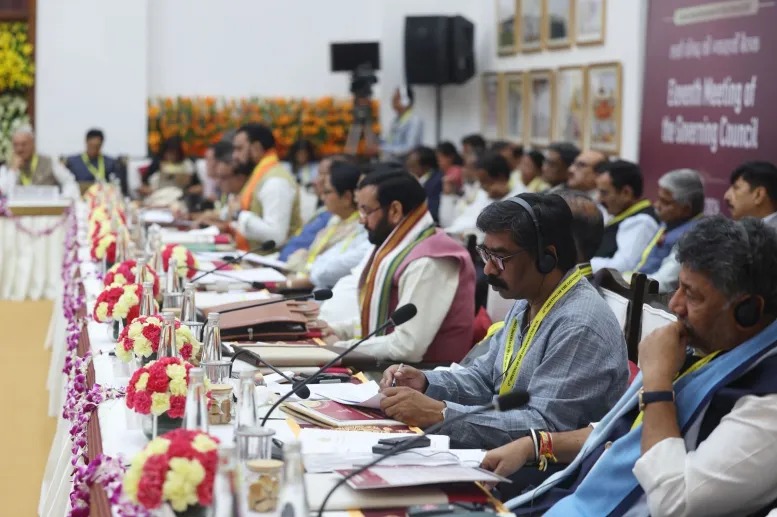
At the 11th NITI Aayog Governing Council meeting, Jharkhand Chief Minister Hemant Soren requested the release of ₹1.36 lakh crore in pending mining dues from central public sector companies. Soren emphasized that these funds are essential to transition the state from a mining economy into a sustainable manufacturing hub.
NEW DELHI — In a major development for federal economic relations, Jharkhand Chief Minister Hemant Soren strongly demanded that the Central Government clear approximately ₹1.36 lakh crore in long-pending mining dues owed to the state. Speaking at the 11th Governing Council meeting of NITI Aayog, chaired by Prime Minister Narendra Modi in New Delhi on Thursday, Soren stated that these massive outstanding funds are critical to accelerating local human capital development and infrastructure initiatives. Presenting a comprehensive economic blueprint, the Chief Minister urged the Union Government to support Jharkhand’s structural transition from a traditional mining-dependent economy into a premium national manufacturing and innovation hub.
Clearing the ₹1.36 Lakh Crore Public Sector Debt
The financial core of Jharkhand’s address centered on the massive unpaid fiscal compensation owed by central public sector undertakings (CPSUs). Soren explicitly called on the Ministry of Coal and major central coal subsidiaries, including Central Coalfields Ltd (CCL) and Eastern Coalfields Ltd (ECL), to settle their outstanding royalty and land compensation liabilities.
According to state administrative records presented during the council, the cumulative unpaid amount has reached ₹1.36 lakh crore. The state government maintains that receiving this withheld capital is a prerequisite for funding its ambitious green-energy and welfare initiatives.
Aside from the primary coal liabilities, Soren requested the immediate release of the remaining ₹6,000 crore allocated to the state under the central Jal Jeevan Mission (JJM) scheme. He noted that timely central funding is essential to expand piped drinking water infrastructure across drought-prone tribal villages.
Pivoting From Mineral Sourcing to Advanced Manufacturing
A key element of Jharkhand's long-term development strategy is moving its economic identity away from basic mineral extraction. Historically, the state has contributed over 25 percent of India's total steel output and managed vast iron ore, bauxite, and rare earth mineral reserves. However, Soren emphasized that mineral wealth alone cannot ensure sustainable development unless it is directly linked to advanced industrial processing.
The state is pushing to attract private sector investment into premium industries, including textiles, automotive electronics, green energy component assembly, logistics hubs, and agro-food processing. Soren stated that the state intends to promote artificial intelligence (AI)-based mineral exploration and sustainable mining practices. This vision draws on global industrial experiences discussed at the World Economic Forum in Davos and recent collaborations with leading technical institutions in the United Kingdom.
Structural Reforms in Land Acquisition and Mineral Funds
To accelerate this manufacturing shift, Jharkhand has requested major structural reforms to clear ongoing bureaucratic bottlenecks:
Land Acquisition Flexibility: The Chief Minister urged the Centre to provide greater flexibility in land-use approvals for social infrastructure projects in districts falling under the direct command of the Damodar Valley Corporation (DVC) and Coal India subsidiaries.
DMFT Framework Overhaul: Soren called for a formal review of the existing District Mineral Foundation Trust (DMFT) norms. The state is pushing for an expanded role for regional governments in direct project planning and fund management to ensure local communities benefit from nearby mining projects.
Industrial Park Expansion: Under the current investment policy, the state is actively setting up Private and Joint Venture industrial parks under the Public-Private Partnership (PPP) model to streamline corporate setups.
Strengthening Human Capital and Social Infrastructure
The Chief Minister noted that India cannot achieve its broader "Viksit Bharat 2047" development goals unless resource-rich states receive equal support to upgrade their basic social sectors. Highlighting social gaps, Soren pointed out that nearly 15,000 of the state's 38,000 Anganwadi childcare centers currently lack their own permanent buildings. While the state is building 5,000 centers using its internal revenues, it requires extra central financial assistance to clear the remaining deficit.
In education and sports, the state requested an increase in the number of central PM SHRI and Kendriya Vidyalayas. It also sought a regional NCERT centre to support curricula in the state’s 32 distinct tribal and regional languages. On skill development, Jharkhand is investing over ₹1,400 crore annually in its "Gurukul Skill Training Model". Additionally, a massive ₹1,200 crore skilling ecosystem is being built with support from the Asian Development Bank (ADB) to prepare the local workforce for emerging sectors like electric vehicles (EVs), drones, and solar energy installation.
Official Institutional Oversight
The governance issues raised during the summit fall under the dual jurisdictional oversight of NITI Aayog and the Ministry of Finance. Inter-ministerial land allocation and public sector debt clearances are managed through standard regulatory frameworks supervised by the Ministry of Coal and the Department of Public Enterprises, ensuring federal compliance across all resource distributions.
Statement from State Leadership Officials
"According to officials accompanying the Chief Minister at the New Delhi summit, Jharkhand must no longer be viewed merely as a source of raw mineral extraction. State representatives stated that the ₹1.36 lakh crore in pending dues represents legitimate sovereign capital belonging to the people of the state. Securing these funds will play a decisive role in building a modern, self-reliant manufacturing economy."
Why It Matters
Resolving federal fiscal disputes directly impacts regional economic growth and job creation. If the Centre clears the requested ₹1.36 lakh crore in mining dues, it will give Jharkhand the capital needed to upgrade its roads, power grids, and tech hubs. For businesses and international investors, this transition creates an attractive, well-connected destination for setting up green manufacturing plants outside hyper-congested metro zones.
Key Facts at a Glance
Sovereign Demand: Jharkhand requested the immediate release of ₹1.36 lakh crore in outstanding coal mining dues from the Centre.
Water Allocation: The state urged the timely disbursement of its remaining ₹6,000 crore under the Jal Jeevan Mission.
Economic Transition: The state is actively moving from a mining-dependent framework toward high-tech manufacturing, electronics, and textiles.
Infrastructure Deficit: Chief Minister Soren highlighted that 15,000 local Anganwadi centers still lack permanent buildings.
Skilling Investment: A new ₹1,200 crore skilling ecosystem is being deployed in partnership with the Asian Development Bank.
FAQ Section
Why does the Central Government owe Jharkhand ₹1.36 lakh crore?
The ₹1.36 lakh crore balance consists of long-pending statutory dues, royalty corrections, and land acquisition compensation owed by central public sector undertakings—primarily Coal India subsidiaries like CCL and ECL—that have conducted extensive mining operations within the state over several decades.
How does Jharkhand plan to transform into a manufacturing hub?
The state is leveraging its immense mineral foundations to promote local value addition. By setting up specialized PPP industrial parks and investing in advanced AI, EV, and drone training models, Jharkhand aims to attract large-scale corporate investments in electronics, textiles, and green energy assembly lines.
What administrative changes did Chief Minister Soren request for land use?
Soren requested greater flexibility and faster clearance processes for land acquisition in areas managed by central entities like the Damodar Valley Corporation (DVC). This flexibility would allow the state to quickly deploy vital social infrastructure, such as public schools, medical colleges, and healthcare centers.
Source: Official addresses and media transcripts from the NITI Aayog 11th Governing Council Meet, press statements from the Chief Minister’s Office (CMO) Jharkhand, and financial data archives via the Ministry of Coal.