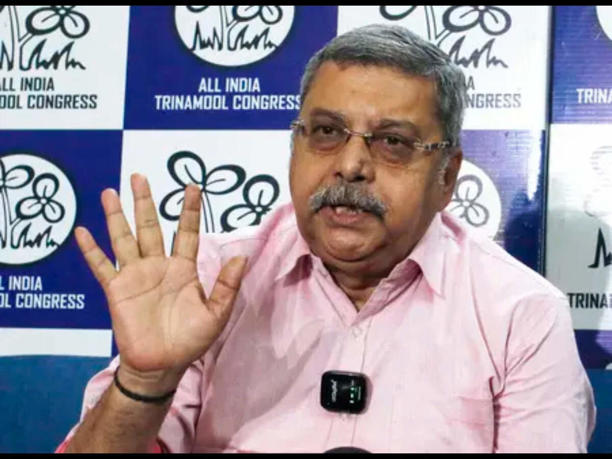
Senior advocate and TMC MP Kalyan Banerjee has withdrawn as legal counsel for party General Secretary Abhishek Banerjee in a Calcutta High Court forgery case. Issuing a "choose between us" ultimatum to Mamata Banerjee, the veteran lawmaker publicly condemned Abhishek's arrogance, exposing a severe internal generational rift.
KOLKATA — A major political and legal rift exploded within the ruling Trinamool Congress (TMC) on Thursday, June 11, 2026, as veteran parliamentarian and senior advocate Kalyan Banerjee abruptly withdrew as legal counsel for the party's National General Secretary, Abhishek Banerjee, in a high-profile case before the Calcutta High Court.
The seasoned lawyer issued a stark "choose between me and Abhishek Banerjee" ultimatum to party supremo Mamata Banerjee, exposing a widening generational power struggle within the West Bengal ruling party.
The dramatic withdrawal occurred just as the Calcutta High Court was set to deliberate on a petition filed by Abhishek Banerjee, the Member of Parliament (MP) representing Diamond Harbour, who is seeking protection from coercive action by the state's Criminal Investigation Department (CID) over an ongoing MLA signature forgery investigation.
Breakdown in Communication Triggers Legal Exit
Kalyan Banerjee, a four-time Lok Sabha MP from Sreerampur with 45 years of legal experience, stated that his decision to step down was prompted by a complete breakdown of communication and a parallel legal strategy engineered behind his back.
The senior counsel had spent the preceding night preparing the brief and had successfully moved the court of Justice Kausik Chanda on Wednesday to secure an urgent hearing following CID searches at the TMC party office in Kalighat. However, shortly before the scheduled court session on Thursday, Kalyan Banerjee discovered that another independent writ petition concerning the same CID searches had been filed by a separate legal team without his knowledge.
"I asked, 'If you had already filed this matter, why didn't you discuss it with us?'" Kalyan Banerjee told reporters, visibly aggrieved by the lack of internal coordination. He noted that despite his senior standing and active management of the primary defense strategy, alternative counsel had been surreptitiously assigned to lead the new application.
Escalating Generational Tensions and Accusations of Arrogance
The courtroom drama quickly spilled over into an overt political confrontation. In public remarks following his withdrawal, Kalyan Banerjee launched a direct attack on Abhishek Banerjee—who is also Mamata Banerjee's nephew—accusing him of institutional arrogance and a failure to show basic professional respect to veteran party colleagues.
"He thinks everyone is beneath him, as if everyone is merely an employee from Camac Street," Kalyan Banerjee asserted, referencing the location of Abhishek Banerjee's political headquarters. "I have been in this profession for 45 years. Leave aside this court, even in the Supreme Court people know me. But he has become so arrogant and does not respect anyone."
The public fallout highlights long-simmering friction between the veteran guard loyal to former Chief Minister Mamata Banerjee and the younger, corporate-style leadership faction accumulating around Abhishek Banerjee. The internal friction has intensified over recent months following multiple public disagreements among top-tier TMC lawmakers over party management and parliamentary roles.
Context of the 'Signgate' Forgery Investigation
The underlying legal battle, colloquially dubbed the "Signgate" scam by local media, centers on a highly sensitive state investigation. The CID is probing a formal resolution letter submitted to the West Bengal Assembly Speaker on May 20, which nominated veteran leader Sovandeb Chattopadhyay for a senior legislative role.
Two expelled TMC MLAs, Ritabrata Banerjee and Sandipan Saha, subsequently filed a First Information Report (FIR) at Kolkata's Hare Street police station, alleging that their signatures on the document had been forged. Because the resolution was submitted under the letterhead of National General Secretary Abhishek Banerjee, the CID took over the case and issued three consecutive summonses to the Diamond Harbour MP for handwriting analysis and questioning.
Abhishek Banerjee bypassed the personal appearances, citing medical reasons and travel to New Delhi, prompting the CID's unannounced search operation at the Kalighat party office on June 9—the event that triggered the current wave of emergency High Court petitions.
Official Sources Section
According to official filings documented by the Calcutta High Court and statements logged by the Press Trust of India (PTI), Kalyan Banerjee formally communicated his withdrawal from the proceedings on Thursday morning.
Concurrently, the court of Justice Kausik Chanda proceeded with the scheduled hearing, ultimately granting Abhishek Banerjee interim protection from arrest or any coercive police action for a duration of three weeks, while concurrently directing the MP to cooperate and appear before the CID for formal interrogation.
Quote Section
"According to officials and close associates, the internal dispute has been escalated directly to the party leadership for mediation," a senior Trinamool Congress leader stated on condition of anonymity.
"While the legal team secured three weeks of crucial interim immunity for the General Secretary today, the public confrontation between a senior parliamentarian and the party’s second-in-command has created a deep administrative crisis that requires immediate intervention by the party supremo."
Why It Matters
The fallout extends far beyond a routine change of legal representation. For the Trinamool Congress, a public ultimatum delivered by a highly visible founding member like Kalyan Banerjee threatens to fracture the party's internal cohesion ahead of upcoming legislative sessions. For West Bengal's citizens and political observers, the open defiance against Abhishek Banerjee's leadership signifies a critical power struggle that could alter the future succession pipeline and policy direction of the state's dominant political structure.
Key Facts at a Glance
Legal Withdrawal: Senior advocate and TMC MP Kalyan Banerjee resigned as chief counsel for Abhishek Banerjee in the Calcutta High Court signature forgery case.
The Ultimatum: Kalyan Banerjee issued a direct challenge to Mamata Banerjee, demanding she choose between his allegiance and her nephew's faction.
Allegations of Arrogance: The veteran lawyer publicly accused Abhishek Banerjee of treating senior party colleagues like "employees" and harboring institutional arrogance.
Court Ruling: Despite the internal defense shakeup, Justice Kausik Chanda granted Abhishek Banerjee three weeks of interim protection from coercive CID action.
Investigation Focus: The case involves a state CID probe into the alleged forging of two MLAs' signatures on an official legislative resolution letter.
FAQ Section
Q1: What caused Kalyan Banerjee to quit as Abhishek Banerjee's lawyer?
Kalyan Banerjee withdrew after discovering that an alternative legal team had filed a parallel writ petition regarding the Kalighat CID searches without consulting him, despite him being the designated lead counsel who had prepared the case overnight.
Q2: What is the "Signgate" or signature forgery case about?
The West Bengal CID is investigating allegations by two former Trinamool Congress MLAs, Ritabrata Banerjee and Sandipan Saha, who claim their signatures were forged on an official party resolution letter submitted to the Assembly Speaker in May.
Q3: Did Abhishek Banerjee receive legal protection from the court?
Yes. Despite the sudden exit of Kalyan Banerjee, the Calcutta High Court granted Abhishek Banerjee interim protection from arrest or coercive action by the CID for three weeks, though he has been ordered to appear for questioning.
Source: Calcutta High Court daily cause lists, Press Trust of India (PTI) legal dispatches, West Bengal Criminal Investigation Department (CID) case records, and official press briefings from the All India Trinamool Congress (AITC) media cell.