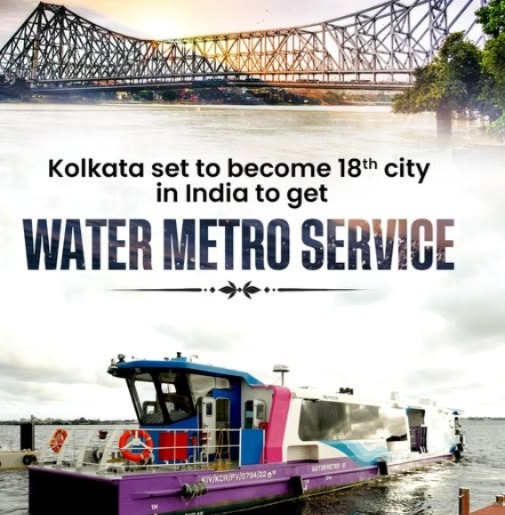
West Bengal has formally announced the Kolkata Water Metro project, establishing the city as the 18th national urban hub to implement a state-backed water transport network. Operating on the Hooghly River, the hybrid battery-electric fleet aims to relieve severe road congestion by delivering high-speed public transit alternatives.
KOLKATA — West Bengal is officially joining India’s expanding eco-friendly transit grid with the introduction of the Kolkata Water Metro project. In a high-level policy shift announced on June 4, 2026, state authorities confirmed that the capital city will become the 18th urban center in the country to adopt a structured, water-based network. This development introduces high-speed, disability-friendly hybrid vessels designed to provide an alternate, eco-friendly public transport model across the heavily congested twin cities of Kolkata and Howrah.
The multi-agency maritime upgrade is being fast-tracked through the integration of the central government’s Sagarmala 2.0 framework. Local officials confirmed that technical plans have already secured explicit clearance from the Union Ministry of Ports, Shipping and Waterways. The execution of the infrastructure phase is scheduled to begin immediately to replace aging, low-capacity ferry boats operating along the Hooghly River corridors.
Technical Expansion Across the Hooghly Waterways
The new transit system will introduce high-frequency, climate-controlled hybrid boats capable of carrying between 50 to 100 passengers per trip. The specialized fleet is engineered with commercial battery-electric propulsion packages alongside auxiliary backup diesel generators, matching the sustainable urban mobility parameters successfully deployed during the initial phases of the Kochi Water Metro.
The structural blueprint features the creation of modern passenger terminals to ensure high safety standards. To facilitate smooth routing across existing commercial channels, the state secured crucial clearances from riverine regulatory bodies.
State engineers are simultaneously carrying out extensive restoration and structural reinforcement at multiple historic points along the river bank. Major upgrades are currently underway at Baghbazar, Sovabazar, Babughat, Ahiritola, and Mullick Ghat, with complete operational readiness projected ahead of the autumn festival season.
Intergovernmental Funding and Port Modernization
Unlike prior infrastructure programs where West Bengal remained outside central maritime configurations, the state has formally integrated its regional development blueprint with the national Sagarmala 2.0 program. This framework allows for a shared capital investment model between the state administration and the central government. Officials have also opened windows for Public-Private Partnerships (PPP) to manage terminal operations, charging infrastructure, and passenger bunkering systems.
Over the next five years, the state intends to build out a port and coastal manufacturing network valued at approximately Rs 22,700 crore. As part of this wider maritime strategy, authorities are dropping the long-delayed, unviable deep-sea project at Tajpur. Instead, technical teams are pivoting toward an alternate 1,700-acre land parcel located approximately 10 kilometers beyond the original site in Dadanpatra, East Midnapore, following recent exploratory discussions with Adani Ports and Special Economic Zone (APSEZ).
Official Sources Section
The statutory data, structural details, and financial parameters featured in this report are sourced from official state administrative orders, inter-ministerial clearances, and institutional briefings provided by:
The Office of the Chief Minister of West Bengal Nabanna
The Union Ministry of Ports, Shipping and Waterways MoPSW
The Syama Prasad Mookerjee Port Trust, Kolkata SMP Port
Project briefs distributed via the Press Trust of India (PTI)
Quote Section
"The proposed water metro systems are significantly less capital-intensive as they utilize existing natural waterways with minimal civil infrastructure requirements. The system will reduce urban road congestion and provide an alternative mode of transport with substantially lower operating costs."
- Union Minister for Ports, Shipping and Waterways, Sarbananda Sonowal
"According to officials at Nabanna, technical teams from the Kolkata Municipal Corporation are coordinating direct strategy sessions with the Kochi Water Metro agency to ensure a seamless technical roll-out of the hybrid vessels."
Why It Matters
For daily commuters and travelers in the Kolkata Metropolitan Region, the project shortens travel times between the commercial districts of Howrah and Kolkata, bypassing congested road choke points like the Howrah Bridge.
For urban planning authorities and environmental agencies, replacing old diesel-powered passenger ferries with battery-operated hybrid vessels reduces carbon emissions and minimizes the environmental footprint of heavy public transport on the Hooghly River ecosystem.
Key Facts at a Glance
National Expansion: Kolkata is now the 18th Indian city designated to implement a centralized Water Metro network.
Infrastructure Layout: The network will feature 44 newly designed, disabled-friendly jetties across the major river channels.
Eco-Friendly Fleet: The fleet will consist of air-conditioned, 50-to-100-seat hybrid vessels combining battery power with emergency backup generators.
Broader Investment: The project aligns with a larger Rs 22,700-crore maritime push under the newly adopted Sagarmala 2.0 scheme.
FAQ Section
How is a Water Metro different from regular ferry services?
Unlike traditional, unorganized ferry services, a Water Metro operates on fixed timetables using modern, climate-controlled, twin-hulled catamarans. The infrastructure includes integrated ticketing systems, automated docking walkways, and high-capacity battery-charging terminals that match urban metro rail standards.
Who is financing the Kolkata Water Metro project?
The project's financial structure relies on a shared investment model between the Government of India and the West Bengal state administration. Additionally, specific operational segments such as passenger bunkering, terminal retail facilities, and navigation aids are being structured to accommodate private sector investments through a PPP format.
When will the first water metro routes become operational?
Initial structural renovations at key historical ghats are scheduled to finish before the autumn festival season of 2026. The full commissioning of the hybrid fleet and the rollout of the main phase routes will follow the final submission of the Detailed Project Report (DPR) being drafted by the technical teams.
Source: West Bengal Administrative Press Briefings, Union Ministry of Ports, Shipping and Waterways, Syama Prasad Mookerjee Port Trust, Press Trust of India.